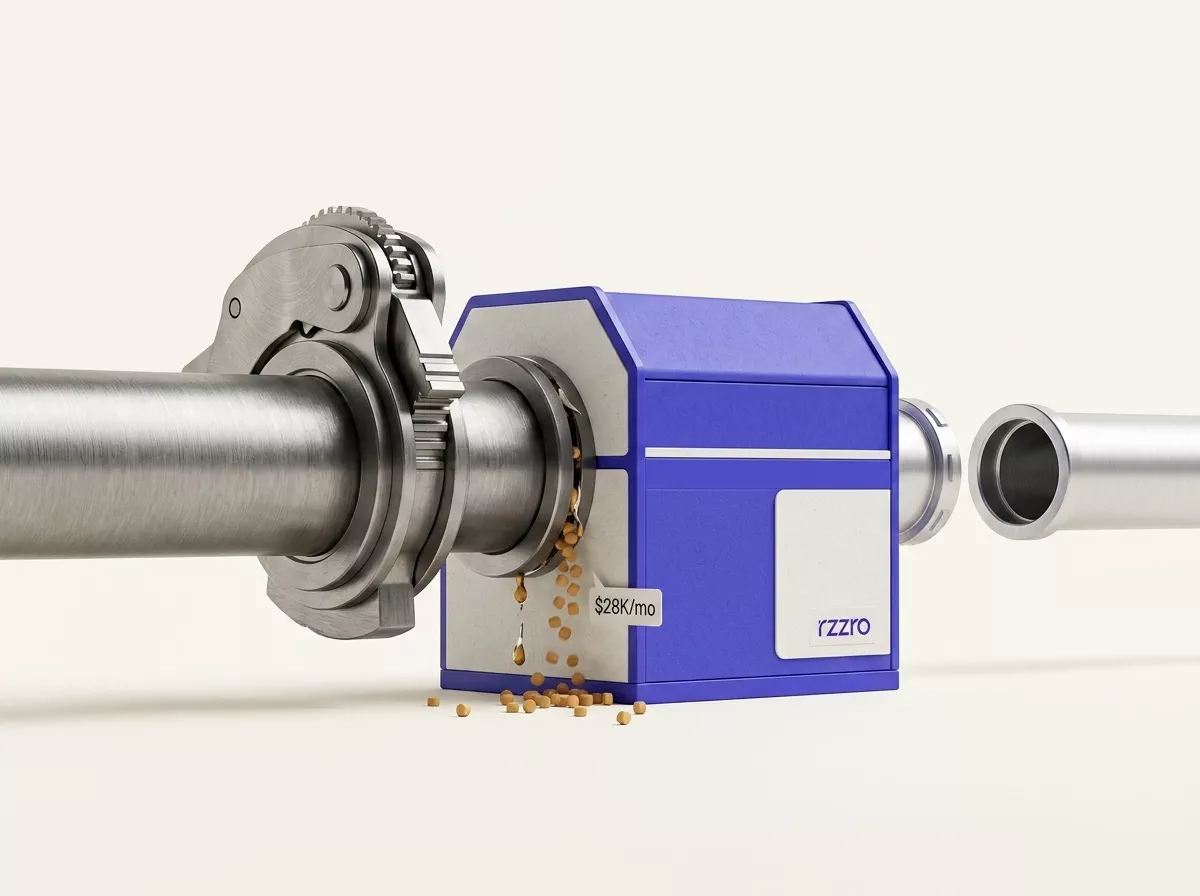
The original concept: Prospect Theory and loss aversion
Daniel Kahneman and Amos Tversky published Prospect Theory in Econometrica in 1979. The core finding upended the rational-agent model of economics: people do not evaluate outcomes in absolute terms. They evaluate them relative to a reference point, and losses relative to that point hurt roughly twice as much as equivalent gains feel good.
In economics, losing $100,000 should feel exactly as bad as gaining $100,000 feels good. In reality, the loss hurts roughly twice as much. A 2023 global study replicated this finding across 19 countries and 13 languages with a 90% replication rate. The endowment effect — where people value what they already own more than what they could acquire — is a direct consequence. Status quo bias, documented by Samuelson and Zeckhauser in 1988, follows from the same mechanism.
How loss aversion translates into procurement decisions
Procurement managers are not exempt from Prospect Theory. Dropping a supplier is framed as realizing a loss — of invested onboarding time, relationship capital, systems integration, and perceived supply security. Switching to a new supplier is framed as a risky gain — the benefits are abstract and uncertain, while the switching costs are concrete and immediate.
Wagner and Friedl's 2007 study on supplier switching decisions documented extensive inertia: buyers switch suppliers significantly slower than rational economic models predict. Six interrelated biases drive this:
- Loss aversion: dropping a supplier is a certain loss; switching is an uncertain gain — and the loss is weighted ~2x
- Sunk cost fallacy: past investment in supplier tooling, co-development, and onboarding is treated as recoupable when it is not
- Status quo bias: doing nothing is the cognitive default; switching requires active decision-making and organizational energy
- Risk aversion masquerading as prudence: staying is framed as the safe choice even when the data shows the current supplier is the larger risk
- Information asymmetry: the buyer knows the incumbent's performance intimately and the alternative's only on paper — uncertainty favors the known
- Fear of failure: category managers avoid admitting the original selection was a mistake, especially when senior stakeholders approved it
The failure pattern: zombie supplier relationships
Zombie supplier relationships — retained long after value evaporates — are the most visible symptom of loss aversion in procurement. LeadershipIQ data shows managers spend 17% of their time managing underperformers. In procurement, that time goes to suppliers who should have been exited years ago. The relationship persists because switching is framed as a loss and staying is framed as neutral, when in reality staying is a monthly drain.
A 2021 study on supplier switching versus development under risk confirmed that more risk-averse buyers are significantly more likely to continue with problematic suppliers. Risk aversion and loss aversion compound: the buyer fears both the loss of the known supplier and the uncertainty of the unknown replacement.
Where the analogy breaks down
Loss aversion in personal finance is well-studied and well-defined. In procurement, the dynamics are more complex because switching costs are real — not just psychological. Onboarding a new strategic supplier can take 6-18 months and cost $100K-$500K in qualification, systems integration, and process alignment. Treating this as "just a cognitive bias" ignores the legitimate operational cost of switching.
The correct application is not to ignore switching costs. It is to quantify them, compare them against the quantified cost of staying, and make the decision on net present value — not on feel. Most organizations never quantify either side. The cost of staying with an underperforming supplier — late deliveries, quality defects, missed innovation, reputational damage — is diffuse, hidden in operations budgets, and rarely attributed to the procurement decision that allowed it to continue.
What correct behavior looks like
- Evaluate supplier retention on forward-looking value, not past investment. The five years of good performance in 2019-2023 are irrelevant to whether this supplier is the right choice for 2026-2028.
- Set automated performance triggers. Define thresholds for on-time delivery, quality, cost competitiveness, and innovation contribution. When a supplier drops below threshold for two consecutive quarters, a switch-or-develop review is mandatory — not optional.
- Reframe the decision. Quantify what staying costs per month. When a supplier delivering 92% on-time costs $45K/month in disruption, write that number on the review document. Make the cost of staying as visible as the cost of switching.
- Reduce psychological switching costs. Standardize supplier onboarding. Maintain plug-and-play contract templates. Pre-qualify backup suppliers so switching is a 3-month process, not a 12-month one. The faster switching is, the less loss aversion can anchor the decision.
- Separate the decision from the decision-maker. Use a sourcing committee or pre-committed criteria. The category manager who selected the original supplier should not be the sole decision-maker on whether to retain them.
What this means in practice
- For your five highest-spend suppliers, run the sunk-cost test: if you had no prior relationship, would they win the business today on current performance data? If two would not, you have two zombie relationships.
- Build a switch-or-develop review trigger. Define the performance thresholds that, when breached for two consecutive quarters, make a formal review mandatory. Publish the thresholds before the review is needed — pre-commitment defeats loss aversion at the moment of decision.
- Quantify the monthly cost of each underperforming supplier. Late deliveries, quality defects, missed innovation, and management overhead all have dollar values. Assign them. When the cost of staying has a number, loss aversion starts working for the correct decision.
- Pre-qualify one backup supplier for each strategic category. The existence of a viable alternative — even if not activated — reduces the psychological distance of switching and makes the decision feel less like a leap into the unknown.
Frequently asked questions
How much stronger is loss aversion than gain-seeking?
Roughly twice as strong. Kahneman and Tversky's original coefficient is approximately 2.0, meaning the pain of losing $100K is equivalent to the pleasure of gaining $200K. This has been replicated across 19 countries with a 90% replication rate in a 2023 global study.
What is the difference between loss aversion and risk aversion?
Risk aversion means preferring a known outcome over an uncertain one with the same expected value. Loss aversion means losses hurt more than equivalent gains feel good. A buyer can be entirely risk-neutral yet still loss-averse — and most procurement decisions involve both, which makes the biases compound.
Can loss aversion ever be useful in procurement?
Yes. Reframe staying with a bad supplier as the loss. Quantify what the underperforming supplier is costing per month and present that number alongside the switching cost. When the buyer sees staying as "losing $X/month," loss aversion works for the correct decision. The framing, not the psychology, determines which direction the bias pulls.
How common is supplier switching inertia?
Extensive. Wagner and Friedl (2007) documented switching speeds significantly slower than what rational economic models predict. A 2021 study confirmed that more risk-averse buyers disproportionately continue with problematic suppliers. Inertia is the default state; deliberate switching requires organizational mechanisms designed to overcome it.
What is the simplest test for whether sunk costs are driving a supplier decision?
Ask: if we had no prior relationship with this supplier, would we select them today based on current performance data? If the answer is no, sunk costs — not performance — are keeping them in place. The follow-up: quantify the monthly cost of staying. Compare that to the one-time switching cost. If the payback is under 12 months, the delay is loss aversion, not prudence.
Sources
- Kahneman, D. & Tversky, A. (1979). Prospect Theory: An Analysis of Decision under Risk. Econometrica. en.wikipedia.org/wiki/Loss_aversion
- Wagner, S.M. & Friedl, G. (2007). Supplier switching decisions. European Journal of Operational Research. sciencedirect.com/science/article/abs/pii/S0377221706010319
- Supplier switching vs. development under risk (2021). Computers & Industrial Engineering. sciencedirect.com/science/article/abs/pii/S0360835221006410
- LeadershipIQ. The Sunk Cost Fallacy. leadershipiq.com/blogs/leadershipiq/the-sunk-cost-fallacy
- The Decision Lab. Loss Aversion. thedecisionlab.com/biases/loss-aversion
- Consumer loss aversion and switching costs (2023). Journal of Economic Behavior & Organization. sciencedirect.com/science/article/pii/S0899825623000015
- Can loss aversion explain sourcing diversification? (2021). Economics Letters. sciencedirect.com/science/article/abs/pii/S0167637721001528
- Asana (2025). Sunk Cost Fallacy: Definition and Examples. asana.com/resources/sunk-cost-fallacy
- Guo (2025). Loss Aversion and Sunken Costs. HBEM. hbem.org/index.php/OJS/article/view/410
- ACR Journal (2025). Subscription Models and Psychology. acr-journal.com/article/understanding-subscription-models