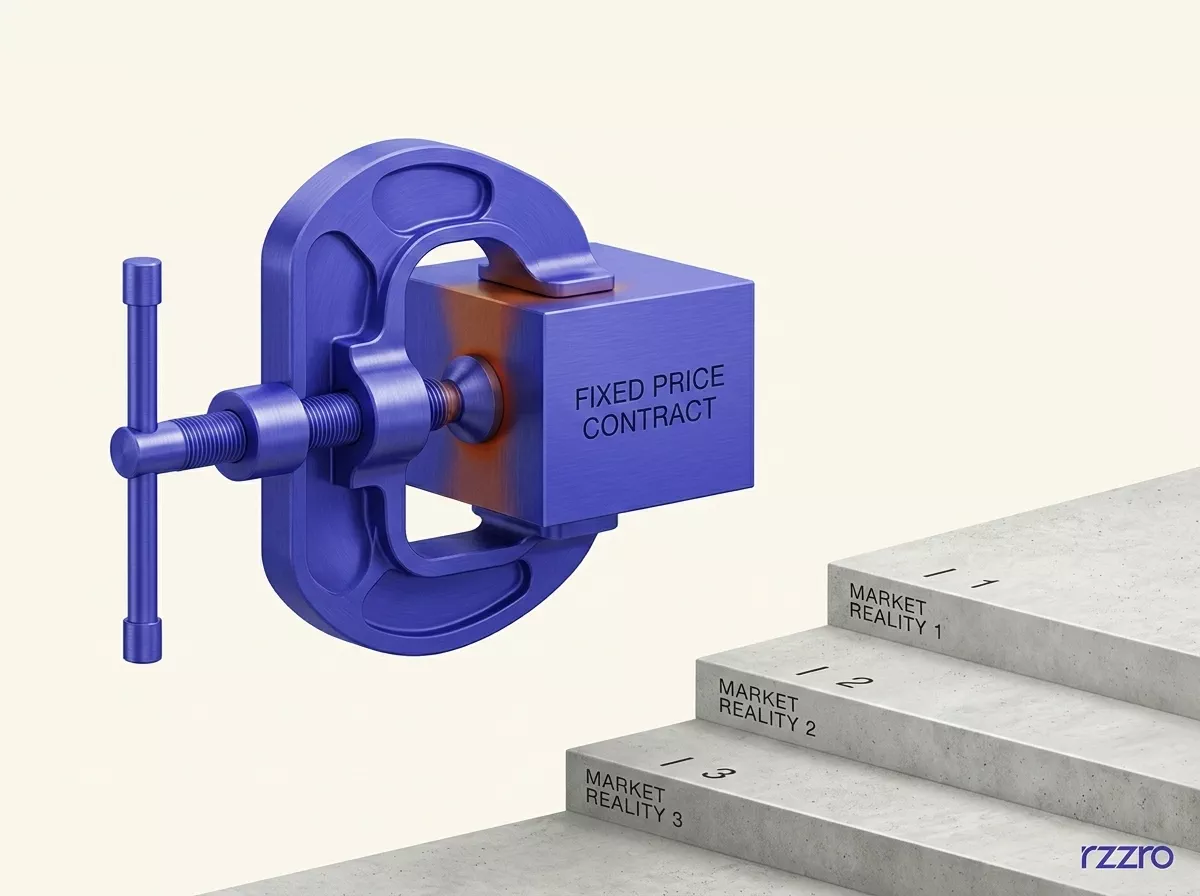
The logic feels airtight. Commit to a supplier for three years, give them volume certainty, and in return you get a lower unit price. Every procurement textbook endorses this. Every CFO's instinct confirms it. The only problem: the data does not back it up.
Research across multiple industries and academic studies finds that long-term contracts do not systematically produce lower prices than shorter-term alternatives. In some categories, they cost more. The real advantage of contract length is not better pricing. It is something else entirely, and mistaking what long-term contracts actually deliver is why so much negotiated value disappears between signature and the P&L.
The myth, stated fairly
This is not a straw man. The belief that longer contracts produce better pricing comes from sound logic. A supplier with guaranteed revenue over multiple years can invest in dedicated production lines, optimize their supply chain around your volumes, and amortize setup costs over a longer period. They should be able to offer a lower unit price than a supplier who might lose the business next quarter.
And sometimes they do. The problem is that this logic only holds under specific conditions that most procurement organizations do not verify before they commit. When those conditions are absent, the long-term contract becomes a ceiling on savings, not a floor.
Where it breaks down: the three scenarios that contradict the myth
Scenario 1: The market price drops and you are locked above it
FMCG logistics costs fell to 92% of 2022 levels by late 2024, according to Sievo's analysis of $403 billion in procurement spend. Organizations locked into pre-2023 logistics contracts overpaid for 18 months while competitors on shorter agreements captured the decline. This is not a hypothetical. It happens in every commodity cycle, in every category with price volatility.
Kearney's 2025 Supply Chain Navigator found supply-chain costs running 4-7% above inflation through Q4 2025. A buyer locked into a three-year contract with annual escalation clauses tied to CPI was paying those increases automatically. A buyer on a one-year contract could renegotiate or switch suppliers.
Scenario 2: Supplier technology changes and your contract locks in the old approach
A 2020 study in the International Journal of Production Economics by Merckx and Chaturvedi examined procurement strategies in markets where supplier production technology evolves. Their finding: system cost was typically lower with short-term contracts than with long-term agreements. The mechanism is straightforward. Short-term auctions force suppliers to compete on current cost structures. Long-term contracts let the incumbent coast on the cost structure that existed at signing.
This effect is strongest in categories with rapid innovation: SaaS, logistics technology, manufactured components with automation-driven cost curves. A five-year IT services contract signed in 2020 locked in on-premise data center pricing. By 2023, cloud-native competitors were offering equivalent services at 30-40% less.
Scenario 3: The contract value leaks faster than the discount was worth
Even when the negotiated price was genuinely lower at signing, the savings do not survive contact with operations. World Commerce and Contracting research finds approximately 11% of contract value evaporates after signature. Efficio Consulting warns that 50% or more of procurement savings never reach the P&L without active post-award management. ContractSafe's data shows contracts experience 8.6% annual erosion in realized value.
The arithmetic is uncomfortable. A three-year, $10 million contract with a 5% negotiated discount saves $500,000 on paper. But if 11% leaks annually through poor compliance and another 8.6% erodes through unmanaged indexation and unclaimed rebates, the net result after three years is a loss, not a saving.
The most common failure mode: treating the contract as done at signature
Procurement teams negotiate hard, secure pricing that looks competitive, and move to the next category. The handover from sourcing to operations is a single email. Nobody measures whether negotiated prices are the prices actually paid. Nobody tracks whether the volume commitments that earned the discount were met. Nobody checks whether the supplier's market position improved and their costs fell after year one.
Within six months, the contract is a document in a shared drive that nobody has opened since the ink dried. Within eighteen months, the pricing is stale, the supplier relationship has ossified, and the savings that justified the three-year commitment exist only in the business case presentation from the sourcing event.
A case from Sirion.ai's contract management research captures the pattern. A Fortune 500 manufacturer discovered contracts "buried in SharePoint that nobody's tracked in five years." A healthcare system found three suppliers performing the work of one at triple the cost. These are not negotiation failures. They are governance failures.
What replaces the myth: a portfolio approach to contract length
The evidence does not say long-term contracts are always wrong. It says contract length is a risk management decision, not a pricing decision. The right framework treats procurement volume as a portfolio with different contract lengths serving different objectives.
Lock in 100% of volume with a single supplier for 3-5 years. Assume volume commitment automatically produces the best price. Move on after signature and treat the contract as settled.
Commit 60-80% of base-load volume through long-term contracts for supply security. Keep 20-40% for spot buying, short-term auctions, or annual contracts. Benchmark contract pricing against market quarterly. Govern actively.
This is not theoretical. Stanford research on optimal procurement with online spot markets found significant profit improvements from even moderate spot market use. An LNG transportation study found spot purchases cheaper than long-term contracts in every case tested. A steel manufacturer in India found profit was higher from spot market procurement than contract pricing when demand and price volatility were significant.
The base-load contract gives the supplier the volume certainty they need to invest and optimize. The flexible portion keeps competitive pressure on the incumbent and lets the buyer capture favorable market movements. This hybrid outperforms either pure strategy in nearly all environments.
What this means in practice
Five specific actions for buyers and category managers:
- Audit your last ten contracts. Check whether post-award pricing was actually tracked and whether realized spend matched negotiated rates. If the answer is no for more than three of them, you have a governance gap, not a negotiation gap.
- Classify each category by market dynamics, not just spend. Is the technology evolving? Are new competitors entering? Is the price trend declining? Categories with positive answers to these questions are poor candidates for long lock-ins, regardless of spend volume.
- Build a 60/40 or 80/20 split into your next strategic sourcing event. Award the base load through a long-term agreement and reserve a portion for quarterly spot buying, short-term auctions, or an annual mini-tender. Track which portion produces the lower average price over 12 months.
- Add quarterly benchmarking to every contract over 18 months. A simple market check: is the contracted price still within 5% of what a new buyer would pay today? If not, trigger a review clause. This costs almost nothing and prevents the drift that silently erodes value.
- Stop reporting savings at award. Report savings at the point they hit the P&L. This single metric change reorients the entire team from negotiating paper discounts to governing realized outcomes. The gap between award savings and realized savings is the single most important number most procurement organizations never measure.
Why the myth persists
The bias toward long-term contracts is not irrational. It reduces workload. A three-year contract means three years of not running another sourcing event for that category. It simplifies supplier relationship management. It gives Finance a predictable cost line to model. These are real operational benefits.
The error is assuming those benefits translate into better pricing. They do not. Procurement teams that separate the pricing decision from the workload decision make better choices. If a long-term contract genuinely produces the best price after benchmarking against market alternatives, take it. If it is chosen primarily because nobody wants to re-source the category next year, the pricing is probably worse than the team believes.
Frequently asked questions
Do long-term contracts actually deliver lower prices than spot buying?
Not always. Academic research finds system cost is typically lower with short-term contracts in dynamic markets where supplier technology evolves. Long-term contracts provide price certainty and supply security, not necessarily the lowest price. The two objectives are distinct.
How much savings leak from long-term contracts after signing?
Approximately 11% of contract value disappears after signature according to World Commerce and Contracting research. Efficio Consulting warns of 50% or more savings leakage without active governance. A $10 million contract can lose $860,000 to $1.1 million per year through poor post-award management alone.
Under what conditions should I choose short-term contracts?
Short-term or spot buying outperforms when market prices are declining, supplier technology evolves rapidly, demand is uncertain, you have strong supplier competition, or the category has high price volatility. The metric to use: if the expected cost of flexibility is lower than the risk premium built into long-term contract pricing, go short.
What is the best hybrid strategy for contract length?
Use long-term contracts for 60-80% of base-load volume to secure supply and hedge against extreme price spikes. Use short-term or spot buying for the remaining 20-40% to capture favorable market movements and maintain competitive pressure on suppliers. This hybrid approach outperforms either pure strategy in virtually all environments.
Data sources
- Sievo — FMCG Procurement Industry Benchmarks ($403B spend data). Accessed June 24, 2026.
- Kearney — Supply Chain Navigator H2 2025. Accessed June 24, 2026.
- Merckx & Chaturvedi — Short-term vs. long-term procurement strategies, International Journal of Production Economics (2020). Accessed June 24, 2026.
- Trace Consultants — Why Procurement Savings Leak After Award. Accessed June 24, 2026.
- Efficio Consulting — What Happened to Those Procurement Savings You Promised? Accessed June 24, 2026.
- Sirion.ai — Procurement Cost Savings Strategies. Accessed June 24, 2026.
- Stanford Graduate School of Business — Optimal Procurement Strategies with Online Spot Markets. Accessed June 24, 2026.
- ContractSafe / ProcurementTactics — 55 Contract Management Statistics (2025). Accessed June 24, 2026.