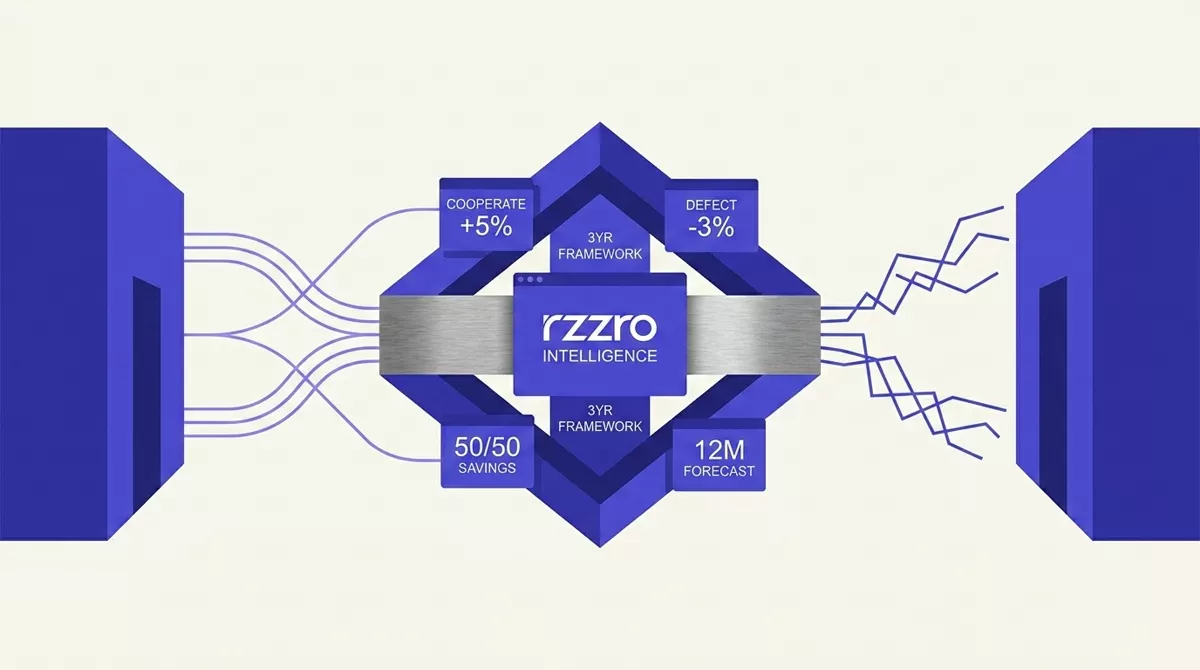
Two parties enter a negotiation. Each can either cooperate or defect. If both cooperate, both benefit. If one cooperates and the other defects, the defector captures a large gain and the cooperator takes a large loss. If both defect, both get a worse outcome than if they had cooperated.
This is the prisoner's dilemma, the most famous model in game theory. And it describes the default state of most buyer-supplier negotiations.
The problem is not that buyers or suppliers are irrational. It is that the incentives of their negotiation structure push both sides toward defection. What looks like a tough negotiation producing good short-term results for the buyer is actually a stable but suboptimal equilibrium where both sides leave value on the table. Kloepfel Consulting describes this pattern: suppliers withhold cost information even though transparency would allow better planning and lower total costs for both parties.
The original concept: how the prisoner's dilemma works
In the classic prisoner's dilemma, two suspects are arrested and interrogated separately. Each has two options: cooperate with the other (stay silent) or defect (confess). The payoff matrix produces four possible outcomes:
If both stay silent, both serve a short sentence. If one confesses and the other stays silent, the confessor goes free and the silent prisoner serves a long sentence. If both confess, both serve a moderate sentence. Each prisoner's individually rational choice is to confess, because defecting yields a better outcome regardless of what the other does. But when both defect, both end up worse than if they had cooperated.
Where it breaks down in procurement
The prisoner's dilemma explains three common procurement patterns that individually make sense but collectively produce worse outcomes.
Pattern 1: information hoarding. Buyers do not share demand forecasts because they fear suppliers will use the information to raise prices. Suppliers do not share cost breakdowns because they fear buyers will squeeze margins. Both sides operate with partial information. The result is suboptimal pricing, excess inventory on one side, and expedited orders on the other. Game theory research from Learn How to Source notes that asymmetric information leads to adverse selection and moral hazard in supplier relationships. Openly sharing procurement plans can encourage suppliers to disclose more information, leading to better joint outcomes.
Pattern 2: adversarial e-auctions. Reverse auctions designed around price alone create a prisoner's dilemma for suppliers. Each supplier must decide whether to bid their true floor price or hold margin. If one supplier defects by bidding aggressively and others cooperate by maintaining price discipline, the defector wins the contract but at a margin that undermines service commitment. The buyer wins on unit price in the short term but absorbs the cost of performance issues, expediting, and switching in the medium term. Genpact research finds that when e-auctions are structured well, they yield 7 to 14 percent savings. When structured poorly, they produce a winner's curse where the winning supplier cannot sustain the price.
"Each interaction with suppliers in procurement is an opportunity to apply game theory and behavioral science to influence better outcomes."
— Arkestro, Game Theory in Procurement
Pattern 3: short-term contract cycles. Annual or biannual contract renegotiations create a repeated prisoner's dilemma. Each renegotiation resets the relationship to zero-sum. Suppliers who invested in process improvements during the contract term see those savings captured by the buyer in the next round of bidding. The rational response is to stop investing. The buyer responds by switching suppliers, incurring transition costs, and starting over with a provider who has no relationship investment.
Kogan Page's analysis of game theory in negotiations notes that a buyer can offer flexibility on timing, promote the supplier to their customers, or offer to serve as a reference. These moves signal a cooperative strategy. But they require the buyer to be willing to cooperate first, which most are not programmed to do.
Why the analogy holds: the distinct procurement pattern
What makes the prisoner's dilemma specifically useful for procurement is that it predicts behavior that looks individually rational but produces collectivley worse outcomes. A procurement team that squeezes 3 percent price reduction from a supplier in one quarter may be rewarded internally. But if that squeeze causes the supplier to cut quality investment, delay delivery, or resist future cost-reduction initiatives, the organization has lost more than 3 percent over the contract lifecycle. The individual incentive (short-term savings target) conflicts with the collective interest (long-term total cost reduction).
The solution is not to abandon competitive bidding. It is to redesign the game so that cooperation becomes the dominant strategy. Kloepfel describes game-theory-based procurement designs that through rules incentivize suppliers to disclose their true costs, creating conditions in which transparency becomes rational for all parties.
What correct application looks like
Organizations that apply game theory principles to supplier negotiations share three design choices.
Design choice 1: multi-year frameworks with shared savings. A three-year contract with an explicit mechanism for sharing cost reductions changes the supplier's calculation. If the supplier automates a process and reduces unit cost by 5 percent, and the contract splits the savings 50-50, the supplier has a financial incentive to invest in improvement. The buyer captures value that would not have existed under annual bidding.
Design choice 2: structured information sharing. Both sides commit to sharing specific data at defined intervals. The buyer shares 12-month rolling demand forecasts. The supplier shares production capacity, lead time ranges, and raw material cost breakdowns. The data is verified by a third party to prevent strategic misrepresentation. With symmetric information, both sides can optimize jointly.
Design choice 3: transparent evaluation criteria. When suppliers know exactly how they will be evaluated, they compete on the dimensions that matter for long-term value, not just price. A published scoring rubric that weights service reliability, innovation capability, and quality performance at 50 percent and price at 30 percent (with 20 percent for risk and compliance) produces different supplier behavior than a rubric that is opaque or price-only.
Beroe's analysis of game theory in procurement strategy concludes that game theory enables procurement teams to change the rules of the game itself to ensure the buyer gets the best achievable outcome, structuring negotiations in ways that systematically drive better outcomes and unlock the full savings potential available.
Where the analogy breaks down
The prisoner's dilemma assumes a one-shot interaction with no communication and no enforcement mechanism. Procurement relationships are repeated, communication is possible, and contracts can include enforcement clauses. This means the prisoner's dilemma prediction of universal defection is too pessimistic for well-designed procurement relationships. With multi-year frameworks, information-sharing protocols, and dispute resolution mechanisms, cooperation becomes achievable.
The model is diagnostic, not prescriptive. It tells you why adversarial negotiations produce suboptimal outcomes for both sides. It does not tell you that all negotiations should be collaborative. Some categories, particularly commoditized indirect spend with many interchangeable suppliers, are appropriately transactional. The value of the prisoner's dilemma model is recognizing when you are playing a game that penalizes both sides.
What this means in practice
- Map your top 10 supplier relationships by spend. For each one, ask: are both sides cooperating on joint value, or is this an adversarial equilibrium? If service issues, quality problems, or resistance to cost reductions characterize the relationship, you are likely in a defection trap.
- Identify one strategic supplier where a multi-year framework with shared savings would change the incentive structure. Propose a three-year term with explicit cost-reduction sharing (50-50) and quarterly business reviews focused on joint improvement.
- Publish evaluation criteria for every competitive sourcing event. Include the weight for each dimension. Suppliers who know how they will be scored compete on the dimensions that matter most for long-term value.
- Share rolling 12-month demand forecasts with key suppliers. If the concern is strategic risk, share ranges rather than point estimates. Partial transparency is still better than no transparency.
- Test loss aversion in your own decisions. When faced with a supplier who costs 5 percent more but has a significantly better quality track record, check whether the 5 percent price premium feels like a loss. It may be an investment in lower total cost of ownership.
What is the prisoner's dilemma in procurement negotiations?
In procurement, the prisoner's dilemma describes how both buyer and supplier choose to act in their own short-term interest (withholding information, pushing for price concessions, hiding cost data) even though mutual cooperation would produce a better outcome for both. Each side fears the other will exploit cooperation, so both defect. The result is a stable but suboptimal equilibrium where both sides leave value on the table.
How does loss aversion affect procurement decisions?
Loss aversion, a behavioral economics concept, causes buyers to over-weight the pain of paying a higher price versus the potential long-term gain from supplier innovation or reliability. This pushes buyers to over-optimize on immediate unit price and under-invest in partnership value. Suppliers in turn over-weight the risk of losing a contract, leading to unsustainably low bids and the winner's curse.
How can procurement teams apply game theory to improve negotiation outcomes?
Procurement teams can apply game theory by redesigning sourcing formats to make cooperation the dominant strategy. This includes multi-year frameworks with shared savings mechanisms, transparent evaluation criteria published before bidding, structured information sharing (demand forecasts, cost breakdowns), and auction designs that incentivize truthful cost revelation. The goal is to change the rules so that defection becomes less attractive than cooperation for both sides.
Sources
- Kloepfel Consulting — Game Theory in Purchasing
- Learn How to Source — Game Theory in Procurement
- Genpact via SDCExec — Game Theory in Sourcing
- Kogan Page — Using Game Theory in Negotiations
- Beroe — Game Theory for Procurement Strategy
- Arkestro — Game Theory in Procurement
- Oboloo — Game Theory in Procurement