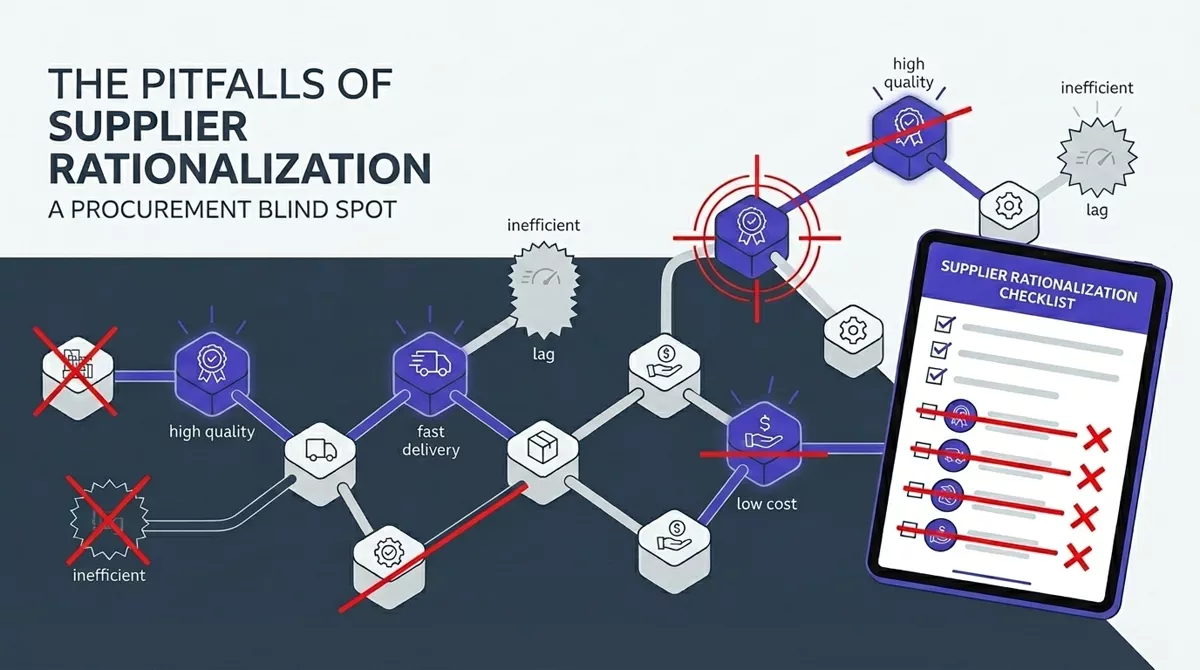
Eighty-two percent of enterprises are cutting suppliers. That number — from 2025 NPI research — has become the procurement industry's most cited statistic of the year. Boards love it. CFOs approve the headcount savings. But here is what nobody asks: which suppliers are being cut, and by what criteria?
In most organizations, the answer is spend volume. Sort the supplier list by total spend, draw a line, and everything below it gets consolidated. It is clean, defensible, and wrong.
The spend-volume trap: why your ERP's default sort order is sabotaging your supply base
A supplier with $200K in annual spend is not necessarily less valuable than one with $2M. The $200K supplier might be the sole qualified source for a critical alloy specification. It might hold three patents your R&D team relies on. It might be the only regional producer within 500 miles of your primary plant, providing resilience your global suppliers cannot match in a disruption. The $2M supplier might sell a commodity available from seven other vendors at comparable quality and price.
Spend volume captures transaction size. It captures nothing about strategic dependency, innovation contribution, supply continuity risk, or total cost of ownership. Yet it remains the default criterion because it is easy to measure and hard to argue against in a spreadsheet review.
What the 82% statistic hides: rationalization without strategy is consolidation theater
The Inverto/BCG procurement trends report for 2026 identifies supplier-led innovation as one of four strategic imperatives. CPOs are being asked to build ecosystems where suppliers co-develop performance, sustainability, and AI capabilities. Cutting by spend volume directly undermines this mandate. The supplier you need for next year's product line may be the one that looks smallest on this year's P&L.
Supplier management has shifted from broad, lowest-cost global sourcing toward strategic ecosystems that prioritize resilience and innovation. Enterprises that cut mechanically — without evaluating what each supplier actually contributes — end up with a smaller base that is also more fragile. They trade complexity for concentration risk.
Five questions to ask before cutting any supplier
A KodiakHub analysis of 2026 procurement trends reinforces that procurement is moving toward "living strategies" — continuously updated assessments informed by data flows, not static three-year plans. Supplier rationalization deserves the same treatment. Before cutting a supplier, score it against these five factors:
Strategic dependency. Is this supplier the sole or single qualified source for any specification, geography, or process? If yes, cutting it creates immediate concentration risk regardless of spend volume.
Innovation contribution. Does this supplier participate in co-development, hold relevant IP, or provide unique technical capability? The Hackett Group's research shows that "Digital Masters" — top procurement performers — treat suppliers as innovation partners, not transactional vendors.
Resilience and redundancy. Does this supplier provide geographic or operational diversification? A regional supplier with $150K in spend may be the difference between one-week and six-week recovery time in a logistics corridor disruption.
Total cost of ownership. Does this supplier's pricing, quality, and delivery performance actually produce lower TCO than alternatives, even if the unit price is higher? Procurement is shifting from minimum price to TCO as the standard metric, per the BuyingStation 2026 procurement trends report.
ESG and compliance alignment. Does this supplier meet Scope 3, labor practice, and regulatory requirements that alternatives cannot match? With 58% of companies decreasing climate communications while continuing sustainability work — a trend called "greenhushing" — procurement's supplier decisions carry compliance exposure even when not publicly discussed.
What this means in practice
- Build a supplier scorecard before drawing the cut line. Weight the five factors above. Spend volume can be one input but not the only one. Organizations that score suppliers before rationalizing report fewer post-cut disruptions and faster recovery when disruptions do occur.
- Run the concentration-risk scenario before executing. Simulate what happens if your top three remaining suppliers in each category are simultaneously disrupted. A leaner base that fails this test is worse than the original problem.
- Involve R&D and operations in the rationalization decision. Procurement cannot assess innovation contribution or specification dependency alone. A supplier that looks redundant on a spend report may be critical to an engineering team's roadmap.
- Treat rationalization as a continuous process, not a one-time project. The 2026 trend toward "living strategies" applies here. Review supplier scores quarterly as conditions change. A supplier cut today may need to be re-engaged in six months when market conditions shift.
What percentage of enterprises are rationalizing suppliers in 2026?
According to 2025 NPI research, 82% of enterprises are actively trimming supplier lists and simplifying their supply base. This is the dominant supplier management trend of 2026.
What criteria should procurement use when deciding which suppliers to cut?
Instead of cutting by spend volume alone, evaluate suppliers across five factors: strategic dependency (single/sole source?), innovation contribution, resilience/redundancy, total cost of ownership, and ESG alignment. A supplier with low spend but high innovation contribution is more valuable than a high-spend commodity supplier with no strategic differentiation.
What are the risks of cutting suppliers based only on spend volume?
Three risks dominate: losing innovation partners who contribute disproportionately to product development, creating single-source dependencies in the remaining supply base, and losing regional redundancy that protects against geopolitical or logistics disruptions. A leaner base that is also more fragile is worse than the original problem.
Sources
- Precoro — Top 10 Procurement Trends in 2026. NPI 2025 research cited: 82% of enterprises actively trimming supplier lists. Accessed June 23, 2026.
- Inverto/BCG — Procurement Trends 2026. Supplier-led innovation as strategic imperative. Accessed June 23, 2026.
- KodiakHub — Top 10 Procurement Trends to Watch in 2026. Living strategies concept and risk orchestration. Accessed June 23, 2026.
- BuyingStation — What Does 2026 Have in Store for Procurement?. TCO shift from minimum price. Accessed June 23, 2026.
- Procurement Tactics — 12 Procurement Trends Set to Reshape 2026. Hackett Group Digital Masters data. Greenhushing statistics. Accessed June 23, 2026.
- Suplari — Procurement Trends 2026: Key Data, Priorities, and Pitfalls. 9% efficiency gap (10% workload vs 1% budget). Accessed June 23, 2026.