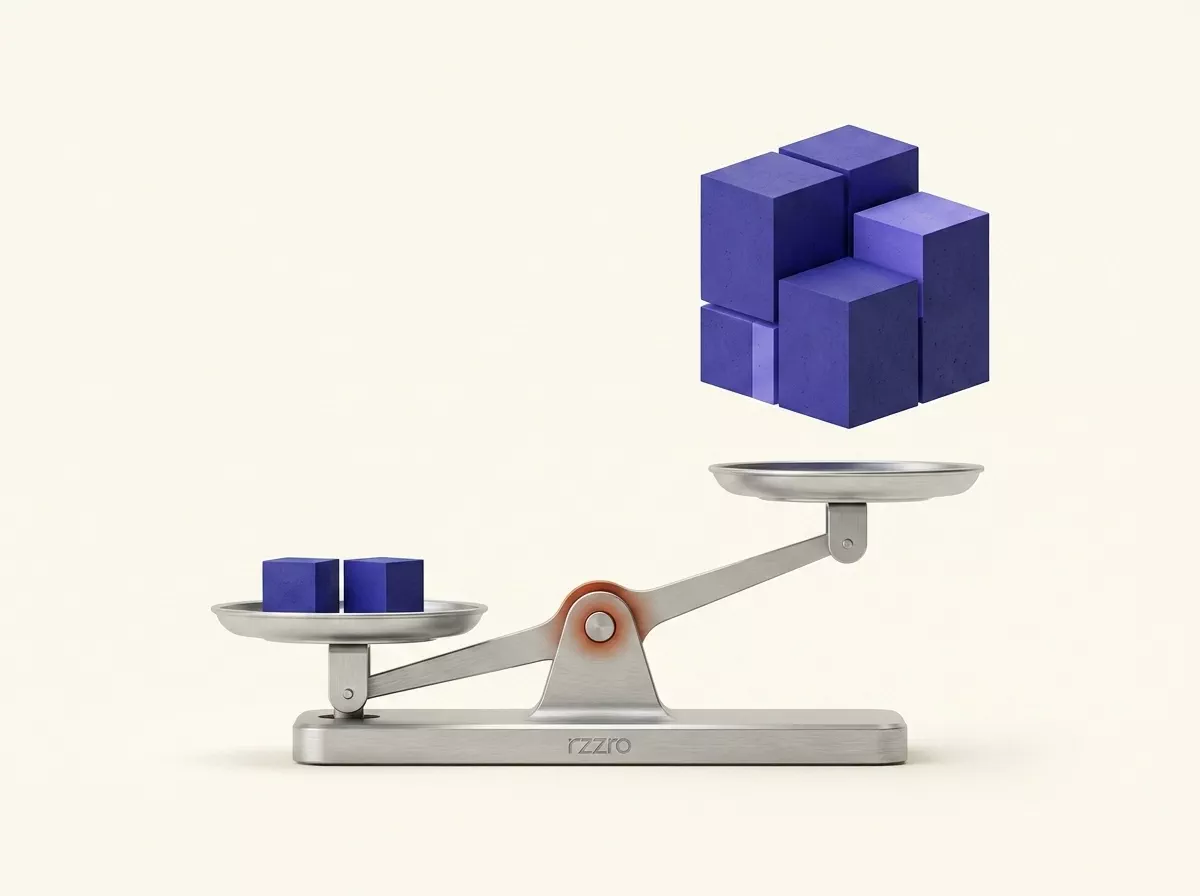
Walk into any procurement department and ask to see the supplier scorecard. You will find cost savings, on-time delivery rates, and defect counts. What you will almost never find: a measure of whether the supplier contributed an idea that improved your product, a signal of whether the relationship is healthy enough to survive the next disruption, or any indicator of the supplier's financial resilience.
Most procurement teams are measuring exactly the wrong things. The scorecards inherited from 1990s-era strategic sourcing were built for a world where suppliers were interchangeable and cost was king. That world is gone. In its place: concentrated supplier markets, geopolitical supply shocks, and regulatory pressures that make the quality of supplier relationships a competitive differentiator.
Cost and OTD: the two numbers that blind procurement to real supplier value
Cost savings and on-time delivery (OTD) dominate most supplier scorecards because they are easy to measure. A purchase order has a unit price. A delivery has a date. The gap between expected and actual fits in a spreadsheet. The problem is that optimizing for these two metrics produces behavior that actively damages the supplier relationship.
Suppliers who are scored exclusively on OTD respond rationally: they hold more inventory, pad lead times, and over-produce safety stock. The metric stays green while real supply chain flexibility deteriorates. A supplier with 99.8% OTD and 12 weeks of hidden buffer inventory is not performing better than one at 96% OTD with 3 weeks of buffer and the ability to flex production inside a week. But the scorecard will tell you the first supplier is superior.
Deloitte's 2025 Global CPO Survey found that 61% of procurement leaders identify supplier collaboration as their most effective risk mitigation strategy. Yet fewer than one in five organizations track collaboration quality, innovation contribution, or relationship health in their scorecards. The data says these things matter. The scorecards ignore them.
The four dimensions a supplier scorecard actually needs
Leading organizations have moved to multi-dimensional scorecards organized around four domains. Each domain answers a different question about the supplier relationship.
Cost and value. Year-over-year savings, total cost of ownership, payment term compliance. This is the dimension most teams already measure — but only as one of four, not as the entire scorecard.
Service and quality. On-time delivery, order accuracy, defect rates, lead time consistency. Measure outcomes, not proxy metrics. A supplier can hit 99% OTD by overstocking; measure lead time variability instead.
Risk and resilience. Financial health scores, regulatory compliance status, business continuity readiness, geographic concentration risk. A supplier with perfect delivery but mounting debt is a disruption waiting to happen. Third-party data from providers like EcoVadis and Dun & Bradstreet can feed into this layer automatically.
Innovation and relationship health. Joint development projects, supplier-driven process improvements, communication frequency, and — critically — supplier satisfaction with the partnership. The relationship is a two-way street. If suppliers dread working with your procurement team, the innovation pipeline will dry up regardless of what the cost metrics show.
One scorecard does not fit all suppliers
Segmentation is where most scorecard implementations break. A strategic partner that supplies a custom-engineered component central to your product should not be measured the same way as a transactional supplier of office supplies. Yet most organizations apply the same scorecard template to every supplier.
Spend volume alone is not the right segmentation criterion. A $500,000 supplier of a single-source proprietary material is more strategic than a $5 million supplier of a commodity available from 12 alternatives. Segment by strategic importance, switching cost, and innovation potential — not just spend. Supplier relationship management research consistently shows that systematic segmentation by these criteria produces better outcomes than spend-based tiering.
What a working supplier scorecard system produces
Organizations that implement multi-dimensional, segmented scorecards see three shifts within 12 months of consistent use.
First, supplier conversations change. Quarterly business reviews shift from "your delivery was 97.3%, target is 98%" to "what capabilities do you need from us to co-develop the next generation faster?" The scorecard becomes a collaboration tool, not a report card.
Second, risk signals surface earlier. When financial health is tracked alongside delivery performance, a supplier whose D&B score drops 40 points in a quarter triggers an intervention before the first late shipment. When geographic concentration is visible on the dashboard, a tariff announcement prompts a contingency conversation — not a scramble.
Third, innovation becomes trackable. A formal count of supplier-driven process improvements and joint development projects, tracked quarterly, makes innovation a real outcome rather than a vague aspiration mentioned in strategy documents. One automotive manufacturer reduced development times by 25% after implementing structured innovation scorecards for its top 50 strategic suppliers, according to published SRM research.
What this means in practice
- Audit your current scorecards. Count how many dimensions they measure. If the answer is two (cost + delivery), you have a transactional scorecard applied to strategic relationships. Add innovation and risk dimensions for the top-quartile suppliers within 90 days.
- Segment before you score. Classify every active supplier into three tiers — strategic, core, transactional — using switching cost, innovation potential, and supply risk, not just annual spend. Apply the full four-dimension scorecard only to strategic suppliers.
- Include supplier satisfaction. A scorecard that measures only buyer-side metrics creates a one-way relationship. Add a quarterly supplier satisfaction pulse — three questions: ease of doing business, clarity of requirements, quality of communication. Track the trend.
- Feed external data into the scorecard automatically. Financial health scores, ESG ratings, and regulatory compliance data should flow into the scorecard from third-party sources, not from manual supplier surveys. If a supplier's D&B score changes, the scorecard should reflect it without anyone touching a spreadsheet.
What should a supplier scorecard measure beyond cost and delivery?
A modern supplier scorecard should measure four dimensions: cost and value (TCO, year-over-year savings), service and quality (on-time delivery, defect rates), risk and resilience (financial health, continuity readiness), and innovation and relationship health (joint development projects, collaboration index, supplier satisfaction).
Why do traditional supplier scorecards fail?
Traditional scorecards fail because they measure only lagging indicators like cost and on-time delivery. This creates perverse incentives where suppliers optimize for the scorecard metric rather than the partnership outcome. Suppliers often meet delivery targets by holding excess inventory, which hides real lead-time problems and increases total cost.
How should scorecards differ between strategic and transactional suppliers?
Strategic partners require comprehensive scorecards measuring innovation, relationship health, ESG performance, and resilience. Transactional suppliers can be measured on core operational metrics like cost, delivery, and quality. The depth of the scorecard should match the depth of the relationship.
Sources
- How strategic supplier relationship management delivers ROI — Amazon Business, Deloitte 2025 Global CPO Survey (accessed June 24, 2026)
- The Ultimate 2026 Guide to Supplier Relationship Management — Ivalua (accessed June 24, 2026)
- Supplier relationship management: definition & strategic importance — Tacto (accessed June 24, 2026)
- 8 Supplier Relationship Management Strategies To Try In 2026 — Spendflo (accessed June 24, 2026)
- Top 10 Procurement Trends to Watch in 2026 — Kodiak Hub (accessed June 24, 2026)