Download Image
Education — Failure Pattern

Why procurement savings fail to reach the profit statement

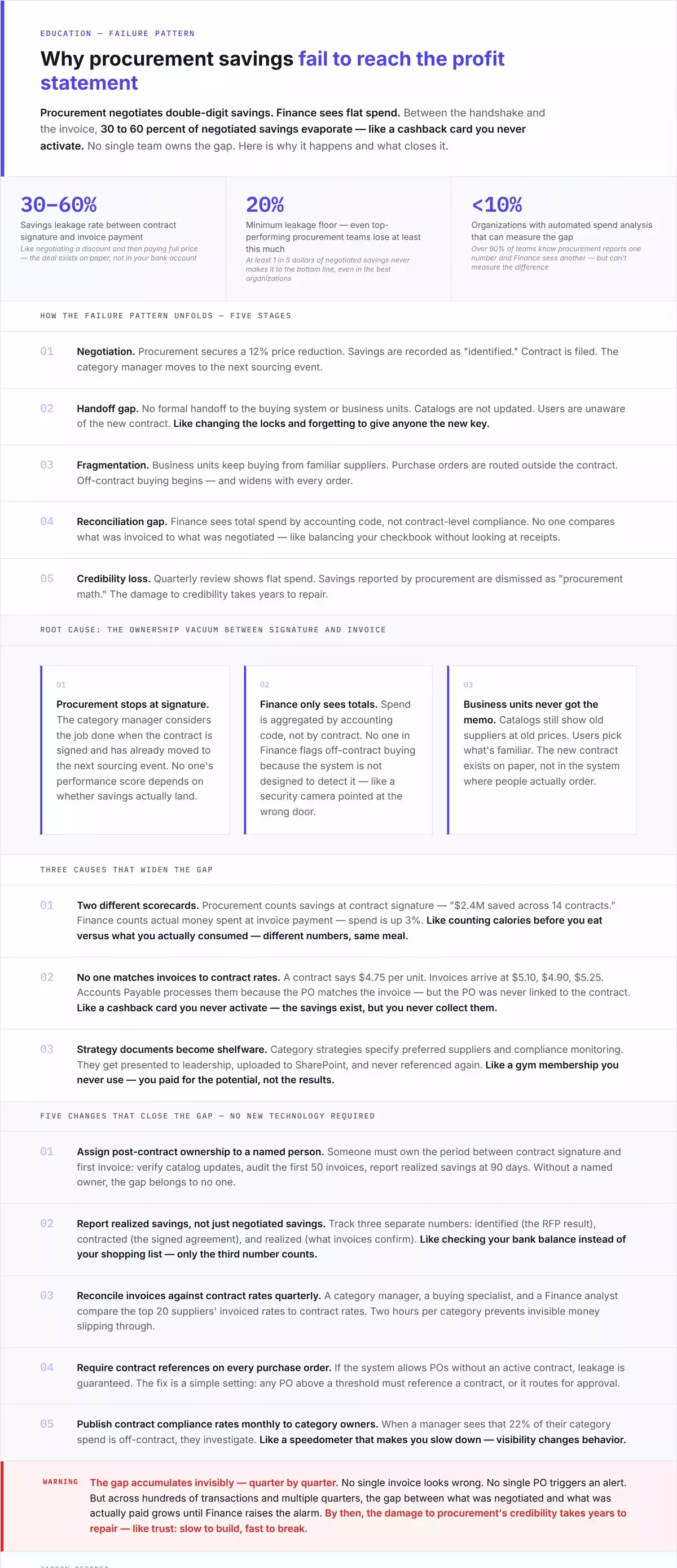
Procurement negotiates double-digit savings. Finance sees flat spend. Between the handshake and the invoice, 30 to 60 percent of negotiated savings evaporate — like a cashback card you never activate. No single team owns the gap. Here is why it happens and what closes it.
30–60%
Savings leakage rate between contract signature and invoice payment
Like negotiating a discount and then paying full price — the deal exists on paper, not in your bank account
20%
Minimum leakage floor — even top-performing procurement teams lose at least this much
At least 1 in 5 dollars of negotiated savings never makes it to the bottom line, even in the best organizations
<10%
Organizations with automated spend analysis that can measure the gap
Over 90% of teams know procurement reports one number and Finance sees another — but can't measure the difference
01
Negotiation. Procurement secures a 12% price reduction. Savings are recorded as "identified." Contract is filed. The category manager moves to the next sourcing event.
02
Handoff gap. No formal handoff to the buying system or business units. Catalogs are not updated. Users are unaware of the new contract. Like changing the locks and forgetting to give anyone the new key.
03
Fragmentation. Business units keep buying from familiar suppliers. Purchase orders are routed outside the contract. Off-contract buying begins — and widens with every order.
04
Reconciliation gap. Finance sees total spend by accounting code, not contract-level compliance. No one compares what was invoiced to what was negotiated — like balancing your checkbook without looking at receipts.
05
Credibility loss. Quarterly review shows flat spend. Savings reported by procurement are dismissed as "procurement math." The damage to credibility takes years to repair.
01
Procurement stops at signature. The category manager considers the job done when the contract is signed and has already moved to the next sourcing event. No one's performance score depends on whether savings actually land.
02
Finance only sees totals. Spend is aggregated by accounting code, not by contract. No one in Finance flags off-contract buying because the system is not designed to detect it — like a security camera pointed at the wrong door.
03
Business units never got the memo. Catalogs still show old suppliers at old prices. Users pick what's familiar. The new contract exists on paper, not in the system where people actually order.
01
Two different scorecards. Procurement counts savings at contract signature — "$2.4M saved across 14 contracts." Finance counts actual money spent at invoice payment — spend is up 3%. Like counting calories before you eat versus what you actually consumed — different numbers, same meal.
02
No one matches invoices to contract rates. A contract says $4.75 per unit. Invoices arrive at $5.10, $4.90, $5.25. Accounts Payable processes them because the PO matches the invoice — but the PO was never linked to the contract. Like a cashback card you never activate — the savings exist, but you never collect them.
03
Strategy documents become shelfware. Category strategies specify preferred suppliers and compliance monitoring. They get presented to leadership, uploaded to SharePoint, and never referenced again. Like a gym membership you never use — you paid for the potential, not the results.
01
Assign post-contract ownership to a named person. Someone must own the period between contract signature and first invoice: verify catalog updates, audit the first 50 invoices, report realized savings at 90 days. Without a named owner, the gap belongs to no one.
02
Report realized savings, not just negotiated savings. Track three separate numbers: identified (the RFP result), contracted (the signed agreement), and realized (what invoices confirm). Like checking your bank balance instead of your shopping list — only the third number counts.
03
Reconcile invoices against contract rates quarterly. A category manager, a buying specialist, and a Finance analyst compare the top 20 suppliers' invoiced rates to contract rates. Two hours per category prevents invisible money slipping through.
04
Require contract references on every purchase order. If the system allows POs without an active contract, leakage is guaranteed. The fix is a simple setting: any PO above a threshold must reference a contract, or it routes for approval.
05
Publish contract compliance rates monthly to category owners. When a manager sees that 22% of their category spend is off-contract, they investigate. Like a speedometer that makes you slow down — visibility changes behavior.
Warning
The gap accumulates invisibly — quarter by quarter. No single invoice looks wrong. No single PO triggers an alert. But across hundreds of transactions and multiple quarters, the gap between what was negotiated and what was actually paid grows until Finance raises the alarm. By then, the damage to procurement's credibility takes years to repair — like trust: slow to build, fast to break.
Jargon Decoder
Profit statement (P&L) The financial report that shows whether the company made or lost money in a period. Where savings must appear to count.
Off-contract buying Buying from suppliers outside of negotiated contracts — like shopping at a convenience store when you have a Costco membership.
ERP / Accounting system The company's main financial system that tracks money in and out. Sees totals, not contract details.
Buying system (P2P) Procure-to-Pay — the system that handles purchase orders, receiving, and invoice payment. Where the gap lives.
Category strategy A plan for how to buy a group of related products or services — which suppliers, what terms, how to monitor compliance.
Realized savings Savings confirmed by actual invoice data — not the estimate from the RFP, not the number in the contract. What actually landed.
Sources: GEP — "Why Procurement Savings Don't Stick"; Suplari — "The Gap Between Negotiated and Realized Savings"; Ardent Partners — "The State of Procurement 2025" benchmark data; Future Purchasing / IoSCM category management survey; Efficio — "Realising Procurement Savings"
Rzzro
Procurement, quantified.