Download PNG
Finance & Procurement

Virtual Cards: The Rebate Engine Procurement Ignores

Virtual cards — single-use credit card numbers per transaction — return 0.5–2% in cash rebates on every supplier payment. No negotiation. No discount terms. No supplier onboarding. Yet only 27% of companies capture this. Think of it like a cashback credit card, but on every supplier invoice instead of groceries.
0.5–2%
Rebate per virtual card transaction
Like getting cashback on a credit card — but on every supplier invoice. $0.50 to $2 comes back for every $100 you pay.
27%
Companies fully capturing rebates
Only about 1 in 4 companies gets this money back. The other 3 out of 4 are literally leaving free cash on the table.
$250K–$1M
Annual rebates on $50M spend
A mid-size company with $50M in supplier spend could get a quarter-million to a million dollars back each year — without touching a single contract.
ACH / CHECK
Like paying cash at a store — the money leaves your account and nothing comes back. You get the goods, the supplier gets paid, and the transaction is done. Zero rebate. Zero float benefit beyond negotiated terms.
$0 rebate on any spend amount
VIRTUAL CARD
Like using a cashback credit card — except the cashback is 0.5–2% on every invoice. The card network charges the supplier a small fee and rebates part of it to you. Plus, you get 30–45 extra days before the bill is due.
$500K–$2M rebates on $100M spend
OWNERSHIP GAP
Treasury owns the payment rails. Procurement owns the supplier. Virtual cards fall between the two. Treasury sees them as a working capital tool. Procurement sees them as "a finance thing." Nobody claims the rebate revenue.
SUPPLIER PUSHBACK
Suppliers resist card fees, but most already accept cards from other customers. Getting paid in 2–3 days instead of 60 saves them more in financing costs than the interchange fee costs them — the math favors them too.
INVISIBLE IMPACT
Rebates never appear in procurement KPIs. If your team reports cost savings to the CFO, virtual card rebates should be a line item. The number is auditable — card statements show the rebate per transaction.
01
Segment suppliers by card compatibility. Start with indirect spend: software subscriptions, professional services, marketing. These suppliers have high margins and high card acceptance rates. Timeline: 2 weeks.
02
Partner with treasury or AP. If your company already has a corporate card program, the infrastructure exists. Ask treasury to add virtual card issuance. Platforms from J.P. Morgan, Stripe, and others offer virtual card APIs. Timeline: 1–3 months.
03
Make virtual card the default for new suppliers under $100K. Add card acceptance details to your supplier onboarding process alongside banking information. Start with the next new supplier you onboard.
04
Track rebate revenue as a procurement KPI. Add virtual card rebates as a line item in your cost savings report to the CFO. The data is auditable, and it turns procurement's narrative from cost center to revenue contributor. Starting next quarter.
MISSED OPPORTUNITY
Every invoice paid by check or ACH is a missed rebate. A company with $50M in supplier spend that shifts 60% to virtual cards at a 1% blended rebate generates $300,000 per year — equivalent to finding 1% cost savings across $30M in spend, without touching a single contract or price negotiation. The only cost of inaction is leaving the money on the table.
Jargon Decoder
Virtual Card A single-use credit card number generated for one transaction — like a disposable payment method that can't be reused or stolen
Interchange Fee The fee (1.5–3%) the card network charges the supplier's bank on each transaction — part of this flows back to you as a rebate
Rebate Cash the card network returns to the buyer — 0.5–2% of each transaction. Think of it as cashback, but on your supplier invoices
DPO (Days Payable Outstanding) How long you take to pay suppliers. Virtual cards extend this by 30–45 days without changing supplier terms
Payment Float The 30–45 day gap between when the supplier gets paid and when your card bill is due — free working capital
P&L Profit & Loss statement — the official financial record where rebate revenue appears as income, directly improving the bottom line
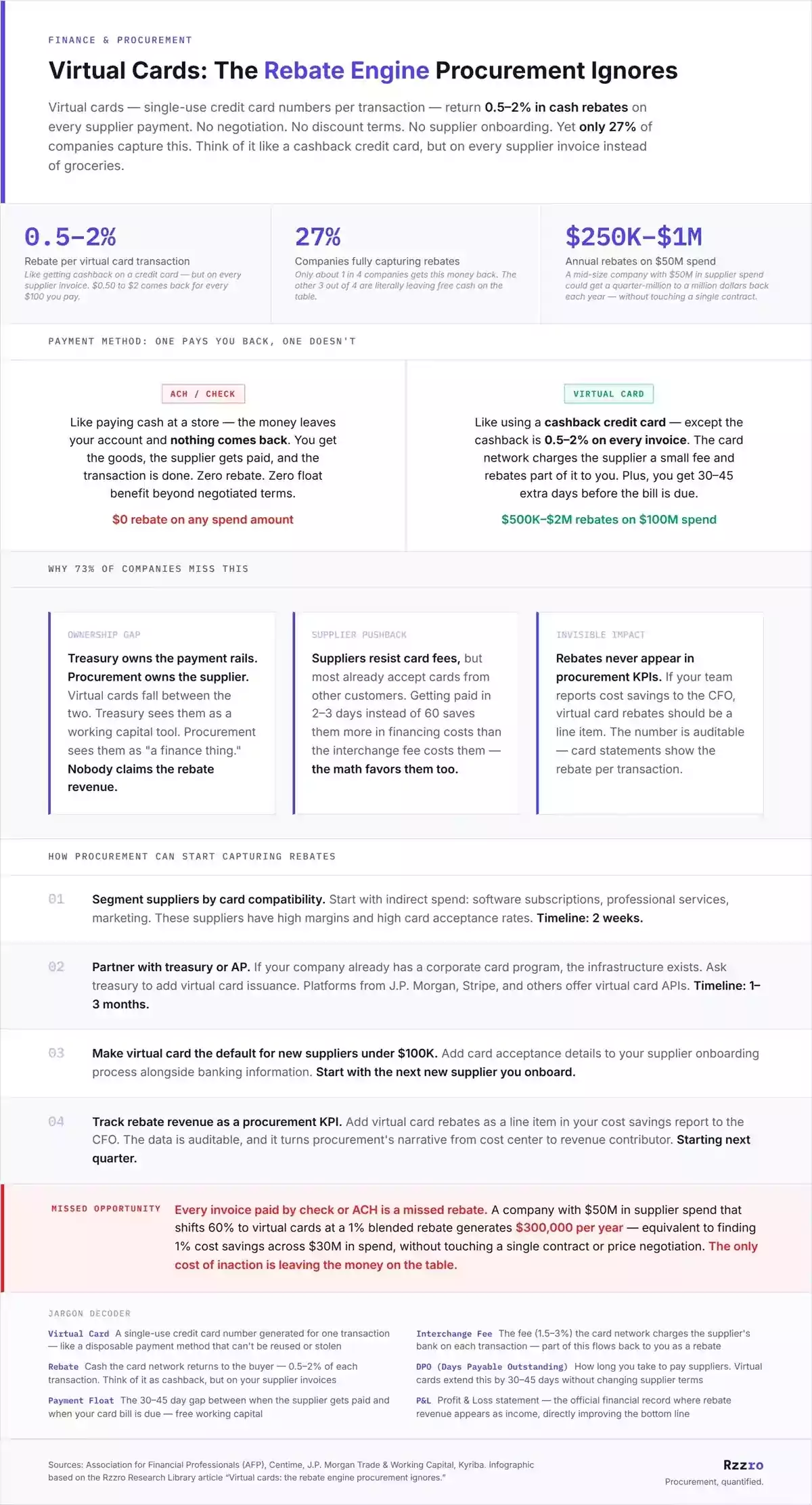
Sources: Association for Financial Professionals (AFP), Centime, J.P. Morgan Trade & Working Capital, Kyriba. Infographic based on the Rzzro Research Library article “Virtual cards: the rebate engine procurement ignores.”
Rzzro
Procurement, quantified.