Download PNG
Supplier Management

Supplier-Led Innovation — Why Cost-First Procurement Kills the Ideas That Reduce Cost

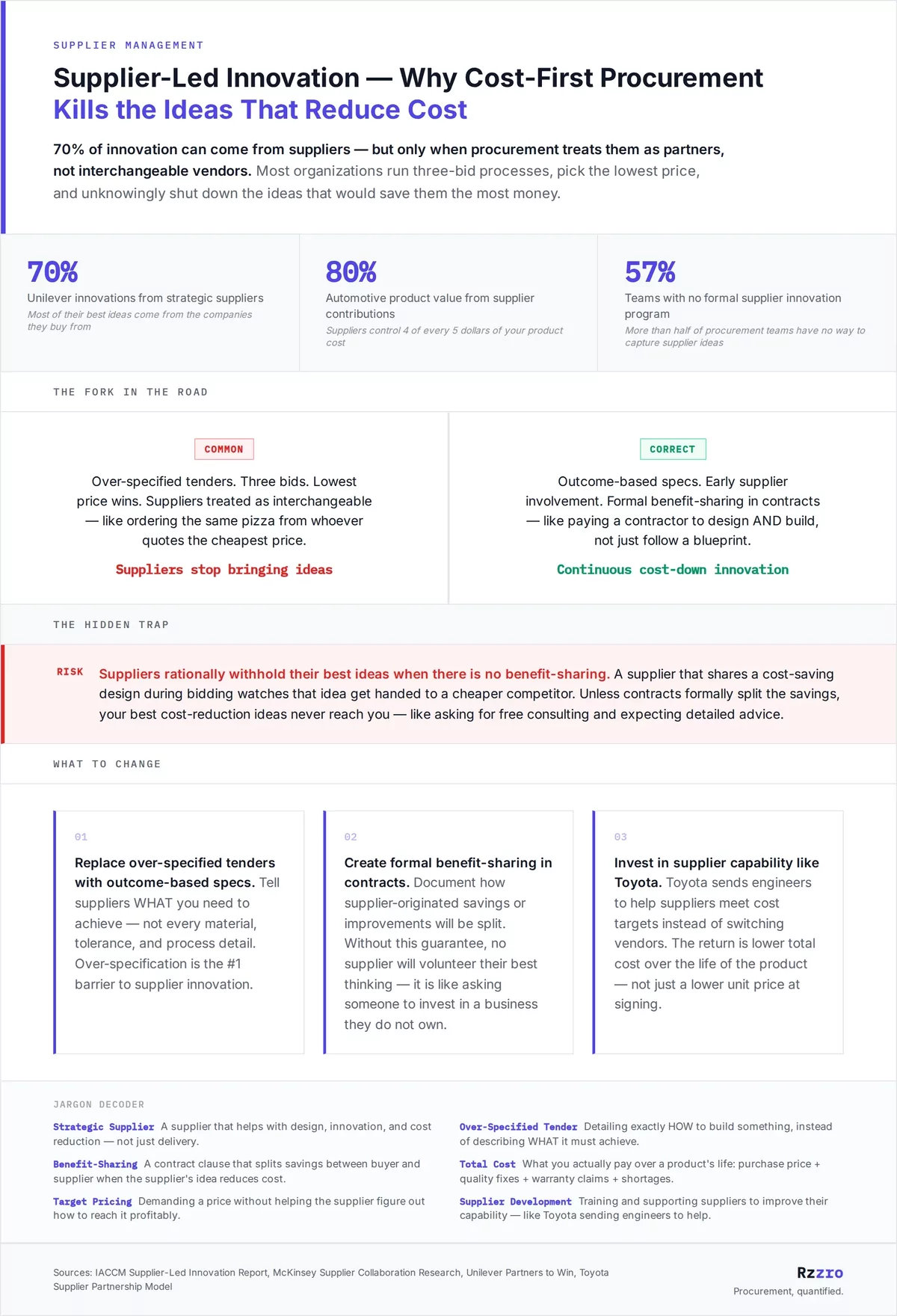
70% of innovation can come from suppliers — but only when procurement treats them as partners, not interchangeable vendors. Most organizations run three-bid processes, pick the lowest price, and unknowingly shut down the ideas that would save them the most money.
70%
Unilever innovations from strategic suppliers
Most of their best ideas come from the companies they buy from
80%
Automotive product value from supplier contributions
Suppliers control 4 of every 5 dollars of your product cost
57%
Teams with no formal supplier innovation program
More than half of procurement teams have no way to capture supplier ideas
Common
Over-specified tenders. Three bids. Lowest price wins. Suppliers treated as interchangeable — like ordering the same pizza from whoever quotes the cheapest price.
Suppliers stop bringing ideas
Correct
Outcome-based specs. Early supplier involvement. Formal benefit-sharing in contracts — like paying a contractor to design AND build, not just follow a blueprint.
Continuous cost-down innovation
Risk
Suppliers rationally withhold their best ideas when there is no benefit-sharing. A supplier that shares a cost-saving design during bidding watches that idea get handed to a cheaper competitor. Unless contracts formally split the savings, your best cost-reduction ideas never reach you — like asking for free consulting and expecting detailed advice.
01
Replace over-specified tenders with outcome-based specs. Tell suppliers WHAT you need to achieve — not every material, tolerance, and process detail. Over-specification is the #1 barrier to supplier innovation.
02
Create formal benefit-sharing in contracts. Document how supplier-originated savings or improvements will be split. Without this guarantee, no supplier will volunteer their best thinking — it is like asking someone to invest in a business they do not own.
03
Invest in supplier capability like Toyota. Toyota sends engineers to help suppliers meet cost targets instead of switching vendors. The return is lower total cost over the life of the product — not just a lower unit price at signing.
Jargon Decoder
Strategic Supplier A supplier that helps with design, innovation, and cost reduction — not just delivery.
Over-Specified Tender Detailing exactly HOW to build something, instead of describing WHAT it must achieve.
Benefit-Sharing A contract clause that splits savings between buyer and supplier when the supplier's idea reduces cost.
Total Cost What you actually pay over a product's life: purchase price + quality fixes + warranty claims + shortages.
Target Pricing Demanding a price without helping the supplier figure out how to reach it profitably.
Supplier Development Training and supporting suppliers to improve their capability — like Toyota sending engineers to help.
Sources: IACCM Supplier-Led Innovation Report, McKinsey Supplier Collaboration Research, Unilever Partners to Win, Toyota Supplier Partnership Model
Rzzro
Procurement, quantified.