Download WebP
Education — Myth Busting

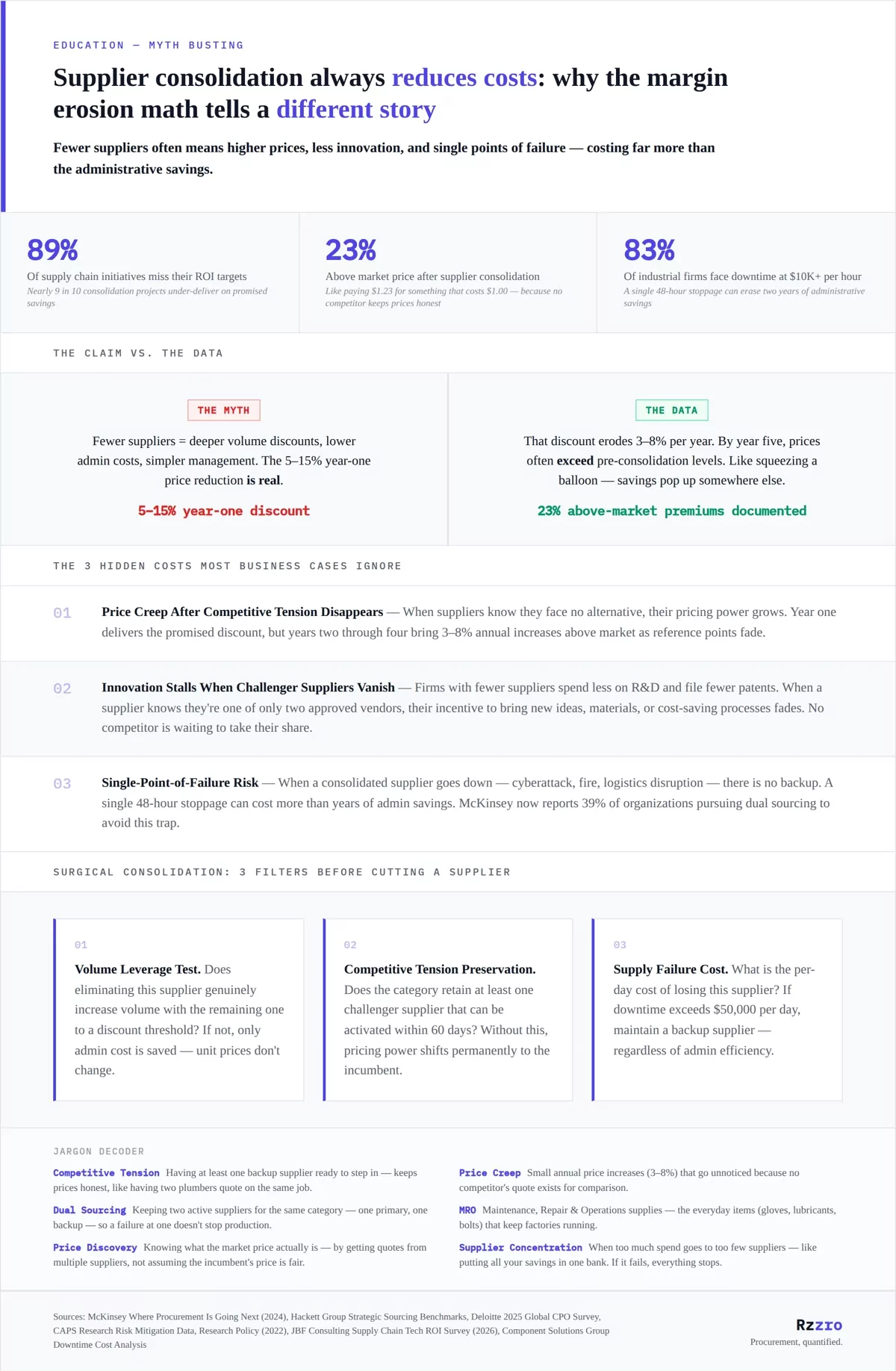
Supplier consolidation always reduces costs: why the margin erosion math tells a different story

Fewer suppliers often means higher prices, less innovation, and single points of failure — costing far more than the administrative savings.
89%
Of supply chain initiatives miss their ROI targets
Nearly 9 in 10 consolidation projects under-deliver on promised savings
23%
Above market price after supplier consolidation
Like paying $1.23 for something that costs $1.00 — because no competitor keeps prices honest
83%
Of industrial firms face downtime at $10K+ per hour
A single 48-hour stoppage can erase two years of administrative savings
The Myth
Fewer suppliers = deeper volume discounts, lower admin costs, simpler management. The 5–15% year-one price reduction is real.
5–15% year-one discount
The Data
That discount erodes 3–8% per year. By year five, prices often exceed pre-consolidation levels. Like squeezing a balloon — savings pop up somewhere else.
23% above-market premiums documented
01
Price Creep After Competitive Tension Disappears — When suppliers know they face no alternative, their pricing power grows. Year one delivers the promised discount, but years two through four bring 3–8% annual increases above market as reference points fade.
02
Innovation Stalls When Challenger Suppliers Vanish — Firms with fewer suppliers spend less on R&D and file fewer patents. When a supplier knows they're one of only two approved vendors, their incentive to bring new ideas, materials, or cost-saving processes fades. No competitor is waiting to take their share.
03
Single-Point-of-Failure Risk — When a consolidated supplier goes down — cyberattack, fire, logistics disruption — there is no backup. A single 48-hour stoppage can cost more than years of admin savings. McKinsey now reports 39% of organizations pursuing dual sourcing to avoid this trap.
01
Volume Leverage Test. Does eliminating this supplier genuinely increase volume with the remaining one to a discount threshold? If not, only admin cost is saved — unit prices don't change.
02
Competitive Tension Preservation. Does the category retain at least one challenger supplier that can be activated within 60 days? Without this, pricing power shifts permanently to the incumbent.
03
Supply Failure Cost. What is the per-day cost of losing this supplier? If downtime exceeds $50,000 per day, maintain a backup supplier — regardless of admin efficiency.
Jargon Decoder
Competitive Tension Having at least one backup supplier ready to step in — keeps prices honest, like having two plumbers quote on the same job.
Price Creep Small annual price increases (3–8%) that go unnoticed because no competitor's quote exists for comparison.
Dual Sourcing Keeping two active suppliers for the same category — one primary, one backup — so a failure at one doesn't stop production.
MRO Maintenance, Repair & Operations supplies — the everyday items (gloves, lubricants, bolts) that keep factories running.
Price Discovery Knowing what the market price actually is — by getting quotes from multiple suppliers, not assuming the incumbent's price is fair.
Supplier Concentration When too much spend goes to too few suppliers — like putting all your savings in one bank. If it fails, everything stops.
Sources: McKinsey Where Procurement Is Going Next (2024), Hackett Group Strategic Sourcing Benchmarks, Deloitte 2025 Global CPO Survey, CAPS Research Risk Mitigation Data, Research Policy (2022), JBF Consulting Supply Chain Tech ROI Survey (2026), Component Solutions Group Downtime Cost Analysis
Rzzro
Procurement, quantified.