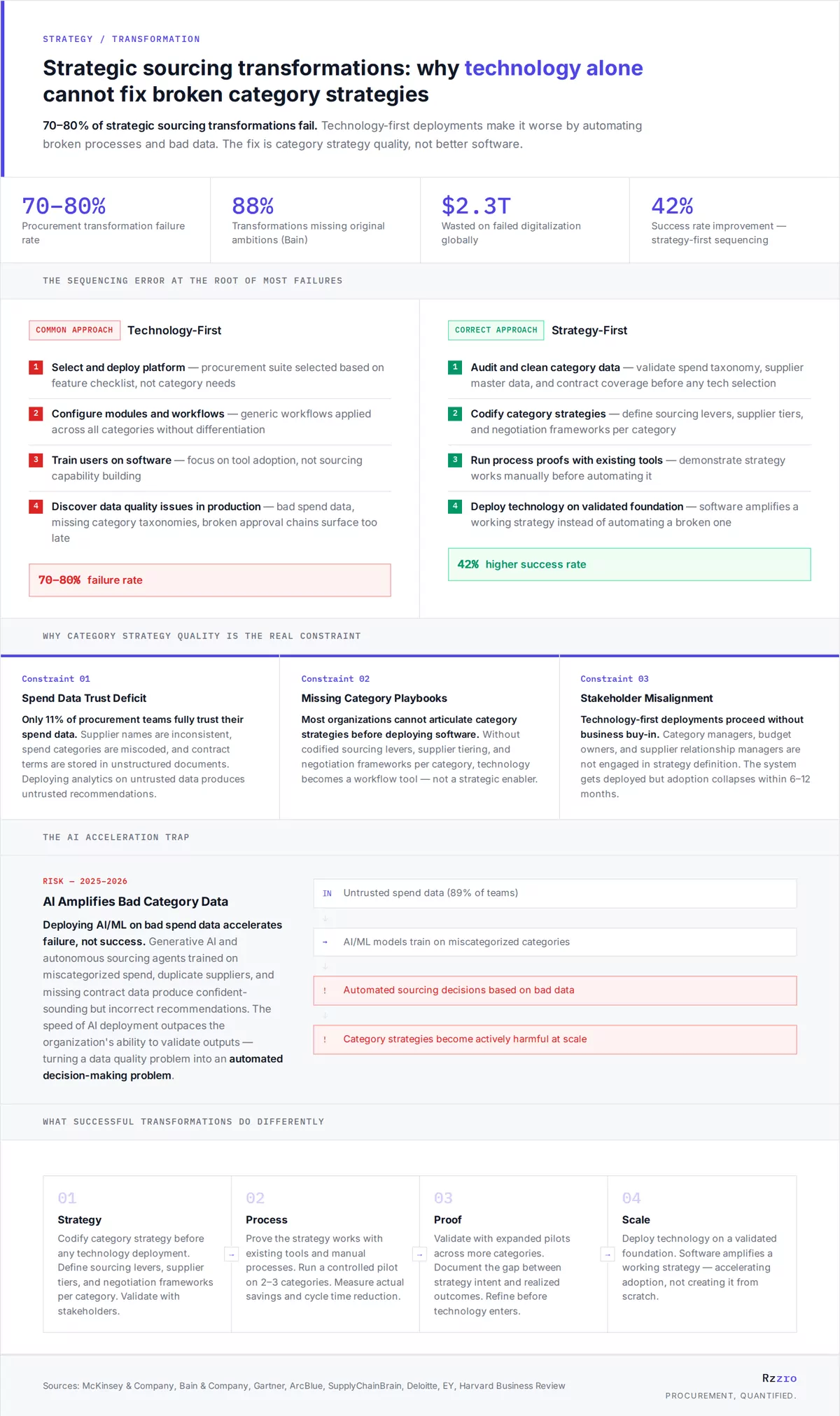
70–80%
Procurement transformation failure rate
88%
Transformations missing original ambitions (Bain)
$2.3T
Wasted on failed digitalization globally
42%
Success rate improvement — strategy-first sequencing
The sequencing error at the root of most failures
1
Select and deploy platform — procurement suite selected based on feature checklist, not category needs
2
Configure modules and workflows — generic workflows applied across all categories without differentiation
3
Train users on software — focus on tool adoption, not sourcing capability building
4
Discover data quality issues in production — bad spend data, missing category taxonomies, broken approval chains surface too late
70–80% failure rate
1
Audit and clean category data — validate spend taxonomy, supplier master data, and contract coverage before any tech selection
2
Codify category strategies — define sourcing levers, supplier tiers, and negotiation frameworks per category
3
Run process proofs with existing tools — demonstrate strategy works manually before automating it
4
Deploy technology on validated foundation — software amplifies a working strategy instead of automating a broken one
42% higher success rate
Why category strategy quality is the real constraint
Constraint 01
Spend Data Trust Deficit
Only 11% of procurement teams fully trust their spend data. Supplier names are inconsistent, spend categories are miscoded, and contract terms are stored in unstructured documents. Deploying analytics on untrusted data produces untrusted recommendations.
Constraint 02
Missing Category Playbooks
Most organizations cannot articulate category strategies before deploying software. Without codified sourcing levers, supplier tiering, and negotiation frameworks per category, technology becomes a workflow tool — not a strategic enabler.
Constraint 03
Stakeholder Misalignment
Technology-first deployments proceed without business buy-in. Category managers, budget owners, and supplier relationship managers are not engaged in strategy definition. The system gets deployed but adoption collapses within 6–12 months.
The AI acceleration trap
Risk — 2025–2026
AI Amplifies Bad Category Data
Deploying AI/ML on bad spend data accelerates failure, not success. Generative AI and autonomous sourcing agents trained on miscategorized spend, duplicate suppliers, and missing contract data produce confident-sounding but incorrect recommendations. The speed of AI deployment outpaces the organization's ability to validate outputs — turning a data quality problem into an automated decision-making problem.
IN Untrusted spend data (89% of teams)
↓
→ AI/ML models train on miscategorized categories
↓
! Automated sourcing decisions based on bad data
↓
! Category strategies become actively harmful at scale
What successful transformations do differently
01
Strategy
Codify category strategy before any technology deployment. Define sourcing levers, supplier tiers, and negotiation frameworks per category. Validate with stakeholders.
→
02
Process
Prove the strategy works with existing tools and manual processes. Run a controlled pilot on 2–3 categories. Measure actual savings and cycle time reduction.
→
03
Proof
Validate with expanded pilots across more categories. Document the gap between strategy intent and realized outcomes. Refine before technology enters.
→
04
Scale
Deploy technology on a validated foundation. Software amplifies a working strategy — accelerating adoption, not creating it from scratch.
Sources: McKinsey & Company, Bain & Company, Gartner, ArcBlue, SupplyChainBrain, Deloitte, EY, Harvard Business Review
Rzzro
Procurement, quantified.