Download PNG (960 × 1200)
Education — Vocabulary

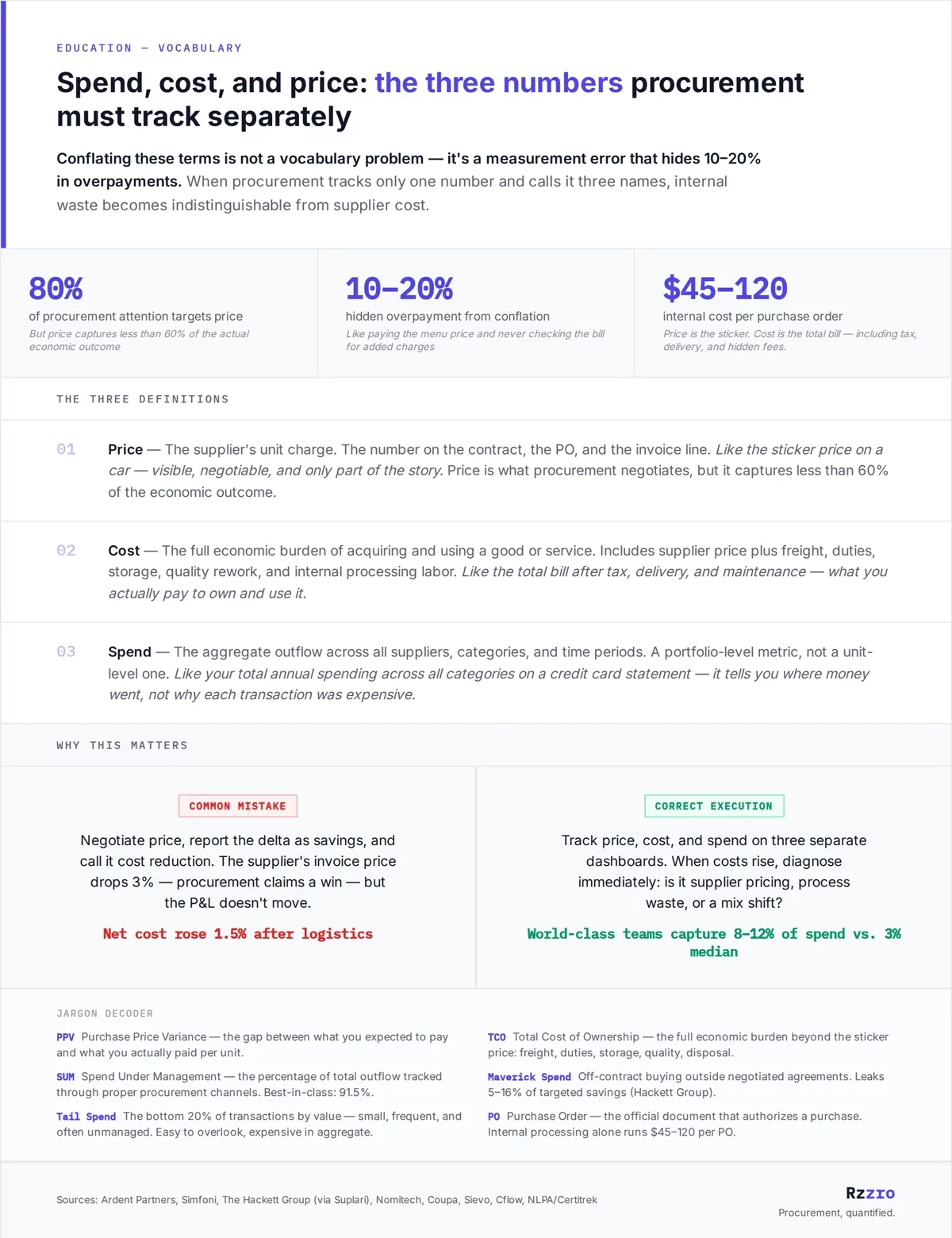
Spend, cost, and price: the three numbers procurement must track separately

Conflating these terms is not a vocabulary problem — it's a measurement error that hides 10–20% in overpayments. When procurement tracks only one number and calls it three names, internal waste becomes indistinguishable from supplier cost.
80%
of procurement attention targets price
But price captures less than 60% of the actual economic outcome
10–20%
hidden overpayment from conflation
Like paying the menu price and never checking the bill for added charges
$45–120
internal cost per purchase order
Price is the sticker. Cost is the total bill — including tax, delivery, and hidden fees.
01
Price — The supplier's unit charge. The number on the contract, the PO, and the invoice line. Like the sticker price on a car — visible, negotiable, and only part of the story. Price is what procurement negotiates, but it captures less than 60% of the economic outcome.
02
Cost — The full economic burden of acquiring and using a good or service. Includes supplier price plus freight, duties, storage, quality rework, and internal processing labor. Like the total bill after tax, delivery, and maintenance — what you actually pay to own and use it.
03
Spend — The aggregate outflow across all suppliers, categories, and time periods. A portfolio-level metric, not a unit-level one. Like your total annual spending across all categories on a credit card statement — it tells you where money went, not why each transaction was expensive.
Common Mistake
Negotiate price, report the delta as savings, and call it cost reduction. The supplier's invoice price drops 3% — procurement claims a win — but the P&L doesn't move.
Net cost rose 1.5% after logistics
Correct Execution
Track price, cost, and spend on three separate dashboards. When costs rise, diagnose immediately: is it supplier pricing, process waste, or a mix shift?
World-class teams capture 8–12% of spend vs. 3% median
Jargon Decoder
PPV Purchase Price Variance — the gap between what you expected to pay and what you actually paid per unit.
TCO Total Cost of Ownership — the full economic burden beyond the sticker price: freight, duties, storage, quality, disposal.
SUM Spend Under Management — the percentage of total outflow tracked through proper procurement channels. Best-in-class: 91.5%.
Maverick Spend Off-contract buying outside negotiated agreements. Leaks 5–16% of targeted savings (Hackett Group).
Tail Spend The bottom 20% of transactions by value — small, frequent, and often unmanaged. Easy to overlook, expensive in aggregate.
PO Purchase Order — the official document that authorizes a purchase. Internal processing alone runs $45–120 per PO.
Sources: Ardent Partners, Simfoni, The Hackett Group (via Suplari), Nomitech, Coupa, Sievo, Cflow, NLPA/Certitrek
Rzzro
Procurement, quantified.