Download PNG
Education — Myth Busting

Sole-source is not always a risk

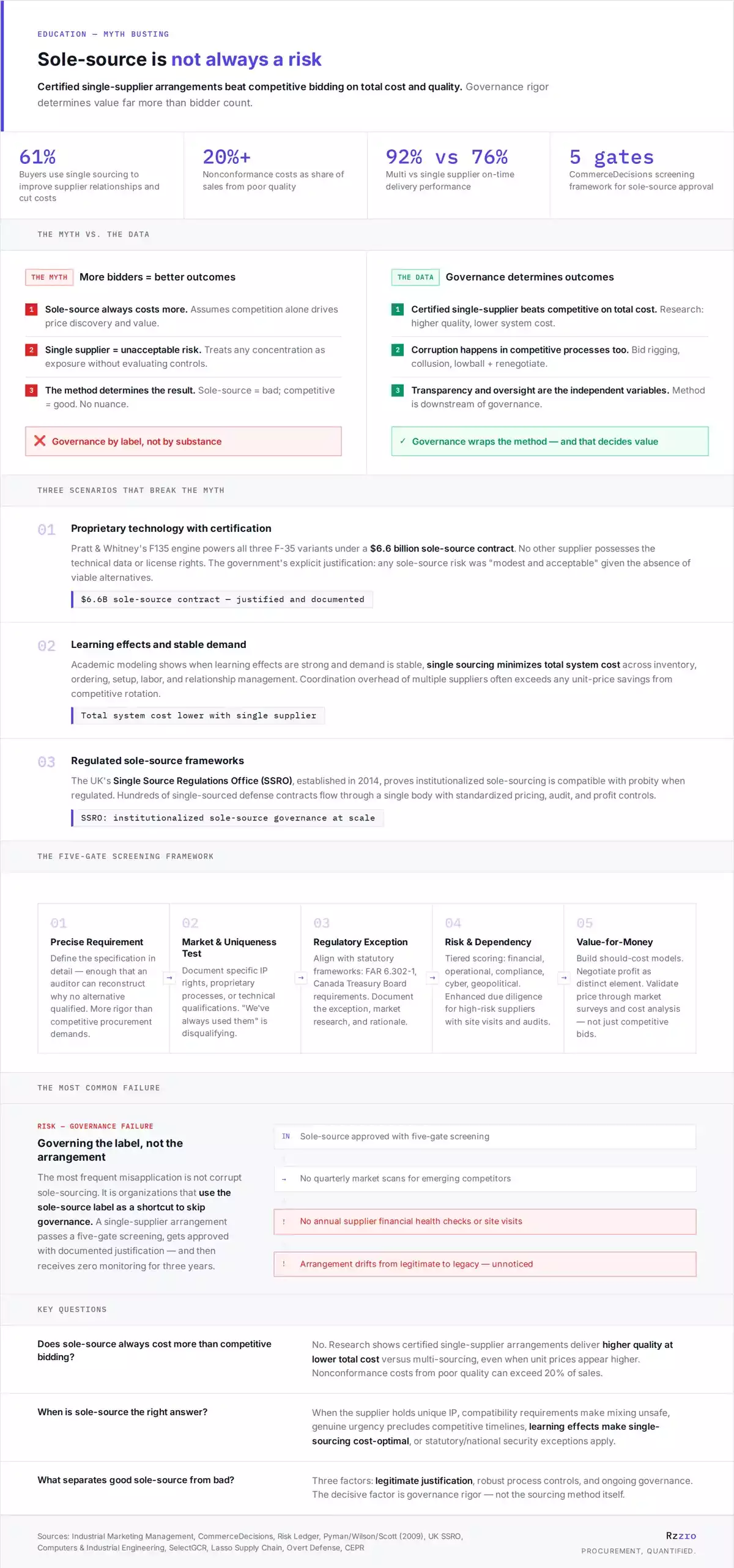
Certified single-supplier arrangements beat competitive bidding on total cost and quality. Governance rigor determines value far more than bidder count.
61%
Buyers use single sourcing to improve supplier relationships and cut costs
20%+
Nonconformance costs as share of sales from poor quality
92% vs 76%
Multi vs single supplier on-time delivery performance
5 gates
CommerceDecisions screening framework for sole-source approval
The Myth
More bidders = better outcomes
1
Sole-source always costs more. Assumes competition alone drives price discovery and value.
2
Single supplier = unacceptable risk. Treats any concentration as exposure without evaluating controls.
3
The method determines the result. Sole-source = bad; competitive = good. No nuance.
Governance by label, not by substance
The Data
Governance determines outcomes
1
Certified single-supplier beats competitive on total cost. Research: higher quality, lower system cost.
2
Corruption happens in competitive processes too. Bid rigging, collusion, lowball + renegotiate.
3
Transparency and oversight are the independent variables. Method is downstream of governance.
Governance wraps the method — and that decides value
01
Proprietary technology with certification
Pratt & Whitney's F135 engine powers all three F-35 variants under a $6.6 billion sole-source contract. No other supplier possesses the technical data or license rights. The government's explicit justification: any sole-source risk was "modest and acceptable" given the absence of viable alternatives.
$6.6B sole-source contract — justified and documented
02
Learning effects and stable demand
Academic modeling shows when learning effects are strong and demand is stable, single sourcing minimizes total system cost across inventory, ordering, setup, labor, and relationship management. Coordination overhead of multiple suppliers often exceeds any unit-price savings from competitive rotation.
Total system cost lower with single supplier
03
Regulated sole-source frameworks
The UK's Single Source Regulations Office (SSRO), established in 2014, proves institutionalized sole-sourcing is compatible with probity when regulated. Hundreds of single-sourced defense contracts flow through a single body with standardized pricing, audit, and profit controls.
SSRO: institutionalized sole-source governance at scale
01
Precise Requirement
Define the specification in detail — enough that an auditor can reconstruct why no alternative qualified. More rigor than competitive procurement demands.
02
Market & Uniqueness Test
Document specific IP rights, proprietary processes, or technical qualifications. "We've always used them" is disqualifying.
03
Regulatory Exception
Align with statutory frameworks: FAR 6.302-1, Canada Treasury Board requirements. Document the exception, market research, and rationale.
04
Risk & Dependency
Tiered scoring: financial, operational, compliance, cyber, geopolitical. Enhanced due diligence for high-risk suppliers with site visits and audits.
05
Value-for-Money
Build should-cost models. Negotiate profit as distinct element. Validate price through market surveys and cost analysis — not just competitive bids.
Risk — Governance Failure
Governing the label, not the arrangement
The most frequent misapplication is not corrupt sole-sourcing. It is organizations that use the sole-source label as a shortcut to skip governance. A single-supplier arrangement passes a five-gate screening, gets approved with documented justification — and then receives zero monitoring for three years.
IN Sole-source approved with five-gate screening
No quarterly market scans for emerging competitors
! No annual supplier financial health checks or site visits
! Arrangement drifts from legitimate to legacy — unnoticed
Does sole-source always cost more than competitive bidding?
No. Research shows certified single-supplier arrangements deliver higher quality at lower total cost versus multi-sourcing, even when unit prices appear higher. Nonconformance costs from poor quality can exceed 20% of sales.
When is sole-source the right answer?
When the supplier holds unique IP, compatibility requirements make mixing unsafe, genuine urgency precludes competitive timelines, learning effects make single-sourcing cost-optimal, or statutory/national security exceptions apply.
What separates good sole-source from bad?
Three factors: legitimate justification, robust process controls, and ongoing governance. The decisive factor is governance rigor — not the sourcing method itself.
Sources: Industrial Marketing Management, CommerceDecisions, Risk Ledger, Pyman/Wilson/Scott (2009), UK SSRO, Computers & Industrial Engineering, SelectGCR, Lasso Supply Chain, Overt Defense, CEPR
Rzzro
Procurement, quantified.