Cause 01
Cost Weighting That Overrides Everything
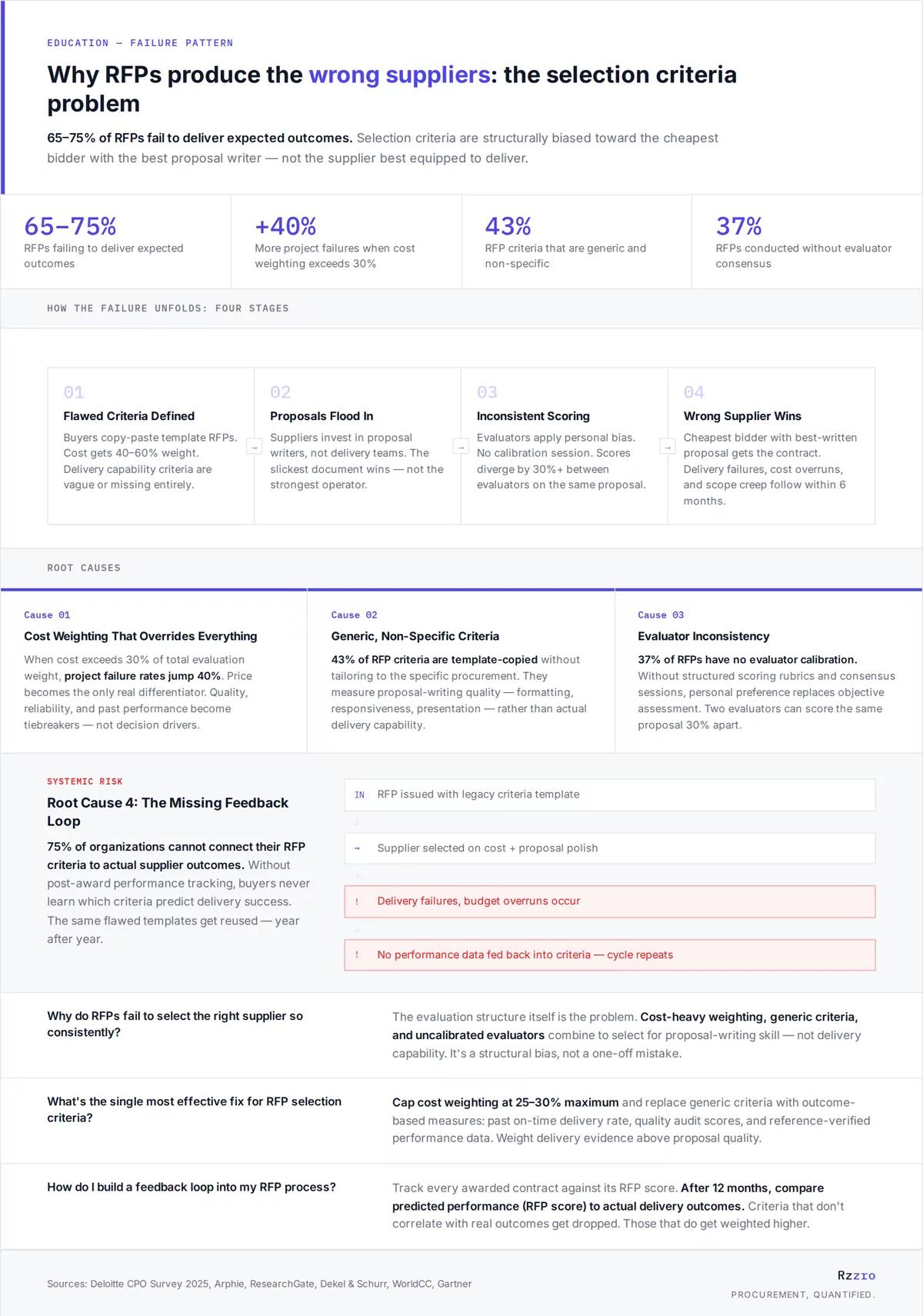
When cost exceeds 30% of total evaluation weight, project failure rates jump 40%. Price becomes the only real differentiator. Quality, reliability, and past performance become tiebreakers — not decision drivers.
Cause 02
Generic, Non-Specific Criteria
43% of RFP criteria are template-copied without tailoring to the specific procurement. They measure proposal-writing quality — formatting, responsiveness, presentation — rather than actual delivery capability.
Cause 03
Evaluator Inconsistency
37% of RFPs have no evaluator calibration. Without structured scoring rubrics and consensus sessions, personal preference replaces objective assessment. Two evaluators can score the same proposal 30% apart.
Systemic Risk
Root Cause 4: The Missing Feedback Loop
75% of organizations cannot connect their RFP criteria to actual supplier outcomes. Without post-award performance tracking, buyers never learn which criteria predict delivery success. The same flawed templates get reused — year after year.
IN RFP issued with legacy criteria template
↓
→ Supplier selected on cost + proposal polish
↓
! Delivery failures, budget overruns occur
↓
! No performance data fed back into criteria — cycle repeats
Why do RFPs fail to select the right supplier so consistently?
The evaluation structure itself is the problem. Cost-heavy weighting, generic criteria, and uncalibrated evaluators combine to select for proposal-writing skill — not delivery capability. It's a structural bias, not a one-off mistake.
What's the single most effective fix for RFP selection criteria?
Cap cost weighting at 25–30% maximum and replace generic criteria with outcome-based measures: past on-time delivery rate, quality audit scores, and reference-verified performance data. Weight delivery evidence above proposal quality.
How do I build a feedback loop into my RFP process?
Track every awarded contract against its RFP score. After 12 months, compare predicted performance (RFP score) to actual delivery outcomes. Criteria that don't correlate with real outcomes get dropped. Those that do get weighted higher.
Sources: Deloitte CPO Survey 2025, Arphie, ResearchGate, Dekel & Schurr, WorldCC, Gartner
Rzzro
Procurement, quantified.