Download Infographic
Strategy

Procurement orchestration: why connecting your tools matters more than buying another platform

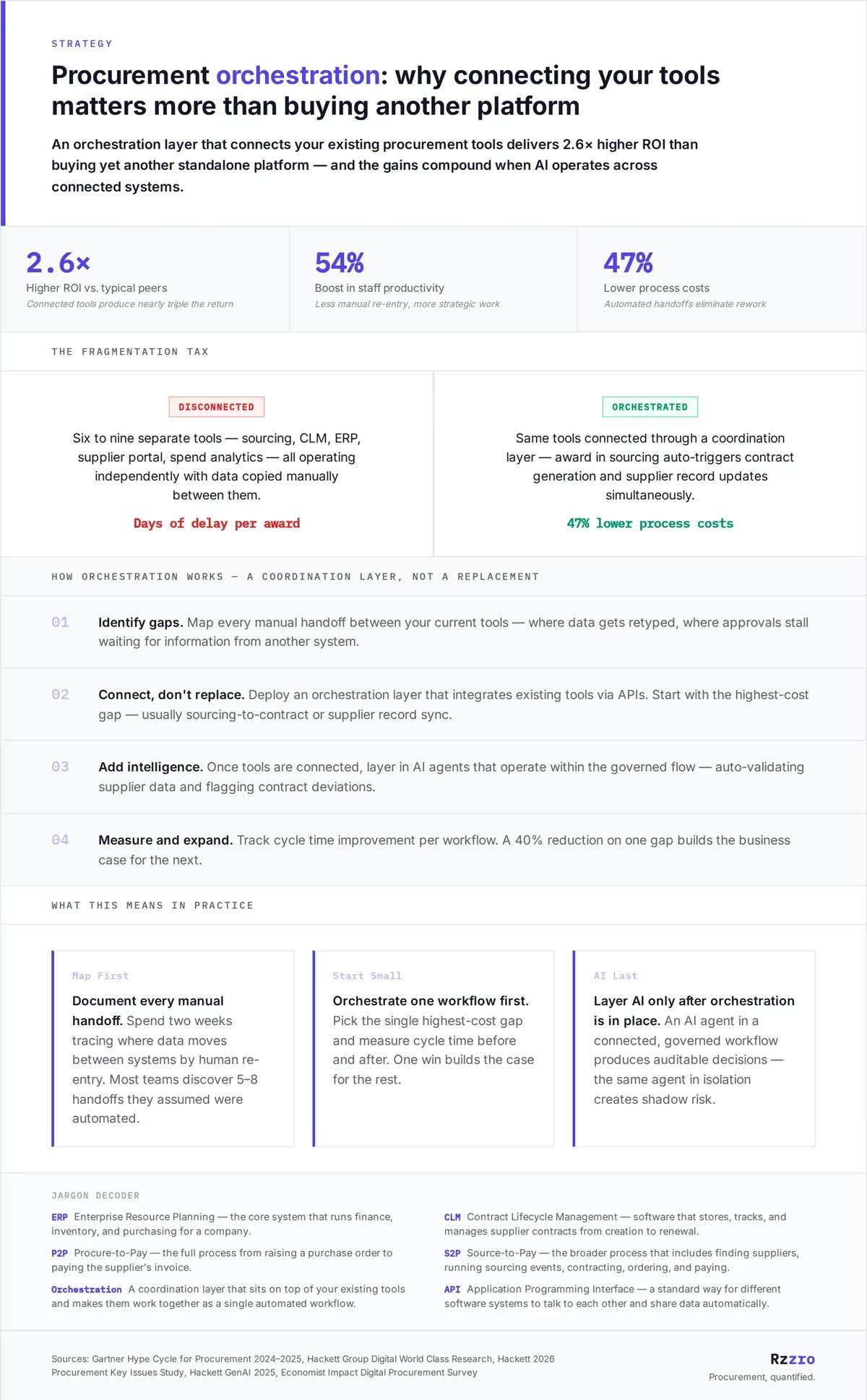
An orchestration layer that connects your existing procurement tools delivers 2.6× higher ROI than buying yet another standalone platform — and the gains compound when AI operates across connected systems.
2.6×
Higher ROI vs. typical peers
Connected tools produce nearly triple the return
54%
Boost in staff productivity
Less manual re-entry, more strategic work
47%
Lower process costs
Automated handoffs eliminate rework
Disconnected
Six to nine separate tools — sourcing, CLM, ERP, supplier portal, spend analytics — all operating independently with data copied manually between them.
Days of delay per award
Orchestrated
Same tools connected through a coordination layer — award in sourcing auto-triggers contract generation and supplier record updates simultaneously.
47% lower process costs
01
Identify gaps. Map every manual handoff between your current tools — where data gets retyped, where approvals stall waiting for information from another system.
02
Connect, don't replace. Deploy an orchestration layer that integrates existing tools via APIs. Start with the highest-cost gap — usually sourcing-to-contract or supplier record sync.
03
Add intelligence. Once tools are connected, layer in AI agents that operate within the governed flow — auto-validating supplier data and flagging contract deviations.
04
Measure and expand. Track cycle time improvement per workflow. A 40% reduction on one gap builds the business case for the next.
Map First
Document every manual handoff. Spend two weeks tracing where data moves between systems by human re-entry. Most teams discover 5–8 handoffs they assumed were automated.
Start Small
Orchestrate one workflow first. Pick the single highest-cost gap and measure cycle time before and after. One win builds the case for the rest.
AI Last
Layer AI only after orchestration is in place. An AI agent in a connected, governed workflow produces auditable decisions — the same agent in isolation creates shadow risk.
Jargon Decoder
ERP Enterprise Resource Planning — the core system that runs finance, inventory, and purchasing for a company.
CLM Contract Lifecycle Management — software that stores, tracks, and manages supplier contracts from creation to renewal.
P2P Procure-to-Pay — the full process from raising a purchase order to paying the supplier's invoice.
S2P Source-to-Pay — the broader process that includes finding suppliers, running sourcing events, contracting, ordering, and paying.
Orchestration A coordination layer that sits on top of your existing tools and makes them work together as a single automated workflow.
API Application Programming Interface — a standard way for different software systems to talk to each other and share data automatically.
Sources: Gartner Hype Cycle for Procurement 2024–2025, Hackett Group Digital World Class Research, Hackett 2026 Procurement Key Issues Study, Hackett GenAI 2025, Economist Impact Digital Procurement Survey
Rzzro
Procurement, quantified.