Download PNG
Supply Chain Risk

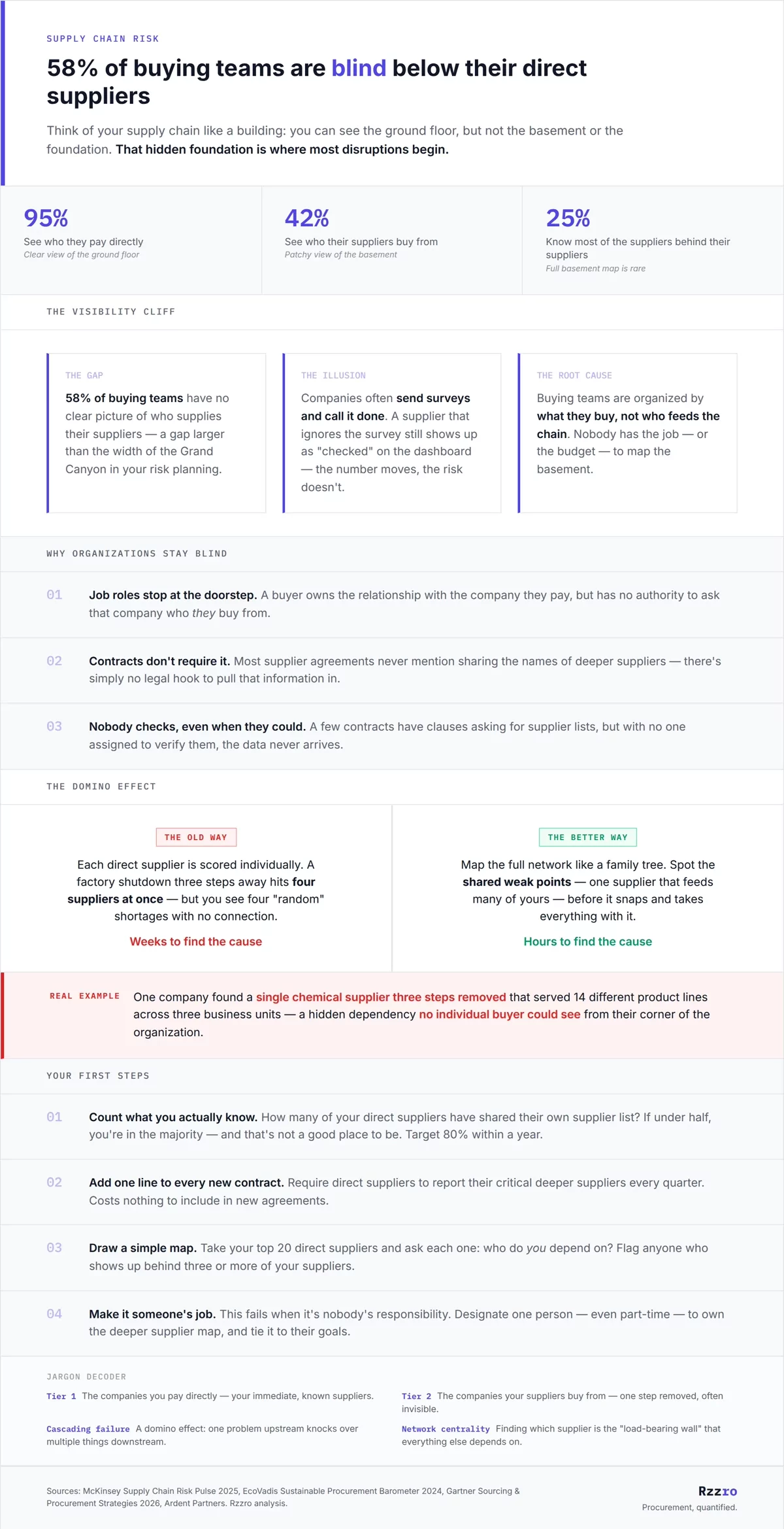
58% of buying teams are blind below their direct suppliers

Think of your supply chain like a building: you can see the ground floor, but not the basement or the foundation. That hidden foundation is where most disruptions begin.

95%
See who they pay directly
Clear view of the ground floor
42%
See who their suppliers buy from
Patchy view of the basement
25%
Know most of the suppliers behind their suppliers
Full basement map is rare
THE GAP
58% of buying teams have no clear picture of who supplies their suppliers — a gap larger than the width of the Grand Canyon in your risk planning.
THE ILLUSION
Companies often send surveys and call it done. A supplier that ignores the survey still shows up as "checked" on the dashboard — the number moves, the risk doesn't.
THE ROOT CAUSE
Buying teams are organized by what they buy, not who feeds the chain. Nobody has the job — or the budget — to map the basement.
01
Job roles stop at the doorstep. A buyer owns the relationship with the company they pay, but has no authority to ask that company who they buy from.
02
Contracts don't require it. Most supplier agreements never mention sharing the names of deeper suppliers — there's simply no legal hook to pull that information in.
03
Nobody checks, even when they could. A few contracts have clauses asking for supplier lists, but with no one assigned to verify them, the data never arrives.
The Old Way

Each direct supplier is scored individually. A factory shutdown three steps away hits four suppliers at once — but you see four "random" shortages with no connection.

Weeks to find the cause
The Better Way

Map the full network like a family tree. Spot the shared weak points — one supplier that feeds many of yours — before it snaps and takes everything with it.
Hours to find the cause
Real Example
One company found a single chemical supplier three steps removed that served 14 different product lines across three business units — a hidden dependency no individual buyer could see from their corner of the organization.
01
Count what you actually know. How many of your direct suppliers have shared their own supplier list? If under half, you're in the majority — and that's not a good place to be. Target 80% within a year.
02
Add one line to every new contract. Require direct suppliers to report their critical deeper suppliers every quarter. Costs nothing to include in new agreements.
03
Draw a simple map. Take your top 20 direct suppliers and ask each one: who do you depend on? Flag anyone who shows up behind three or more of your suppliers.
04
Make it someone's job. This fails when it's nobody's responsibility. Designate one person — even part-time — to own the deeper supplier map, and tie it to their goals.
Jargon Decoder
Tier 1 The companies you pay directly — your immediate, known suppliers.
Tier 2 The companies your suppliers buy from — one step removed, often invisible.
Cascading failure A domino effect: one problem upstream knocks over multiple things downstream.
Network centrality Finding which supplier is the "load-bearing wall" that everything else depends on.
Sources: McKinsey Supply Chain Risk Pulse 2025, EcoVadis Sustainable Procurement Barometer 2024, Gartner Sourcing & Procurement Strategies 2026, Ardent Partners. Rzzro analysis.
Rzzro
Procurement, quantified.