Download PNG (2x Retina)
Education · Decision Framework

Make vs Buy: a five-factor weighted framework for procurement teams

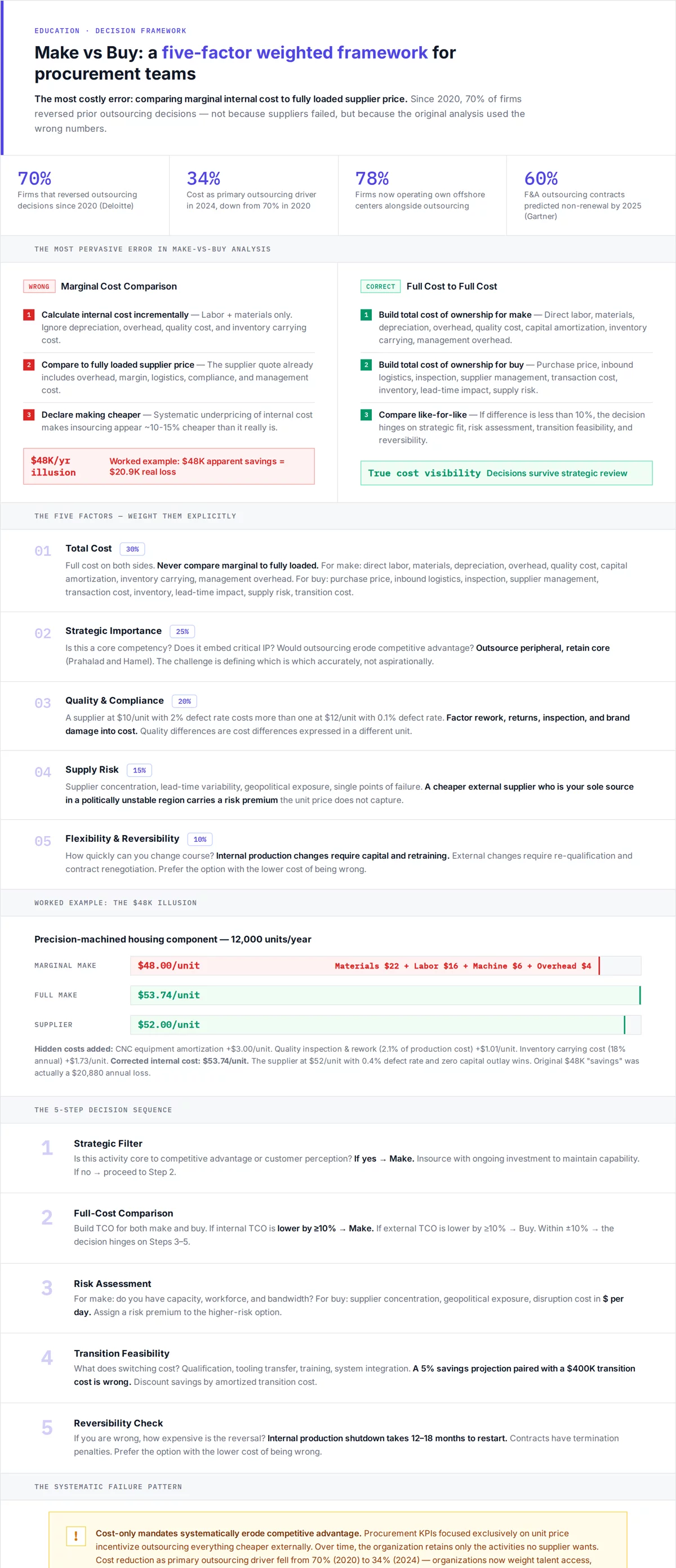
The most costly error: comparing marginal internal cost to fully loaded supplier price. Since 2020, 70% of firms reversed prior outsourcing decisions — not because suppliers failed, but because the original analysis used the wrong numbers.
70%
Firms that reversed outsourcing decisions since 2020 (Deloitte)
34%
Cost as primary outsourcing driver in 2024, down from 70% in 2020
78%
Firms now operating own offshore centers alongside outsourcing
60%
F&A outsourcing contracts predicted non-renewal by 2025 (Gartner)
Wrong
Marginal Cost Comparison
1
Calculate internal cost incrementally — Labor + materials only. Ignore depreciation, overhead, quality cost, and inventory carrying cost.
2
Compare to fully loaded supplier price — The supplier quote already includes overhead, margin, logistics, compliance, and management cost.
3
Declare making cheaper — Systematic underpricing of internal cost makes insourcing appear ~10-15% cheaper than it really is.
$48K/yr illusion Worked example: $48K apparent savings = $20.9K real loss
Correct
Full Cost to Full Cost
1
Build total cost of ownership for make — Direct labor, materials, depreciation, overhead, quality cost, capital amortization, inventory carrying, management overhead.
2
Build total cost of ownership for buy — Purchase price, inbound logistics, inspection, supplier management, transaction cost, inventory, lead-time impact, supply risk.
3
Compare like-for-like — If difference is less than 10%, the decision hinges on strategic fit, risk assessment, transition feasibility, and reversibility.
True cost visibility Decisions survive strategic review
01
Total Cost 30%
Full cost on both sides. Never compare marginal to fully loaded. For make: direct labor, materials, depreciation, overhead, quality cost, capital amortization, inventory carrying, management overhead. For buy: purchase price, inbound logistics, inspection, supplier management, transaction cost, inventory, lead-time impact, supply risk, transition cost.
02
Strategic Importance 25%
Is this a core competency? Does it embed critical IP? Would outsourcing erode competitive advantage? Outsource peripheral, retain core (Prahalad and Hamel). The challenge is defining which is which accurately, not aspirationally.
03
Quality & Compliance 20%
A supplier at $10/unit with 2% defect rate costs more than one at $12/unit with 0.1% defect rate. Factor rework, returns, inspection, and brand damage into cost. Quality differences are cost differences expressed in a different unit.
04
Supply Risk 15%
Supplier concentration, lead-time variability, geopolitical exposure, single points of failure. A cheaper external supplier who is your sole source in a politically unstable region carries a risk premium the unit price does not capture.
05
Flexibility & Reversibility 10%
How quickly can you change course? Internal production changes require capital and retraining. External changes require re-qualification and contract renegotiation. Prefer the option with the lower cost of being wrong.
Precision-machined housing component — 12,000 units/year
Marginal Make
$48.00/unit Materials $22 + Labor $16 + Machine $6 + Overhead $4
Full Make
$53.74/unit
Supplier
$52.00/unit
Hidden costs added: CNC equipment amortization +$3.00/unit. Quality inspection & rework (2.1% of production cost) +$1.01/unit. Inventory carrying cost (18% annual) +$1.73/unit. Corrected internal cost: $53.74/unit. The supplier at $52/unit with 0.4% defect rate and zero capital outlay wins. Original $48K "savings" was actually a $20,880 annual loss.
1
Strategic Filter
Is this activity core to competitive advantage or customer perception? If yes → Make. Insource with ongoing investment to maintain capability. If no → proceed to Step 2.
2
Full-Cost Comparison
Build TCO for both make and buy. If internal TCO is lower by ≥10% → Make. If external TCO is lower by ≥10% → Buy. Within ±10% → the decision hinges on Steps 3–5.
3
Risk Assessment
For make: do you have capacity, workforce, and bandwidth? For buy: supplier concentration, geopolitical exposure, disruption cost in $ per day. Assign a risk premium to the higher-risk option.
4
Transition Feasibility
What does switching cost? Qualification, tooling transfer, training, system integration. A 5% savings projection paired with a $400K transition cost is wrong. Discount savings by amortized transition cost.
5
Reversibility Check
If you are wrong, how expensive is the reversal? Internal production shutdown takes 12–18 months to restart. Contracts have termination penalties. Prefer the option with the lower cost of being wrong.
!
Cost-only mandates systematically erode competitive advantage. Procurement KPIs focused exclusively on unit price incentivize outsourcing everything cheaper externally. Over time, the organization retains only the activities no supplier wants. Cost reduction as primary outsourcing driver fell from 70% (2020) to 34% (2024) — organizations now weight talent access, strategic resilience, and supply security above pure savings.
Gartner: 60% of F&A outsourcing contracts predicted non-renewal by 2025 due to outdated cost-only pricing models
Outcome 01
Fewer Reversals
Multi-factor weighted decisions survive strategic review. 70% reversal rate drops when organizations stop comparing marginal to fully loaded cost.
Outcome 02
10–20% Savings
McKinsey: companies using clean-sheet should-cost modeling and strategic sourcing achieve 10–20% savings per category — from correct activity placement, not supplier squeezing.
Outcome 03
Hybrid Models Work
78% of firms now operate own offshore centers alongside outsourcing. Hybrid models — make-to-stock with buy-on-surge, dual sourcing, contract manufacturing with retained IP — deliver the best of both.
What is the most common make-vs-buy error?
Comparing marginal internal cost to fully loaded supplier price. Always compare full cost to full cost — including overhead, quality, inventory carrying, and management on both sides.
When should a company never outsource?
When the activity is critical to product success or customer perception, requires specialized skills with very limited suppliers, or fits within a core competency the firm needs to develop (Quinn & Hilmer criteria).
How often should decisions be reviewed?
Every 3–5 years for major outsourced activities. More frequently with new market entrants, technology shifts, demand changes, or strategic repositioning.
What is the break-even volume?
Fixed Cost of Making ÷ (Buy Price – Variable Cost of Making). Only valid when both sides use fully loaded costs. Above the volume, make. Below it, buy.
Sources: Deloitte 2024 Global Outsourcing Survey, SupplyChainMath, McKinsey, DoIT Software (aggregating Deloitte/Gartner/KPMG), AuraVMS 2026, Umbrex/McKinsey Eight-Step Sourcing Framework, Gartner 2021 F&A Outsourcing Prediction
Rzzro
Procurement, quantified.