Download PNG (960×px)
Education — Decision Framework

Make vs Buy: A Decision Framework for Manufacturing Buyers

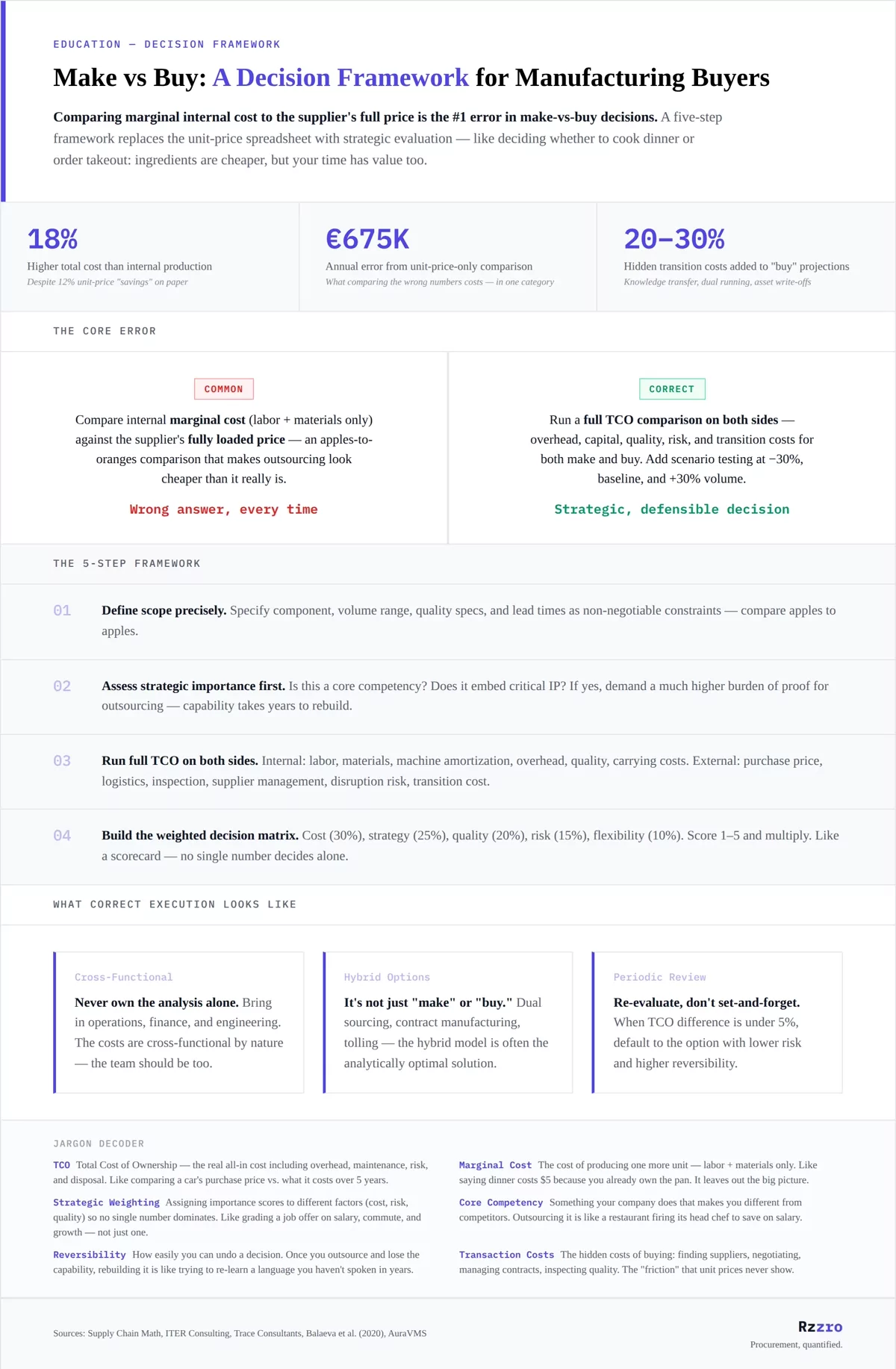
Comparing marginal internal cost to the supplier's full price is the #1 error in make-vs-buy decisions. A five-step framework replaces the unit-price spreadsheet with strategic evaluation — like deciding whether to cook dinner or order takeout: ingredients are cheaper, but your time has value too.
18%
Higher total cost than internal production
Despite 12% unit-price "savings" on paper
€675K
Annual error from unit-price-only comparison
What comparing the wrong numbers costs — in one category
20–30%
Hidden transition costs added to "buy" projections
Knowledge transfer, dual running, asset write-offs
Common
Compare internal marginal cost (labor + materials only) against the supplier's fully loaded price — an apples-to-oranges comparison that makes outsourcing look cheaper than it really is.
Wrong answer, every time
Correct
Run a full TCO comparison on both sides — overhead, capital, quality, risk, and transition costs for both make and buy. Add scenario testing at −30%, baseline, and +30% volume.
Strategic, defensible decision
01
Define scope precisely. Specify component, volume range, quality specs, and lead times as non-negotiable constraints — compare apples to apples.
02
Assess strategic importance first. Is this a core competency? Does it embed critical IP? If yes, demand a much higher burden of proof for outsourcing — capability takes years to rebuild.
03
Run full TCO on both sides. Internal: labor, materials, machine amortization, overhead, quality, carrying costs. External: purchase price, logistics, inspection, supplier management, disruption risk, transition cost.
04
Build the weighted decision matrix. Cost (30%), strategy (25%), quality (20%), risk (15%), flexibility (10%). Score 1–5 and multiply. Like a scorecard — no single number decides alone.
Cross-Functional
Never own the analysis alone. Bring in operations, finance, and engineering. The costs are cross-functional by nature — the team should be too.
Hybrid Options
It's not just "make" or "buy." Dual sourcing, contract manufacturing, tolling — the hybrid model is often the analytically optimal solution.
Periodic Review
Re-evaluate, don't set-and-forget. When TCO difference is under 5%, default to the option with lower risk and higher reversibility.
Jargon Decoder
TCO Total Cost of Ownership — the real all-in cost including overhead, maintenance, risk, and disposal. Like comparing a car's purchase price vs. what it costs over 5 years.
Marginal Cost The cost of producing one more unit — labor + materials only. Like saying dinner costs $5 because you already own the pan. It leaves out the big picture.
Strategic Weighting Assigning importance scores to different factors (cost, risk, quality) so no single number dominates. Like grading a job offer on salary, commute, and growth — not just one.
Core Competency Something your company does that makes you different from competitors. Outsourcing it is like a restaurant firing its head chef to save on salary.
Reversibility How easily you can undo a decision. Once you outsource and lose the capability, rebuilding it is like trying to re-learn a language you haven't spoken in years.
Transaction Costs The hidden costs of buying: finding suppliers, negotiating, managing contracts, inspecting quality. The "friction" that unit prices never show.
Sources: Supply Chain Math, ITER Consulting, Trace Consultants, Balaeva et al. (2020), AuraVMS
Rzzro
Procurement, quantified.