Download PNG (960px)
Education — Concept

Index-Based Pricing: How to Run It Correctly

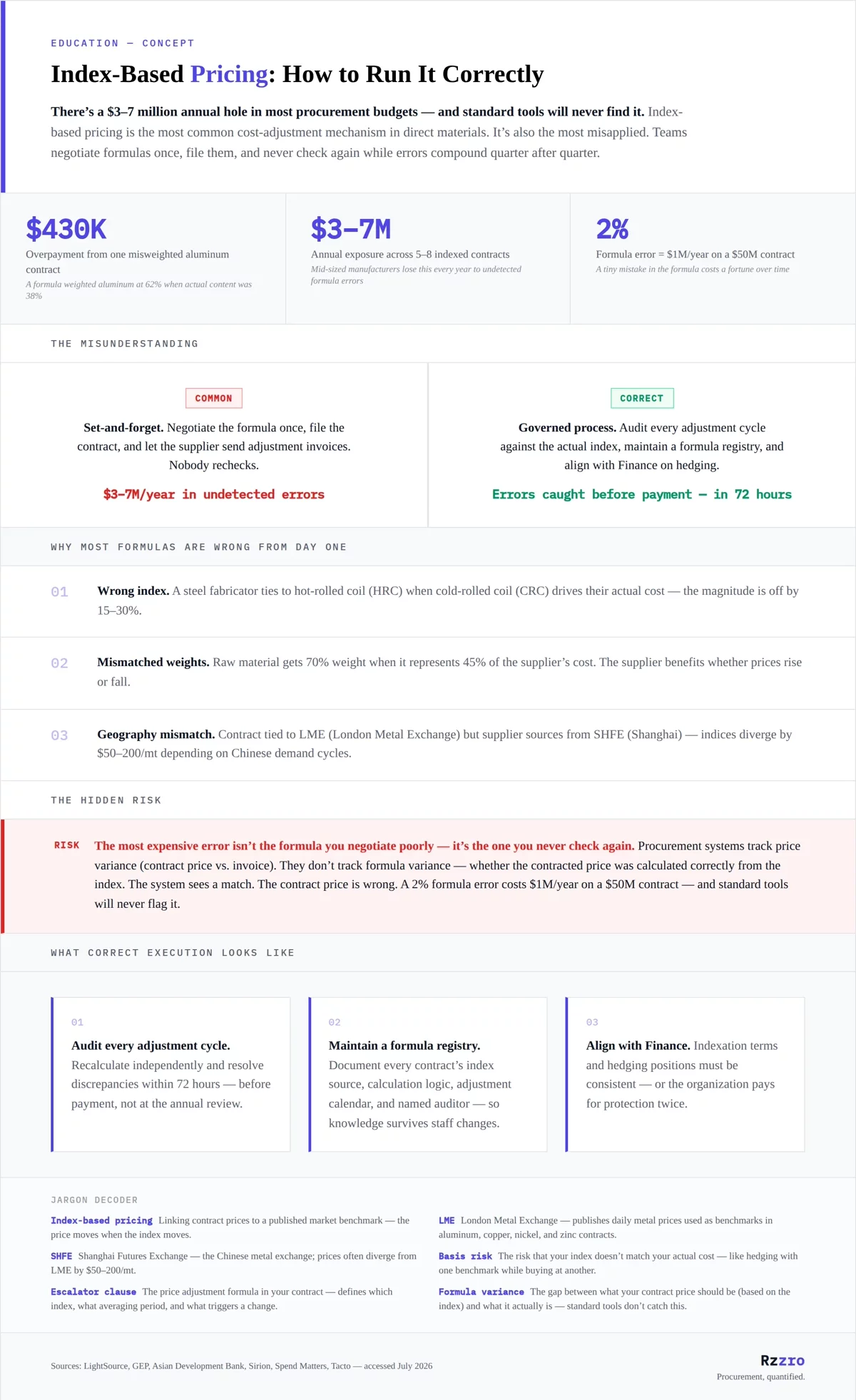
There’s a $3–7 million annual hole in most procurement budgets — and standard tools will never find it. Index-based pricing is the most common cost-adjustment mechanism in direct materials. It’s also the most misapplied. Teams negotiate formulas once, file them, and never check again while errors compound quarter after quarter.
$430K
Overpayment from one misweighted aluminum contract
A formula weighted aluminum at 62% when actual content was 38%
$3–7M
Annual exposure across 5–8 indexed contracts
Mid-sized manufacturers lose this every year to undetected formula errors
2%
Formula error = $1M/year on a $50M contract
A tiny mistake in the formula costs a fortune over time
Common
Set-and-forget. Negotiate the formula once, file the contract, and let the supplier send adjustment invoices. Nobody rechecks.
$3–7M/year in undetected errors
Correct
Governed process. Audit every adjustment cycle against the actual index, maintain a formula registry, and align with Finance on hedging.
Errors caught before payment — in 72 hours
01
Wrong index. A steel fabricator ties to hot-rolled coil (HRC) when cold-rolled coil (CRC) drives their actual cost — the magnitude is off by 15–30%.
02
Mismatched weights. Raw material gets 70% weight when it represents 45% of the supplier’s cost. The supplier benefits whether prices rise or fall.
03
Geography mismatch. Contract tied to LME (London Metal Exchange) but supplier sources from SHFE (Shanghai) — indices diverge by $50–200/mt depending on Chinese demand cycles.
Risk
The most expensive error isn’t the formula you negotiate poorly — it’s the one you never check again. Procurement systems track price variance (contract price vs. invoice). They don’t track formula variance — whether the contracted price was calculated correctly from the index. The system sees a match. The contract price is wrong. A 2% formula error costs $1M/year on a $50M contract — and standard tools will never flag it.
01
Audit every adjustment cycle. Recalculate independently and resolve discrepancies within 72 hours — before payment, not at the annual review.
02
Maintain a formula registry. Document every contract’s index source, calculation logic, adjustment calendar, and named auditor — so knowledge survives staff changes.
03
Align with Finance. Indexation terms and hedging positions must be consistent — or the organization pays for protection twice.
Jargon Decoder
Index-based pricing Linking contract prices to a published market benchmark — the price moves when the index moves.
LME London Metal Exchange — publishes daily metal prices used as benchmarks in aluminum, copper, nickel, and zinc contracts.
SHFE Shanghai Futures Exchange — the Chinese metal exchange; prices often diverge from LME by $50–200/mt.
Basis risk The risk that your index doesn’t match your actual cost — like hedging with one benchmark while buying at another.
Escalator clause The price adjustment formula in your contract — defines which index, what averaging period, and what triggers a change.
Formula variance The gap between what your contract price should be (based on the index) and what it actually is — standard tools don’t catch this.
Sources: LightSource, GEP, Asian Development Bank, Sirion, Spend Matters, Tacto — accessed July 2026
Rzzro
Procurement, quantified.