Download WebP (960×auto)
Education — Framework

Early Supplier Involvement: A Framework Walkthrough

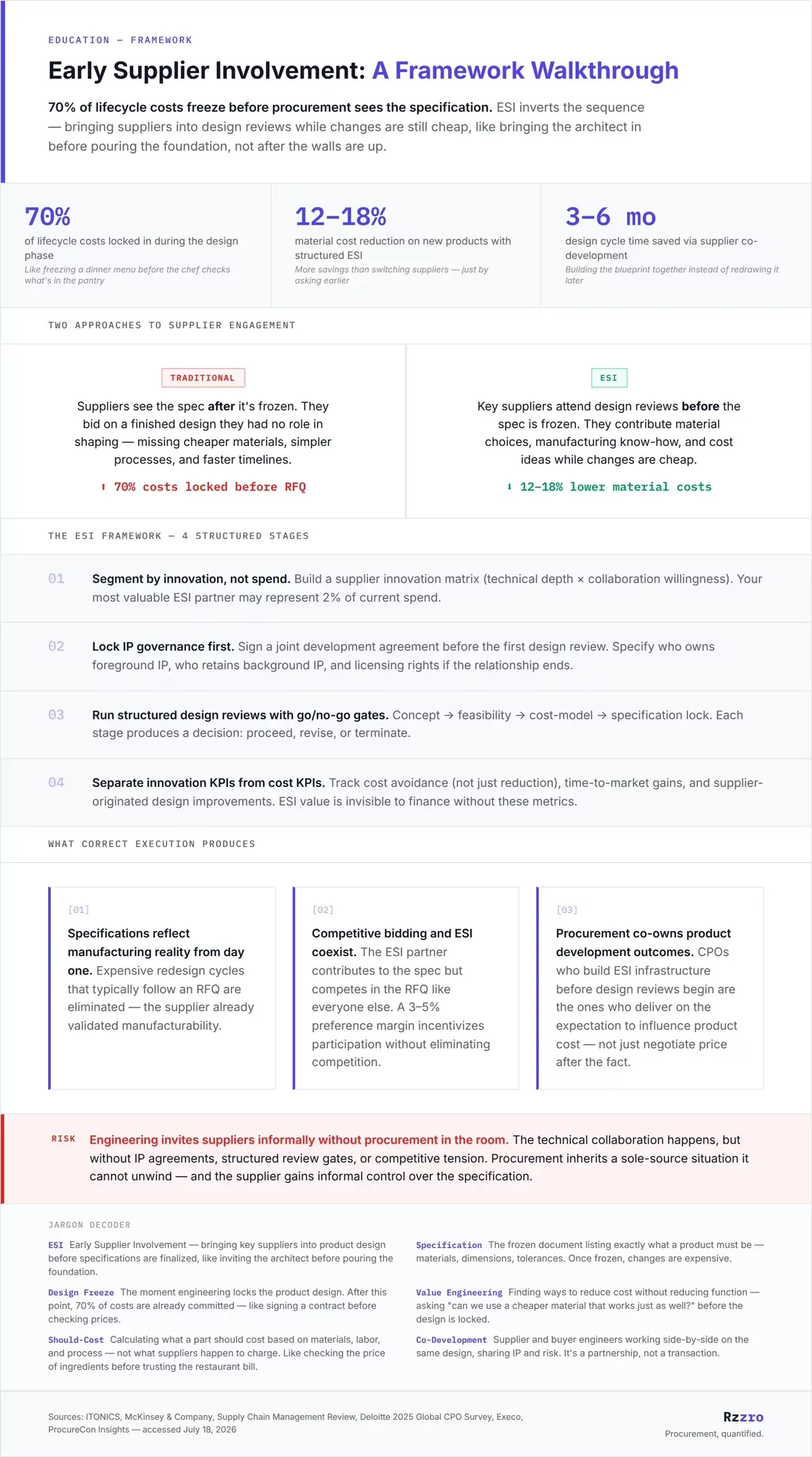
70% of lifecycle costs freeze before procurement sees the specification. ESI inverts the sequence — bringing suppliers into design reviews while changes are still cheap, like bringing the architect in before pouring the foundation, not after the walls are up.
70%
of lifecycle costs locked in during the design phase
Like freezing a dinner menu before the chef checks what's in the pantry
12–18%
material cost reduction on new products with structured ESI
More savings than switching suppliers — just by asking earlier
3–6 mo
design cycle time saved via supplier co-development
Building the blueprint together instead of redrawing it later
Traditional
Suppliers see the spec after it's frozen. They bid on a finished design they had no role in shaping — missing cheaper materials, simpler processes, and faster timelines.
⬆ 70% costs locked before RFQ
ESI
Key suppliers attend design reviews before the spec is frozen. They contribute material choices, manufacturing know-how, and cost ideas while changes are cheap.
⬇ 12–18% lower material costs
01
Segment by innovation, not spend. Build a supplier innovation matrix (technical depth × collaboration willingness). Your most valuable ESI partner may represent 2% of current spend.
02
Lock IP governance first. Sign a joint development agreement before the first design review. Specify who owns foreground IP, who retains background IP, and licensing rights if the relationship ends.
03
Run structured design reviews with go/no-go gates. Concept → feasibility → cost-model → specification lock. Each stage produces a decision: proceed, revise, or terminate.
04
Separate innovation KPIs from cost KPIs. Track cost avoidance (not just reduction), time-to-market gains, and supplier-originated design improvements. ESI value is invisible to finance without these metrics.
[01]
Specifications reflect manufacturing reality from day one. Expensive redesign cycles that typically follow an RFQ are eliminated — the supplier already validated manufacturability.
[02]
Competitive bidding and ESI coexist. The ESI partner contributes to the spec but competes in the RFQ like everyone else. A 3–5% preference margin incentivizes participation without eliminating competition.
[03]
Procurement co-owns product development outcomes. CPOs who build ESI infrastructure before design reviews begin are the ones who deliver on the expectation to influence product cost — not just negotiate price after the fact.
Risk
Engineering invites suppliers informally without procurement in the room. The technical collaboration happens, but without IP agreements, structured review gates, or competitive tension. Procurement inherits a sole-source situation it cannot unwind — and the supplier gains informal control over the specification.
Jargon Decoder
ESI Early Supplier Involvement — bringing key suppliers into product design before specifications are finalized, like inviting the architect before pouring the foundation.
Specification The frozen document listing exactly what a product must be — materials, dimensions, tolerances. Once frozen, changes are expensive.
Design Freeze The moment engineering locks the product design. After this point, 70% of costs are already committed — like signing a contract before checking prices.
Value Engineering Finding ways to reduce cost without reducing function — asking "can we use a cheaper material that works just as well?" before the design is locked.
Should-Cost Calculating what a part should cost based on materials, labor, and process — not what suppliers happen to charge. Like checking the price of ingredients before trusting the restaurant bill.
Co-Development Supplier and buyer engineers working side-by-side on the same design, sharing IP and risk. It's a partnership, not a transaction.
Sources: ITONICS, McKinsey & Company, Supply Chain Management Review, Deloitte 2025 Global CPO Survey, Execo, ProcureCon Insights — accessed July 18, 2026
Rzzro
Procurement, quantified.