Download WebP
Education — Vocabulary

Cost Savings and Cost Avoidance: Tracking What Counts

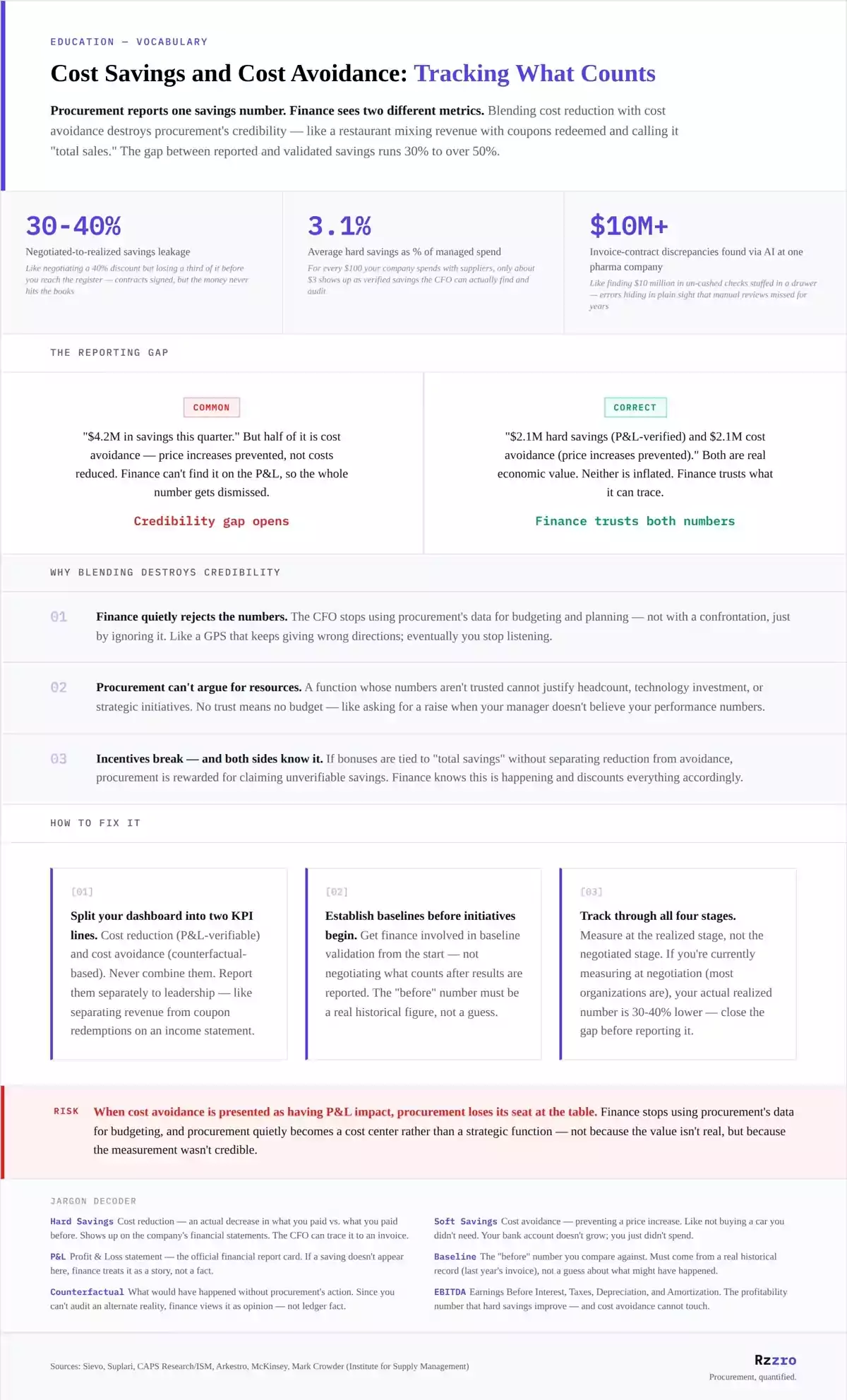
Procurement reports one savings number. Finance sees two different metrics. Blending cost reduction with cost avoidance destroys procurement's credibility — like a restaurant mixing revenue with coupons redeemed and calling it "total sales." The gap between reported and validated savings runs 30% to over 50%.
30-40%
Negotiated-to-realized savings leakage
Like negotiating a 40% discount but losing a third of it before you reach the register — contracts signed, but the money never hits the books
3.1%
Average hard savings as % of managed spend
For every $100 your company spends with suppliers, only about $3 shows up as verified savings the CFO can actually find and audit
$10M+
Invoice-contract discrepancies found via AI at one pharma company
Like finding $10 million in un-cashed checks stuffed in a drawer — errors hiding in plain sight that manual reviews missed for years
Common
"$4.2M in savings this quarter." But half of it is cost avoidance — price increases prevented, not costs reduced. Finance can't find it on the P&L, so the whole number gets dismissed.
Credibility gap opens
Correct
"$2.1M hard savings (P&L-verified) and $2.1M cost avoidance (price increases prevented)." Both are real economic value. Neither is inflated. Finance trusts what it can trace.
Finance trusts both numbers
01
Finance quietly rejects the numbers. The CFO stops using procurement's data for budgeting and planning — not with a confrontation, just by ignoring it. Like a GPS that keeps giving wrong directions; eventually you stop listening.
02
Procurement can't argue for resources. A function whose numbers aren't trusted cannot justify headcount, technology investment, or strategic initiatives. No trust means no budget — like asking for a raise when your manager doesn't believe your performance numbers.
03
Incentives break — and both sides know it. If bonuses are tied to "total savings" without separating reduction from avoidance, procurement is rewarded for claiming unverifiable savings. Finance knows this is happening and discounts everything accordingly.
[01]
Split your dashboard into two KPI lines. Cost reduction (P&L-verifiable) and cost avoidance (counterfactual-based). Never combine them. Report them separately to leadership — like separating revenue from coupon redemptions on an income statement.
[02]
Establish baselines before initiatives begin. Get finance involved in baseline validation from the start — not negotiating what counts after results are reported. The "before" number must be a real historical figure, not a guess.
[03]
Track through all four stages. Measure at the realized stage, not the negotiated stage. If you're currently measuring at negotiation (most organizations are), your actual realized number is 30-40% lower — close the gap before reporting it.
Risk
When cost avoidance is presented as having P&L impact, procurement loses its seat at the table. Finance stops using procurement's data for budgeting, and procurement quietly becomes a cost center rather than a strategic function — not because the value isn't real, but because the measurement wasn't credible.
Jargon Decoder
Hard SavingsCost reduction — an actual decrease in what you paid vs. what you paid before. Shows up on the company's financial statements. The CFO can trace it to an invoice.
Soft SavingsCost avoidance — preventing a price increase. Like not buying a car you didn't need. Your bank account doesn't grow; you just didn't spend.
P&LProfit & Loss statement — the official financial report card. If a saving doesn't appear here, finance treats it as a story, not a fact.
BaselineThe "before" number you compare against. Must come from a real historical record (last year's invoice), not a guess about what might have happened.
CounterfactualWhat would have happened without procurement's action. Since you can't audit an alternate reality, finance views it as opinion — not ledger fact.
EBITDAEarnings Before Interest, Taxes, Depreciation, and Amortization. The profitability number that hard savings improve — and cost avoidance cannot touch.
Sources: Sievo, Suplari, CAPS Research/ISM, Arkestro, McKinsey, Mark Crowder (Institute for Supply Management)
Rzzro
Procurement, quantified.