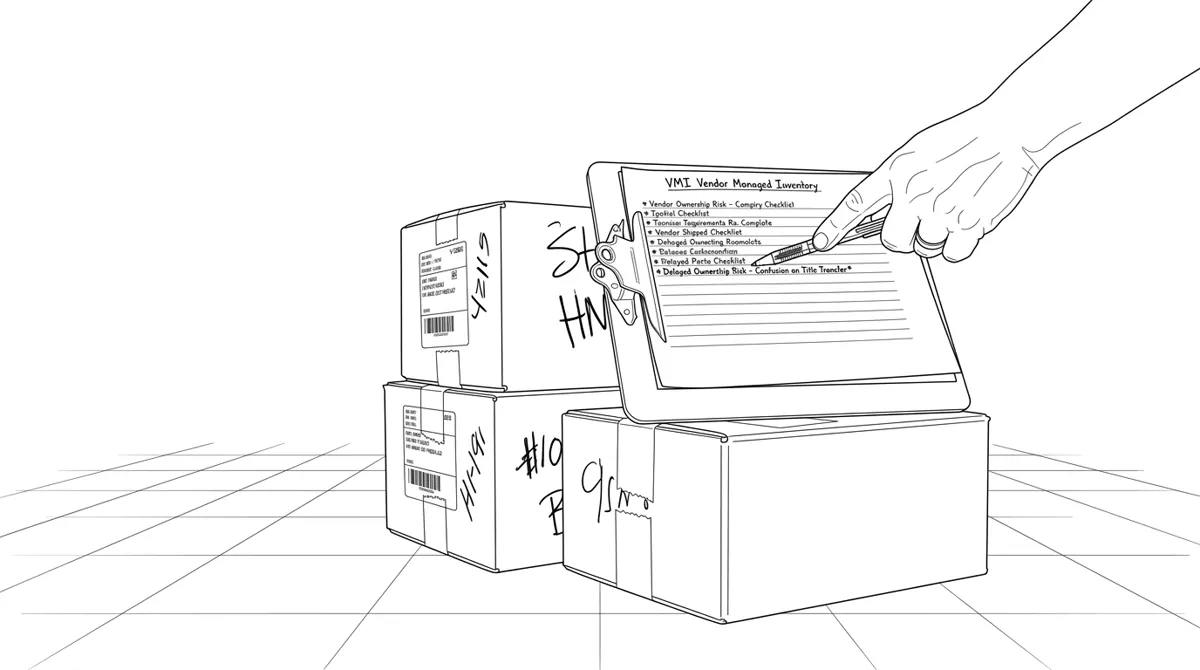
Vendor-managed inventory sounds like a clean deal. The supplier monitors your stock, triggers replenishment, and keeps the shelves full. Your team stops issuing purchase orders for those SKUs. Everyone wins.
That is not how most VMI agreements actually work. The gap between what procurement teams expect and what the contract says is large enough to absorb years of supposed savings in a single write-off event. The confusion traces to one question most buyers never ask explicitly: who owns the stock?
The precise definition: what VMI actually transfers
VMI is a supply chain model where the supplier assumes responsibility for monitoring inventory levels and initiating replenishment orders on the buyer's behalf. The buyer shares consumption data, demand forecasts, and agreed min/max stock parameters. The supplier decides when and how much to ship.
What VMI transfers is the replenishment decision. What it does not transfer — unless explicitly contracted otherwise — is the ownership consequence. Title, inventory risk, shrinkage liability, obsolescence cost, and working capital burden are all separate contractual questions. They do not default to the supplier just because the supplier is placing the orders.
There are two dominant ownership models. In standard VMI, title transfers on delivery to the buyer's site. The inventory sits on the buyer's balance sheet. The buyer absorbs shrinkage, obsolescence, and dead stock. In consignment VMI, the supplier retains ownership until the buyer consumes or sells the goods. The supplier's balance sheet carries the stock until that point. Same operational model — completely different financial outcomes.
The two VMI models buyers conflate
Supplier owns the stock and carries all risk. Inventory sits on supplier's books. Shrinkage, obsolescence, and dead stock are the supplier's problem.
Title transfers on delivery. Buyer owns the stock on receipt. The buyer absorbs shrinkage, obsolescence, and dead stock costs. Only the ordering decision moved to the supplier.
Consignment VMI shifts the ownership transfer point to consumption or sale. The vendor retains legal title until the buyer uses the goods. This moves inventory off the buyer's balance sheet — a genuine working capital improvement. But it also raises governance requirements: someone must own shrinkage, obsolescence, and returns. The vendor has no incentive to minimize losses the buyer physically controls unless the contract specifies count frequency, variance responsibility, and audit rights.
The global VMI market reached $4.12 billion in 2024 and is projected to grow at 11.3% annually through 2033, according to DataIntelo. As adoption accelerates, the number of organizations signing VMI agreements without understanding the ownership structure is almost certainly growing with it.
The most common failure: treating VMI as risk transfer
The single most pervasive VMI failure is not technical. It is contractual. Organizations sign VMI agreements believing the supplier now bears all inventory risk — shrinkage, obsolescence, damage, demand volatility — without verifying the title-transfer clause.
This manifests in four specific ways. First, buyers adopt a hands-off posture, assuming the vendor manages everything. They stop tracking inventory accuracy, stop auditing consumption data, and stop reviewing replenishment parameters. When a write-off hits, they discover they were carrying the risk the entire time.
Second, organizations implement VMI without defining what happens to remaining stock at contract termination. Who pays for buy-backs? Who absorbs markdowns? How is excess and obsolete disposition handled? Without closeout provisions, stranded inventory becomes a post-mortem dispute.
Third, even in consignment VMI where the vendor retains title, organizations fail to specify shrinkage governance: count frequency, variance responsibility, and who audits. The vendor has no incentive to minimize losses the buyer physically controls.
Fourth, buyers misunderstand the working capital impact. Standard VMI does not improve the buyer's balance sheet — the inventory still sits there. Only consignment VMI shifts the asset off the buyer's books. NC State's Supply Chain Resource Cooperative identifies communication breakdowns as the most common cause of VMI failure, citing the gap between what each party believes the other is responsible for.
What correct execution looks like
Organizations that run VMI successfully treat it as a governed partnership, not a handoff. They separate the replenishment agreement from the ownership agreement and contract both explicitly. The VMI agreement covers replenishment parameters: min/max levels, service-level KPIs, data-sharing infrastructure, and joint governance through regular S&OP reviews.
A separate ownership schedule defines title transfer point, shrinkage liability, obsolescence cost-sharing, damage responsibility, and closeout mechanics. Nothing is assumed. Everything is explicit.
The Council of Supply Chain Management Professionals found that effective VMI implementation can reduce inventory costs by up to 20%. But that saving materializes through better replenishment decisions — smaller, more frequent orders that match actual consumption — not through offloading inventory risk to the supplier. The organizations capturing that 20% are the ones that understand the distinction.
Lean Supply Solutions identifies three additional failure modes in VMI programs that survive the ownership question. Silent overrides: buyer planners maintain shadow ordering systems and secretly override vendor replenishment. Vendor complacency: suppliers treat VMI as autopilot and stop optimizing. Misaligned incentives: vendors push volume above agreed maxima because they are compensated on throughput, not inventory efficiency.
What this means in practice
- Audit your active VMI agreements. For each one, identify the exact title-transfer point in the contract. If it is not explicitly defined, it defaults to delivery — and you own the inventory.
- Separate the replenishment agreement from the ownership schedule. These are two different contracts serving two different purposes. Negotiate them separately.
- Define closeout terms before you need them. Specify who buys back remaining stock, who absorbs markdowns, and how excess inventory is handled at termination.
- Establish shrinkage governance for consignment VMI. Specify count frequency, variance responsibility, audit rights, and financial treatment of losses. The vendor must have skin in the game.
- Track inventory accuracy month over month after VMI go-live. A decline signals either silent overrides by your own planners or vendor complacency. Investigate immediately.
Frequently asked questions
Does VMI always improve working capital?
No. Standard VMI leaves inventory on the buyer's balance sheet — the working capital position is unchanged. Consignment VMI shifts inventory off the buyer's books because title transfers on consumption, not delivery. Organizations that confuse the two models report surprise balance-sheet impacts after go-live.
What happens to excess stock when a VMI contract ends?
It depends entirely on what the contract says. Without explicit closeout provisions — buy-back obligations, markdown responsibility, disposition handling — excess stock becomes a dispute. ProProcurement recommends defining return, transfer, and billing terms for remaining stock at project closeout, especially when consignment is involved.
How long do VMI programs typically last before failing?
Programs that collapse typically do so within 12 to 24 months. The failure is rarely sudden. Poorly set min/max parameters, neglected KPI reviews, and unaddressed shadow ordering accumulate gradually until a major service failure or inventory write-off forces reversion to manual ordering.
Sources
- Wolverine LLC — VMI: Vendor-Managed Inventory. Ownership model comparison and title-transfer analysis. Accessed July 19, 2026.
- Lean Supply Solutions — Navigating Pitfalls: Common VMI Challenges and Mitigation Strategies. Silent overrides, vendor complacency, and misaligned incentives. Accessed July 19, 2026.
- ProProcurement — Vendor-Managed Inventory (VMI). Closeout provisions, consignment governance, and ownership accountability. Accessed July 19, 2026.
- Number Analytics — VMI Supply Chains and Firm Performance. CSCMP benchmark: up to 20% inventory cost reduction. Accessed July 19, 2026.
- NC State SCM — VMI: Three Steps in Making It Work. Communication breakdowns as primary failure driver. Accessed July 19, 2026.
- Slimstock — Vendor-Managed Inventory. Legal ownership as the central question in VMI agreements. Accessed July 19, 2026.