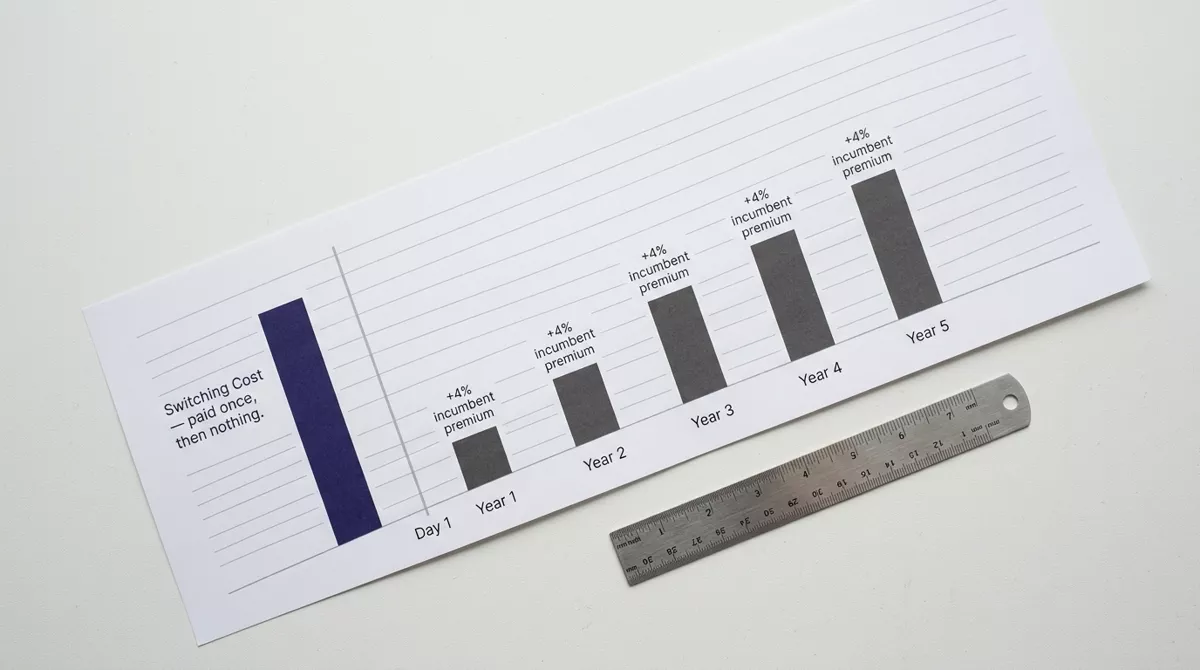
Ask a category manager why they have not switched suppliers in five years, and the answer is almost always the same: "The switching costs are too high." The onboarding, the qualification, the integration, the learning curve — it all sounds expensive enough to justify staying. The logic is intuitive. It is also wrong in more cases than most procurement teams realize.
Supplier switching costs are real. They are also finite, one-time, and amortizable. The costs of not switching — price creep, performance decay, innovation stagnation — are invisible, recurring, and compounding. Most organizations compare the one-time switching cost against zero rather than against the ongoing premium they pay for incumbency. When both sides of the equation are calculated, the myth collapses.
Why the myth has a valid origin
The belief that switching is always more expensive did not come from nowhere. Supplier qualification in regulated industries is genuinely costly — pharmaceutical GMP audits, aerospace AS9100 certifications, and automotive IATF 16949 approvals require significant investment. Technical transition costs in manufacturing — retooling, revalidation, first-article inspection — can run into six figures for complex components. These are not imaginary barriers.
But they are also infrequent, category-specific, and amortizable across the new contract term. A €50,000 transition cost on a €2 million annual spend contract amortizes to 2.5% in year one and zero in subsequent years. If the incumbent is charging 5% above market — a conservative estimate for categories that have not been rebid in three years — switching pays back in six months and generates net savings for the remaining contract life.
Where the myth breaks down: the hidden costs of staying
The most dangerous cost in procurement is the one you stop measuring. Incumbent suppliers, left unchallenged across multiple contract cycles, impose three compounding costs that do not appear on any invoice line.
First: price creep. Without competitive pressure, annual increases of 3-7% become routine. A 4% annual increase on a €1 million contract compounds to €1.17 million by year four — €170,000 in incremental spend that a competitive rebid would likely have eliminated. The incumbent's pricing drifts upward because no signal tells it to stop.
Second: performance decay. Suppliers that know they face no competitive threat optimize for margin, not service. SLA compliance drifts from 98% to 94% to "we stopped tracking." Response times lengthen. Innovation proposals stop arriving. The supplier's A-team moves to contested accounts; the B-team handles yours. Each degradation is individually small enough to ignore. Collectively, they represent a material cost that switching would eliminate.
Third: innovation loss. A supplier that competes for your business brings new technologies, process improvements, and cost-reduction ideas to every quarterly review. A supplier that owns your business brings the minimum required to avoid a conversation. The innovation deficit is hardest to quantify — but organizations that benchmark new suppliers against incumbents consistently find capability gaps that the relationship itself had hidden.
Supplier search and evaluation, qualification and onboarding (€2K-€15K), technical transition and integration, initial learning curve. Amortizes to zero after transition period.
Annual price creep of 3-7%, degrading SLA performance, innovation deficit, reduced service quality. Compounds annually without limit. Typically exceeds switching costs within 18 months.
What the data shows about switching outcomes
In regulated industries, robust supplier qualification programs cut defect-related costs by roughly 30% over three years and reduce recall probability by over 40%, according to pharmaceutical industry data. The qualification cost is not just a switching barrier — it is a quality investment that pays back regardless of which supplier you choose.
Multiple studies across commercial procurement show that structured competitive rebidding — not even full switching, just the credible threat of it — produces 5-15% in cost reductions from incumbents alone. The savings materialize before a single new supplier is onboarded, because the competitive tension changes the negotiation dynamics.
The math that most teams skip
The calculation is two numbers: the one-time switching cost amortized over the expected new contract term, and the annual incumbent premium multiplied by the remaining contract years. If the premium outpaces the amortized switching cost, staying is the expensive decision.
Example: a €500,000 annual spend category with a 5% incumbent premium (€25,000 per year). Switching cost is €30,000 for qualification, transition, and integration. Year one: switching costs €30,000, staying costs €25,000 — staying looks cheaper. Year two: switching costs zero (already amortized), staying costs another €25,000. By the end of year two, switching has saved €20,000. By year five, switching has saved €95,000. The total cost of staying is €125,000 in unnecessary premiums.
What correct execution looks like
Organizations that make sharp switching decisions do not guess at the numbers. They maintain a switching cost model per category that includes search, qualification, technical transition, integration, and relationship ramp-up. They benchmark incumbent pricing against market rates annually — not at renewal, but as a standing practice. And they calculate the stay-vs-switch breakeven point for every strategic supplier at least once per contract cycle.
Critically, they do not treat switching as a binary decision. Partial switching — moving one product line, one geography, or one service tier to a new supplier — reduces transition risk while generating competitive data that improves the incumbent relationship. A credible partial switch often produces better results than a hypothetical full switch, because the incumbent responds to the signal.
- Build a per-category switching cost model: search, qualification, transition, integration, ramp-up — amortized over expected contract term
- Benchmark incumbent pricing against market rates annually, not just at renewal
- Calculate the stay-vs-switch breakeven for every strategic supplier at least once per contract cycle
- Consider partial switching — moving one product line or geography — to reduce risk while generating competitive tension
- Track price creep by supplier: a 3% annual increase on an uncontested category is a signal, not a rounding error
FAQ
Are switching costs the same across all categories?
No. Switching costs range from negligible (commodity indirects like office supplies) to substantial (regulated direct materials requiring revalidation). The stay-vs-switch calculation must be category-specific. In low-complexity categories, the switching cost is often less than one month of incumbent premiums.
Does switching always mean terminating the incumbent?
No. Partial switching — moving a portion of volume to a new supplier while retaining the incumbent — is often the optimal strategy. It reduces concentration risk, generates competitive benchmarking data, and creates leverage for renegotiation with the incumbent. The credible threat of switching often produces savings without the full transition cost.