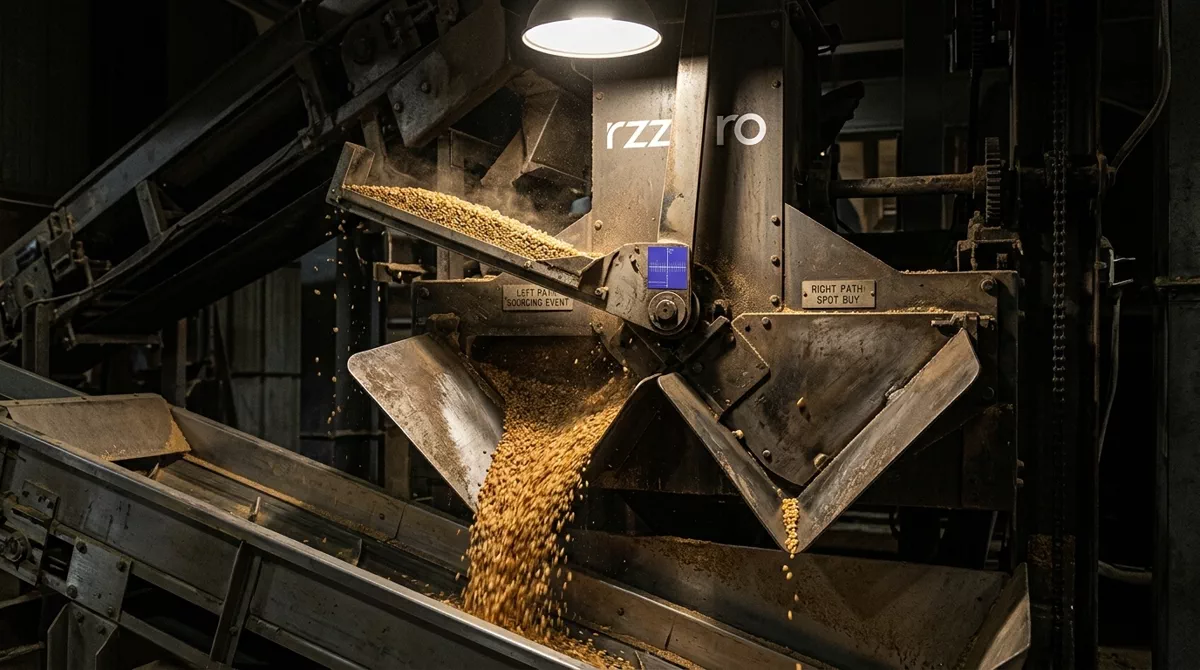
Every buyer makes the sourcing-event-versus-spot-buy decision dozens of times a year. Most make it the same way: a gut check on how much the spend is worth, how much time they have, and whether anyone is watching. The result is predictable inconsistency. High-value categories get spot-bought because the requisition arrived late. Low-value categories get full RFPs because someone asked for three bids and no one questioned it.
Industry benchmarks suggest companies save 10-15% on purchasing costs through structured strategic sourcing, according to Spendesk's 2026 procurement strategy guide. But the cost of running a full sourcing event — staff time, systems, stakeholder alignment, and timeline delay — is rarely weighed against the expected savings. The decision framework below makes the trade-off explicit.
The variables that matter
Four variables determine whether a sourcing event is worth the cost. Each should be scored independently before any decision is made.
Annual spend. The single strongest predictor of whether competitive bidding will produce meaningful savings. A $500,000 category with 8% savings potential returns $40,000. A $5,000 category with the same savings rate returns $400. The process cost is roughly the same in both cases — three to five staff days plus system and delay costs. The breakeven threshold varies by organization, but most procurement teams find the crossover point between $25,000 and $50,000 in annual spend.
Supply risk. A $10,000 sole-source component that stops production if it fails carries more risk than a $200,000 commodity available from twelve suppliers. Risk should be scored on two dimensions: the probability of disruption and the business impact if it occurs. A category with high supply risk justifies a sourcing event even at relatively low spend levels because the event itself — supplier qualification, financial health checks, contingency planning — is a risk mitigation activity, not just a cost reduction exercise.
Market competitiveness. How many viable suppliers exist? A category with three qualified suppliers is worth a sourcing event. A category with one viable supplier and no substitutes is not — you are running a negotiation, not a competitive bid. The decision framework from the ISM supplier evaluation guide emphasizes that supplier selection should be anchored in market analysis before the RFx is designed.
Requirement duration. A one-time $30,000 purchase with no repeat demand is a spot buy candidate regardless of value. A $4,000 monthly recurring service that compounds to $48,000 annually and $144,000 over three years is a sourcing event candidate. Duration converts spot purchases into strategic commitments. Buyers frequently underestimate this variable because the requisition shows the monthly or one-time figure, not the lifetime cost.
The variables that seem to matter but do not
Urgency. The most common override. A stakeholder submits a requisition marked urgent, and the buyer skips the sourcing process to meet the timeline. Here is the problem: procurement research consistently finds that urgency is manufactured by poor planning, not genuine operational need. Running a spot buy to meet an artificial deadline transfers the cost of the planning failure from the stakeholder to the P&L. The framework should treat urgency as a signal to investigate the planning process, not as a valid override.
Stakeholder preference. A stakeholder wants a specific supplier. That is a preference, not a sourcing decision. If the category is large enough to justify a sourcing event, run it. The preferred supplier can participate. If they are genuinely the best option, the process will confirm it. If they are not, the process will surface that and the stakeholder gets better data for their next request.
Process convenience. Some buyers default to spot buys because the sourcing event process in their organization is broken — six months of approvals, manual documentation, no e-sourcing tools. That is a process problem, not a decision problem. Fix the process. Do not let a dysfunctional sourcing workflow drive bad buying decisions.
The decision logic: a four-factor scoring model
Score each of the four real variables on a 1-5 scale. Multiply the scores. The resulting composite determines the sourcing approach.
Annual spend (1 = under $10K, 2 = $10-25K, 3 = $25-100K, 4 = $100-500K, 5 = $500K+).
Supply risk (1 = commodity, many suppliers, low disruption impact; 5 = sole source, no substitutes, stops production).
Market competitiveness (1 = one viable supplier; 5 = five or more qualified suppliers).
Requirement duration (1 = one-time purchase; 5 = multi-year recurring with compounding value).
Composite scoring: multiply all four scores. If the result is 100 or above, run a full sourcing event. Between 36 and 99, run a light sourcing process — request three quotes, benchmark pricing, document the rationale. Below 36, a structured spot buy with documented justification is appropriate.
Worked example: IT services contract
A category manager receives a request for a managed IT services contract. Annual spend is $85,000 (score: 3). The supplier is one of two qualified vendors in the region; switching would cause operational disruption (supply risk: 4). Three suppliers exist nationally but only two are local with adequate capability (market competitiveness: 3). The contract would be a three-year commitment (requirement duration: 4).
Composite: 3 × 4 × 3 × 4 = 144. Score is above 100. Full sourcing event justified. Expected savings at 10% on $85,000 annually over three years: $25,500. Process cost estimate: five staff days at internal cost of approximately $4,000 plus e-sourcing platform fees. Net value: roughly $21,000. The framework confirms what the numbers suggest.
Contrast with a one-time $12,000 software license. Spend: 2. Risk: 1 (multiple alternatives, no production dependency). Market: 5. Duration: 1. Composite: 2 × 1 × 5 × 1 = 10. Below 36. Structured spot buy with documented price benchmarking is the right call. Running a three-month RFP for this would cost more in staff time than the expected savings.
What correct execution looks like
Organizations that make this decision consistently build the scoring model into their intake process. When a requisition arrives, the system prompts for the four variables before routing. If the composite is above 100, it routes to the strategic sourcing team. If below 36, it routes to tactical buying with a required price benchmark. If between 36 and 99, it routes to a light sourcing workflow with a shorter timeline and fewer required steps.
The Hackett Group's 2024 research found procurement professionals ranked data analytics as their top priority for improvement initiatives in 2025. A sourcing threshold framework is the simplest analytics implementation with the highest return. It requires no new software. It requires four questions and a multiplication. The barrier is organizational, not technical.
Operational checklist
- Map the last 20 sourcing decisions your team made. Classify each as sourcing event, light sourcing, or spot buy. Identify which decisions would have changed under the scoring model.
- Calculate the process cost of running a full sourcing event in your organization. Include staff hours, system costs, and average timeline in days. This is your breakeven benchmark.
- Define the four scoring thresholds for your organization. The 1-5 scales described above are starting points. Adjust the dollar bands and risk definitions to match your industry and spend profile.
- Add the four scoring questions to your intake form or requisition workflow. Automation is ideal. A shared spreadsheet with conditional formatting works for teams under 50 people.
- Review sourcing decisions quarterly against the framework. Track how many decisions followed the model and how many overrode it. The override rate is your adoption metric.
- Audit spot buys over $25,000 quarterly. High-value spot buys are the leading indicator that the intake process is being bypassed. Each one is a sourcing event that should have happened.
The most common failure mode: urgency override
The framework produces a clear answer. The composite says "run a sourcing event." Then the stakeholder says the project starts next month, the budget expires this quarter, or the incumbent supplier is already performing the work on an expired contract. The buyer overrides the framework and processes a spot buy.
Every override is data. Track the override rate by stakeholder and by category. A stakeholder with a 40% override rate has a planning problem. A category with a 50% override rate has a demand forecasting problem. The framework does not eliminate overrides. It makes them visible, countable, and attributable. That visibility is what drives process change.
Frequently asked questions
When should procurement run a full sourcing event instead of a spot buy?
Run a full sourcing event when annual spend exceeds a defined threshold, the category carries supply risk, multiple viable suppliers exist, and the requirement is recurring. A scored framework weighing these four variables against process cost makes the decision repeatable and defensible.
What is the risk of using too many spot buys?
Spot buys fragment spend, erode volume leverage, introduce inconsistent pricing, and bypass supplier qualification and compliance checks. Organizations that spot-buy more than 20% of addressable spend typically leave 5-10% of procurement savings unrealized.
How do you calculate whether a sourcing event is worth the cost?
Compare expected savings from competitive bidding (typically 8-15% on first-time events) against the internal cost of running the event. If expected savings exceed three times the process cost, the event is worth running. Below that threshold, a structured spot buy with price benchmarking is more efficient.
Data sources
- Spendesk, "How to Develop an Effective Procurement Strategy in 2026," 2026 — savings benchmarks and procurement trends. spendesk.com
- Institute for Supply Management, "Supplier Evaluation and Selection Criteria Guide," 2026 — supplier risk and evaluation methodology. ism.ws
- The Hackett Group, "2024 Key Issues Research: Procurement," 2024 — analytics priority rankings. thehackettgroup.com
- Spendflo, "12 Common Procurement Mistakes and How to Avoid Them in 2026," 2026 — auto-renewal and spot buy risks. spendflo.com
- Jaggaer, "Category Management in Procurement: Process and Best Practices," 2026 — sourcing event governance. jaggaer.com