The RFP process is the most used and most misused tool in procurement. Every category manager runs RFPs. Few run them the way the process was designed.
A well-designed RFP produces a transparent, defensible supplier selection. A collapsed RFP produces a short-term price decision at the cost of long-term value. The difference is not the tools or the budget. It is whether the category manager treats the RFP as a strategic instrument or a procurement formality. SpendQube's 2025 analysis notes that too many organizations treat RFPs as a commercial checklist: "get three quotes, pick the lowest price." Consultants, by contrast, use RFPs to test strategy, not just to compare bids.
Standard procurement RFPs take 4 to 8 weeks from issue to award. Yet most of that time is spent on steps that should take hours. A structured, front-loaded process consistently produces better outcomes in less calendar time than an unstructured one.
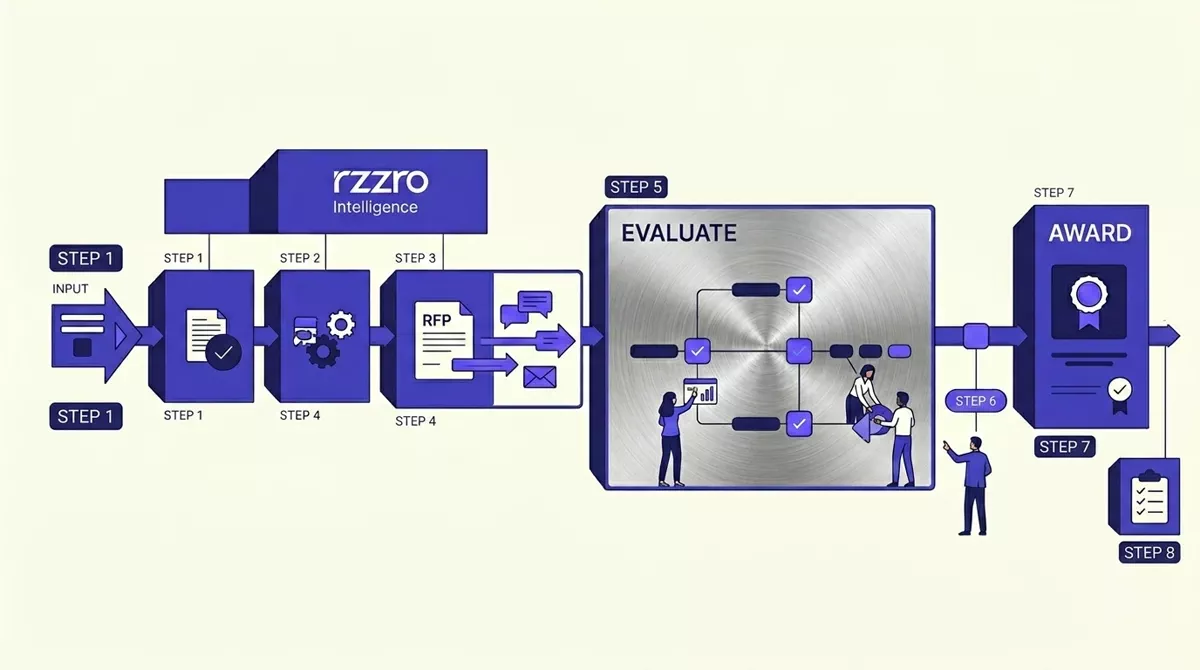
This walkthrough covers the eight core steps, what each produces, and what breaks when you skip it.
Step 1: opportunity identification and spend analysis
Before drafting anything, the category manager must answer the question: is this category best served by a competitive RFP, or would an RFI, an RFQ, or a direct award produce better results? The RFP is not the default instrument for every sourcing event. It is most appropriate when the solution is complex, the market has multiple capable suppliers, and a structured evaluation is needed to compare them.
This step produces a sourcing strategy and a high-level scope. It includes a spend analysis of the category to establish current volumes, prices, and total cost baseline. Without this step, teams jump straight to drafting a document for a problem they have not defined.
What skipping it breaks: the category manager selects the wrong event type, invites the wrong supplier pool, and begins negotiating without knowing the baseline.
Step 2: stakeholder and governance setup
This is the step most teams collapse or skip. Procurement drafts the RFP in isolation and brings in stakeholders only when responses arrive. By then, misalignment is already baked in.
The correct approach: identify end-users, technical SMEs, finance, legal, risk, and IT before the RFP is written. Define decision rights. Book evaluators' time for the scoring window. Sievo's RFP guide emphasizes that this stage, called front-end loading, sets the tone for the entire procurement process. A confirmed evaluation committee and a clear RACI chart are the outputs.
What skipping it breaks: the evaluation stage produces re-litigation of requirements, internal blockers at award, and resistance to the chosen supplier.
Step 3: requirements gathering and scope definition
Conduct workshops with stakeholders. Interview end-users. Document current service levels, pain points, and desired outcomes. Separate must-haves from nice-to-haves. Define volumes, service levels, compliance and security requirements, and commercial terms.
The output is a requirements pack and a draft scope of work. This document is the reference against which every supplier response will be evaluated. Vague requirements produce vague proposals. Specific requirements produce comparable proposals.
What skipping it breaks: suppliers submit bids against different interpretations of the need. The evaluation team compares apples to oranges. Scope creep and change orders follow.
Step 4: supplier longlist and shortlist
Conduct a market scan using supplier databases, internal vendor history, and industry intelligence. Qualify each candidate on size, capability, regulatory compliance, and financial stability. Produce a shortlist of no more than 6 to 8 suppliers for a typical category RFP.
SendEdge notes that many organizations send RFPs to a large number of suppliers hoping to find the best one. This produces evaluation overload, low response quality, and supplier fatigue. A curated shortlist consistently yields better proposals than a mass mailing.
What skipping it breaks: evaluators drown in responses from unqualified vendors. Strong suppliers may opt out, perceiving the competition as unfocused.
Step 5: RFP design and evaluation criteria
This step converts the requirements into a structured document. Sections should include business context and current challenges, project scope, functional and non-functional requirements, standardized pricing template with defined cost buckets, service levels and commercial terms, and published evaluation criteria with weights and scoring methodology.
Best-practice evaluation weights for complex categories: functionality 30-40 percent, price or TCO 25-35 percent, implementation and support 15-20 percent, risk and compliance 10-20 percent. Prokuria's guide warns that one of the biggest RFP headaches is comparing apples to oranges in pricing responses. A structured pricing sheet with predefined cost categories, editable fields, and space for volume discounts eliminates this.
What skipping it breaks: criteria defined after responses arrive leads to hidden bias, inconsistent scoring, and a perception of unfairness. Free-form pricing sheets make comparison impossible.
Step 6: issuance and supplier briefing
Distribute the RFP through an e-sourcing platform for audit trail and controlled communication. Hold a bidder kickoff call to confirm timelines, answer initial questions, and set expectations. Fast, consistent Q&A is critical. Centralize all questions through one channel; share all answers with every participating supplier.
What skipping it breaks: suppliers misinterpret requirements. Answers are inconsistent. Unequal information creates challenge risk and non-comparable proposals.
Step 7: evaluation and scoring
Two-stage evaluation is standard practice. Stage one: administrative screening and independent desk scoring using the published rubric. Each evaluator scores independently before any discussion. Stage two: shortlisted suppliers present demos or participate in structured trials. The same rubric applies to demo performance and written responses.
Routine.co recommends applying the same scoring rubric for RFP responses and demo performance, inviting finalists to hands-on trials, and observing end users completing key tasks without vendor assistance. This eliminates the gap between what a supplier promises in writing and what they deliver in practice.
What skipping it breaks: evaluation and negotiation blur together. Suppliers are "negotiated in" rather than passing objective criteria. Price alone carries the decision.
Step 8: award, debrief, and transition
Award documentation includes the scoring rationale, approved recommendation, and supplier debrief notes. Debrief both winners and losers. Document lessons learned and feed them back into the category strategy.
Step 8 also includes transition planning: handover to the contract owner, KPI setup, and supplier performance management. Invensis's analysis identifies poor post-award follow-up as one of the most common RFP mistakes. The process does not end at signature.
What skipping it breaks: benefits are not realized. Savings leak. The same mistakes repeat in the next RFP cycle.
The failure mode: collapsing steps 2 and 3
The most common failure across all categories and organization sizes is collapsing stakeholder setup and requirements gathering into a single step. Procurement drafts the RFP alone, using last year's template, and sends it to a list of suppliers inherited from the previous category manager. End-users, IT, and finance see the document only when responses arrive. The result is misaligned expectations, rework, and a supplier that serves nobody's needs well.
What this means in practice
- Before your next RFP, map the eight steps to a calendar. Block time for each step. The evaluation window is the one that will slip if not scheduled with evaluators before issuance.
- Hold a stakeholder kickoff workshop before drafting the first RFP section. Identify one person from each affected function. Their input costs one meeting. Skipping it costs the entire evaluation cycle.
- Publish evaluation criteria and weights in the RFP document. Suppliers who know how they will be rated submit more targeted proposals. Hidden criteria produce generic responses.
- Use a structured pricing template with defined cost categories. Every supplier submits in the same format or is excluded from the price comparison.
- Run the evaluation rubric past one test round before finalizing. Calibrate evaluators on what a score of 3 means versus a score of 4. Without calibration, scores vary by two points for the same response.
- Conduct structured debriefs after every RFP. Three questions: what worked, what did not, what would we change. Feed this into the category playbook before the next cycle.
What are the main steps in the RFP process?
The RFP process has 8 core steps: (1) opportunity identification and spend analysis, (2) stakeholder and governance setup, (3) requirements gathering and scope definition, (4) supplier longlist and shortlist, (5) RFP design with evaluation criteria, (6) issuance and supplier briefing, (7) evaluation and scoring, (8) award, debrief, and transition. Most teams collapse steps 2 and 3, creating misalignment that persists through the entire relationship.
Which RFP step do most procurement teams skip?
Most teams skip the stakeholder and governance setup step. Procurement drafts the RFP alone, and end-users, IT, risk, and finance are brought in only after responses arrive. This causes rework, delayed decisions, and internal blockers at the award stage. Sievo and SpendEdge both identify stakeholder alignment as the most commonly collapsed step.
How long does a well-run RFP process take?
A standard commercial RFP cycle takes 4 to 8 weeks from issue to award. Government RFPs can take several months. The biggest time sinks are unclear scope, slow Q&A responses, and evaluators who have not been briefed on scoring criteria. Well-run procurement teams with pre-assigned evaluators complete RFPs faster and with higher quality outcomes.
Sources
- Sievo — How to Run an RFP Process: Step-by-Step Guide
- SpendQube — RFP Process: A Complete Guide
- Invensis — What is the RFP Process? A 5-Step Guide
- Routine — RFP Process Explained: Steps, Best Practices
- Prokuria — A Modern 20-Step Guide for Procurement Teams
- SpendEdge — Avoid Common RFP Selection Process Errors
- Sifthub — Master the RFP Process