Download PNG (1920×4122)
Education — Concept

Payment Terms as a Procurement Lever: What Most Buyers Underuse

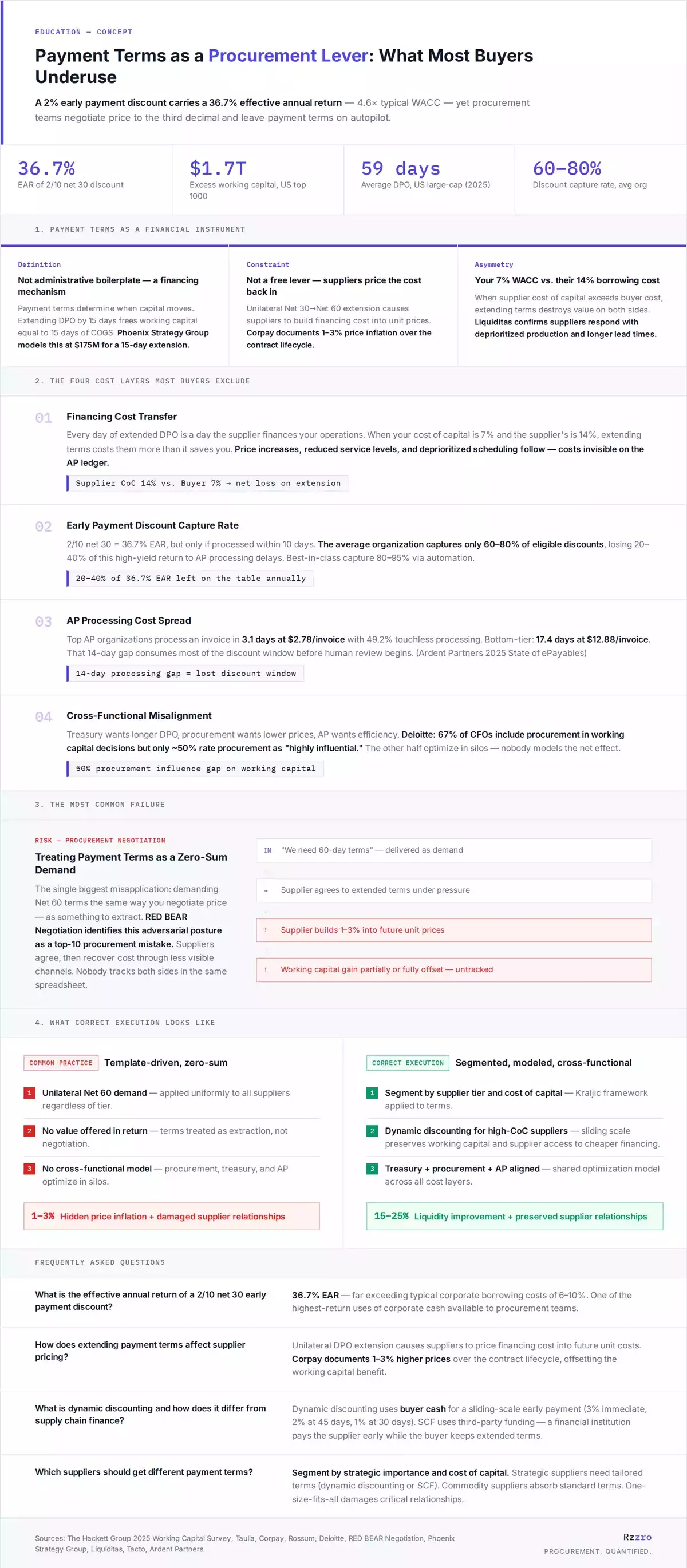
A 2% early payment discount carries a 36.7% effective annual return — 4.6× typical WACC — yet procurement teams negotiate price to the third decimal and leave payment terms on autopilot.
36.7%
EAR of 2/10 net 30 discount
$1.7T
Excess working capital, US top 1000
59 days
Average DPO, US large-cap (2025)
60–80%
Discount capture rate, avg org
Definition
Not administrative boilerplate — a financing mechanism
Payment terms determine when capital moves. Extending DPO by 15 days frees working capital equal to 15 days of COGS. Phoenix Strategy Group models this at $175M for a 15-day extension.
Constraint
Not a free lever — suppliers price the cost back in
Unilateral Net 30→Net 60 extension causes suppliers to build financing cost into unit prices. Corpay documents 1–3% price inflation over the contract lifecycle.
Asymmetry
Your 7% WACC vs. their 14% borrowing cost
When supplier cost of capital exceeds buyer cost, extending terms destroys value on both sides. Liquiditas confirms suppliers respond with deprioritized production and longer lead times.
01
Financing Cost Transfer
Every day of extended DPO is a day the supplier finances your operations. When your cost of capital is 7% and the supplier's is 14%, extending terms costs them more than it saves you. Price increases, reduced service levels, and deprioritized scheduling follow — costs invisible on the AP ledger.
Supplier CoC 14% vs. Buyer 7% → net loss on extension
02
Early Payment Discount Capture Rate
2/10 net 30 = 36.7% EAR, but only if processed within 10 days. The average organization captures only 60–80% of eligible discounts, losing 20–40% of this high-yield return to AP processing delays. Best-in-class capture 80–95% via automation.
20–40% of 36.7% EAR left on the table annually
03
AP Processing Cost Spread
Top AP organizations process an invoice in 3.1 days at $2.78/invoice with 49.2% touchless processing. Bottom-tier: 17.4 days at $12.88/invoice. That 14-day gap consumes most of the discount window before human review begins. (Ardent Partners 2025 State of ePayables)
14-day processing gap = lost discount window
04
Cross-Functional Misalignment
Treasury wants longer DPO, procurement wants lower prices, AP wants efficiency. Deloitte: 67% of CFOs include procurement in working capital decisions but only ~50% rate procurement as "highly influential." The other half optimize in silos — nobody models the net effect.
50% procurement influence gap on working capital
Risk — Procurement Negotiation
Treating Payment Terms as a Zero-Sum Demand
The single biggest misapplication: demanding Net 60 terms the same way you negotiate price — as something to extract. RED BEAR Negotiation identifies this adversarial posture as a top-10 procurement mistake. Suppliers agree, then recover cost through less visible channels. Nobody tracks both sides in the same spreadsheet.
IN "We need 60-day terms" — delivered as demand
Supplier agrees to extended terms under pressure
! Supplier builds 1–3% into future unit prices
! Working capital gain partially or fully offset — untracked
Common Practice
Template-driven, zero-sum
1
Unilateral Net 60 demand — applied uniformly to all suppliers regardless of tier.
2
No value offered in return — terms treated as extraction, not negotiation.
3
No cross-functional model — procurement, treasury, and AP optimize in silos.
1–3% Hidden price inflation + damaged supplier relationships
Correct Execution
Segmented, modeled, cross-functional
1
Segment by supplier tier and cost of capital — Kraljic framework applied to terms.
2
Dynamic discounting for high-CoC suppliers — sliding scale preserves working capital and supplier access to cheaper financing.
3
Treasury + procurement + AP aligned — shared optimization model across all cost layers.
15–25% Liquidity improvement + preserved supplier relationships
What is the effective annual return of a 2/10 net 30 early payment discount?
36.7% EAR — far exceeding typical corporate borrowing costs of 6–10%. One of the highest-return uses of corporate cash available to procurement teams.
How does extending payment terms affect supplier pricing?
Unilateral DPO extension causes suppliers to price financing cost into future unit costs. Corpay documents 1–3% higher prices over the contract lifecycle, offsetting the working capital benefit.
What is dynamic discounting and how does it differ from supply chain finance?
Dynamic discounting uses buyer cash for a sliding-scale early payment (3% immediate, 2% at 45 days, 1% at 30 days). SCF uses third-party funding — a financial institution pays the supplier early while the buyer keeps extended terms.
Which suppliers should get different payment terms?
Segment by strategic importance and cost of capital. Strategic suppliers need tailored terms (dynamic discounting or SCF). Commodity suppliers absorb standard terms. One-size-fits-all damages critical relationships.
Sources: The Hackett Group 2025 Working Capital Survey, Taulia, Corpay, Rossum, Deloitte, RED BEAR Negotiation, Phoenix Strategy Group, Liquiditas, Tacto, Ardent Partners.
Rzzro
Procurement, quantified.