The numbers are stark. In 2024, nearly 80 percent of organizations endured at least one supply chain disruption, according to the BCI Supply Chain Resilience Report. More telling: 43.6 percent of those disruptions traced back to a single root cause — third-party supplier failure. Not natural disasters. Not geopolitical shocks. Not demand spikes. The companies you chose to do business with.
McKinsey's research on global value chains puts the financial impact in sharper relief: supply chain disruptions cost the average company 42 percent of one year's profit over a decade. For a company with a 10 percent margin and $1 billion in revenue, that is $42 million in lost profit — every ten years — from events that could have been identified earlier.
Supplier risk management has historically been an annual exercise: send a questionnaire, collect responses, file the results, repeat next year. That model assumed a stable world. The world is no longer stable. Trade restrictions, tariffs, sanctions, and political instability can cut off a supply source with very little notice. McKinsey's research on the new tariff landscape found that 29 percent of production costs are now affected by tariffs introduced since 2025 for some companies, making this one of the fastest-growing categories of exposure.
The question every CPO and CFO should be asking: if a critical supplier failed tomorrow, how quickly would you know — and how fast could you act?
Six Risk Categories, One Blind Spot
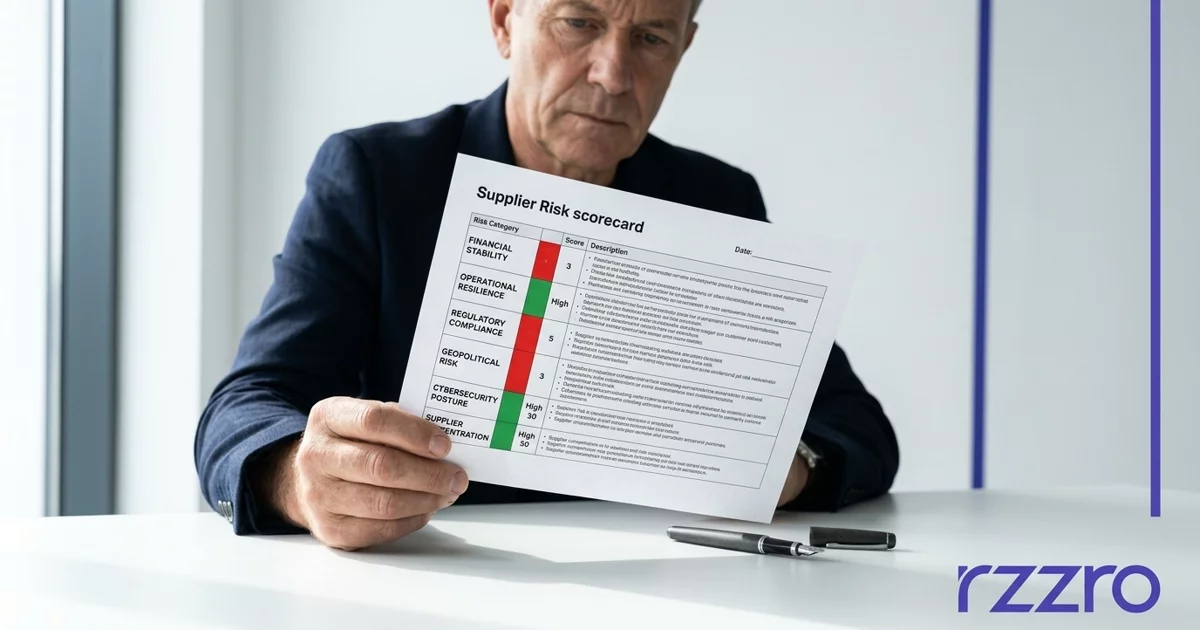
A comprehensive supplier risk management program monitors six distinct risk categories, according to Suplari's procurement risk framework:
- Financial — Liquidity, leverage, profitability erosion, customer concentration, payment performance deterioration. When an automotive seat supplier filed for insolvency in 2024, a major OEM's production halted for months — an outcome that structured financial monitoring might have anticipated.
- Operational — On-time delivery, quality defects, capacity constraints, lead-time stability. These are the most visible risks but often the last to trigger formal escalation.
- Compliance — Regulatory changes, data protection violations, sanctions exposure, lapsed certifications. The regulatory burden on procurement is growing: 66 percent of procurement leaders believe growing regulatory and ESG demands will heavily influence strategic sourcing decisions in the next 3-5 years.
- Geopolitical — Trade policy shifts, tariff impositions, export/import restrictions, sanctions, regional conflict. This is the fastest-growing category. Geopolitically safe sourcing regions can become volatile overnight.
- Cybersecurity — Breach history, security posture, data handling practices. With supply chain attacks now a primary vector for cyber incidents, a supplier's security gap becomes the buyer's liability.
- Concentration — Single-source dependence, single-region dependence, share of supplier's revenue. Over-reliance on one supplier or region amplifies every other risk category.
The blind spot is not that organizations lack data on any single category. It is that most manage them separately — finance watches financial risk, legal watches compliance, IT watches cyber, and nobody connects the dots. Supplier risk is inherently multidimensional. A financially stressed supplier in a geopolitically unstable region with weak cybersecurity represents a very different exposure than the same financial score in a stable jurisdiction with strong IT controls. Weighting matters.
The Visibility Gap Past Tier 1
McKinsey's 2025 supply chain risk survey found a striking asymmetry: 95 percent of companies have reasonable visibility into Tier 1 supplier risks. That number falls to 42 percent for Tier 2 and beyond. An earlier 2024 survey put it even more starkly: only 30 percent of senior supply chain executives said they have genuinely good visibility past their first tier of suppliers.
"Most disruptions originate deeper in the supply chain than companies can see. The gap between knowing your Tier 1 suppliers and understanding your full supply network is where risk compounds."
— McKinsey & Company, 2025 Supply Chain Risk Survey
This matters because the most damaging disruptions often originate at Tier 2 or Tier 3 — a raw material shortage at a sub-supplier, a logistics failure at a freight forwarder you do not directly contract with, or a cyber incident at a SaaS provider embedded in your supply chain software stack. The concentration of the semiconductor industry in Taiwan and the dependence of countless industrial supply chains on a single chip fab in Dresden are examples of Tier 2+ risk that no annual supplier questionnaire will flag.
Mapping supply chains beyond Tier 1 is not easy — it requires collaboration with Tier 1 suppliers to share their sub-supplier data, contractual chain-of-visibility clauses, and often third-party data services. But the organizations that invest in multi-tier visibility consistently outperform their peers in disruption recovery time and total cost impact.
Financial Health: The Early Warning System Most Companies Don't Have
Of the six risk categories, financial health is the most predictive and the most neglected. Over 81 percent of organizations have been impacted by supplier disruptions in the past two years, according to SDCExec research, and financial fragility is the common thread running through most supplier collapses.
A robust supplier financial risk assessment analyzes four dimensions:
- Liquidity — Current ratio, quick ratio, operating cash flow. Can the supplier meet short-term obligations without distress sales of assets?
- Leverage — Debt-to-equity, interest coverage, debt maturity schedule. How much of the supplier's capital structure depends on debt that may need refinancing at higher rates?
- Profitability — Gross margin trend, operating margin, net income trajectory. Is the supplier's core business generating sustainable returns, or are they surviving on one-time gains?
- Customer concentration — Share of revenue from top 3 customers, dependency on your own spend. A supplier that derives 60 percent of revenue from one customer could become insolvent if that customer switches.
Leading organizations monitor financials at least annually for non-critical suppliers and quarterly — or more frequently — for strategic and single-source suppliers, leveraging automated tools for continuous updates. They establish risk thresholds and early-warning triggers: deteriorating credit scores, negative cash flow, late deliveries, and shortened payment terms to the supplier's own vendors. When thresholds are breached, mitigation actions fire automatically: accelerated due diligence, dual-sourcing analysis, or renegotiated terms including step-in rights, escrow agreements, and inventory buffers.
Geopolitical Risk: The Category That Changed Everything
Geopolitical risk has grown sharply since 2020. It is fundamentally different from other supplier risk categories because it affects entire regions, not individual suppliers — potentially impacting multiple parts of a supply base simultaneously. Trade restrictions, tariffs, sanctions, and political instability can cut off a supply source with very little notice, as the 2022 Russia-Ukraine sanctions and the 2025 tariff escalations demonstrated.
- Trade policy announcements and tariff schedules
- Sanctions lists and export/import restriction updates
- Political stability indices for supplier nations
- Currency volatility in key sourcing corridors
- Logistics infrastructure disruptions (port strikes, customs delays, shipping lane security)
The primary mitigation strategy is geographic diversification — blending global, nearshore, and local suppliers to spread risk across geographies and modes. Nearly half of US businesses said they plan to increase nearshoring in 2025 in response to shifting global conditions, according to a QIMA report. Contractual protections addressing political risk — force majeure clauses specifically tied to trade disruptions, flexible Incoterms, and contingency plans for rapid re-sourcing — are the operational complement.
Building a Risk Scoring Model That Works
The most effective procurement organizations do not treat supplier risk as a binary pass/fail. They build multidimensional risk scoring models that produce a single, actionable score per supplier — enabling prioritization at scale.
Best-practice models score suppliers across all six risk categories, with weights adjusted by category and supplier type:
- IT suppliers — Heavier weighting on cybersecurity and data protection
- Logistics and facilities suppliers — Heavier weighting on operational delivery and geopolitical exposure
- Manufacturing component suppliers — Heavier weighting on capacity, quality, and country risk
- Professional services — Heavier weighting on compliance, regulatory, and financial stability
Standardized scoring scales (0-100 or 1-5) mapped to clear risk bands — low, medium, high, critical — linked to specific actions at each threshold level. A medium score triggers enhanced due diligence. A high score requires executive approval and a documented mitigation plan. A critical score triggers a mandatory exit or dual-sourcing requirement within a defined timeframe.
Leading organizations present these scores in dashboards sliced by category, geography, and business unit, allowing procurement to prioritize interventions where risk-adjusted impact is highest.
Continuous Monitoring vs. Periodic Assessment
The single biggest shift in supplier risk management over the past three years is the move from periodic to continuous monitoring. Annual questionnaires cannot keep pace with fast-moving financial deterioration, geopolitical events, or cyber incidents.
Modern supplier risk management solutions integrate external data feeds — financial data, news, ESG ratings, cyber alerts, and geopolitical intelligence — into a continuous risk monitoring loop. Analytics-powered analysis cross-references events against the supplier portfolio and flags affected suppliers in hours, not months.
Gartner's 2026 supplier risk management solutions market review notes that the leading platforms combine machine learning analysis with 24/7 human expert validation to monitor global events and identify potential disruptions across the entire supply chain — including geopolitical events, weather conditions, and supplier performance anomalies.
From Risk Visibility to Action: The Mitigation Playbook
Risk identification without action is theater. The organizations that outperform on supplier risk management have pre-defined mitigation playbooks triggered by specific risk thresholds:
- Dual sourcing — Maintain pre-qualified alternate suppliers with tested tooling, quality approvals, and commercial terms so they can ramp quickly in a disruption.
- Inventory buffers — Increase safety stock for components from high-risk suppliers, sized to cover the estimated lead time to qualify an alternative source.
- Contractual protections — Step-in rights, escrow for intellectual property or tooling, audit clauses, and tiered service-level agreements with financial penalties for critical suppliers.
- Financial security — Performance bonds, letters of credit, and parent company guarantees for suppliers with deteriorating financial health.
- Joint improvement programs — For strategically important suppliers with manageable risk, invest in co-development of risk mitigation: shared demand forecasting, quality improvement initiatives, and capacity planning.
These playbooks are reviewed at least quarterly for critical categories. The risk landscape evolves too quickly for annual reviews.
The Role of AI and Automation
The volume of data required for continuous supplier risk monitoring across thousands of suppliers exceeds what human teams can process manually. AI and advanced analytics shift the paradigm from reactive reporting to predictive risk detection:
- Weak signal detection — AI identifies unusual delivery patterns, adverse media mentions, social or legal events, and financial anomalies that would go unnoticed in manual reviews.
- Risk trajectory forecasting — Rather than static scores, AI models predict which suppliers are likely to move from low-risk to high-risk within the next quarter, enabling preemptive action.
- Automated alerting and escalation — When a risk threshold is breached, the platform automatically notifies the relevant category manager, sourcing lead, and risk officer with a pre-populated report.
- Integrated decision support — Risk scores automatically influence RFP evaluation, award decisions, and contract terms — embedding risk management into the sourcing process rather than treating it as a separate gate.
Frequently Asked Questions
What is supplier risk management?
Supplier risk management (SRM) is the systematic identification, assessment, mitigation, and continuous monitoring of risks associated with an organization's third-party suppliers. It covers six primary risk categories: financial, operational, compliance, geopolitical, cybersecurity, and concentration risk.
How often should supplier risk be assessed?
Leading organizations assess financial health at least annually for non-critical suppliers and quarterly for strategic or single-source suppliers. Geopolitical and cyber risks require continuous monitoring due to their fast-changing nature. Annual assessments alone are no longer considered sufficient for most categories.
What is a supplier risk scoring model?
A supplier risk scoring model is a multidimensional framework that evaluates suppliers across financial stability, operational performance, compliance, geopolitical factors, cybersecurity posture, ESG standards, and concentration risk. Scores are weighted by category (e.g., IT suppliers scored heavier on cybersecurity) and linked to specific actions at each risk band threshold (low, medium, high, critical).
How has tariff exposure changed supplier risk in 2026?
Tariffs introduced since 2025 now affect 29 percent of production costs for some companies, making trade policy one of the fastest-growing supplier risk categories. Procurement teams are responding with geographic diversification, nearshoring, and contractual protections tied to trade disruption events. McKinsey identifies tariff exposure as structurally reshaping supplier risk profiles across manufacturing, electronics, and industrial sectors.
What is the difference between Tier 1 and Tier 2 supplier risk visibility?
Tier 1 visibility covers direct suppliers — the companies your organization has a contractual relationship with. Tier 2 and beyond covers your suppliers' suppliers. While 95 percent of companies have reasonable Tier 1 visibility, only 42 percent have visibility into Tier 2 and beyond. Most disruptions originate deeper in the supply chain than Tier 1, making multi-tier visibility the single most important investment for risk resilience.
Sources
- Suplari — Supplier Risk Management: A Complete Guide
- Art of Procurement — What Is Supplier Risk Management?
- GEP — Supplier Risk Management: A Comprehensive Guide
- o9 Solutions — What Is Supplier Risk Management? A Practical Guide
- Ivalua — Supplier Risk Assessments 2026
- Kodiak Hub — Supplier Financial Risk Assessment
- Kodiak Hub — Supplier Risk Management in 2025
- NetSuite — What Is Supplier Risk Management?
- Gartner — Best Supplier Risk Management Solutions 2026
- 7 Step Solutions — Supplier Risk Scoring 2025-2026
- Concord — Procurement Cost Reduction Strategies 2025