Risk & Compliance
Supplier Concentration Risk: Why Single-Source Dependencies Are Your Next Crisis
75% of firms face disruptions. Single-source dependencies turn manageable events into existential crises. Here's how to measure, mitigate, and monitor concentration risk.
The Hidden Cost of Convenience
Toyota lost ¥160 billion in revenue from a single event: a fire at Aisin Seiki, its sole supplier of P-valves — a low-cost component worth pennies per unit. One fire at one supplier shut down one of the world's most sophisticated production systems.
The same year, a fire at a Philips semiconductor plant in New Mexico crippled two mobile phone giants — but with dramatically different outcomes. Nokia dispatched a team within hours, reengineered products, and secured alternative supply within days. Ericsson, lacking backup suppliers, faced months of disruption and eventually exited the handset business. The difference between survival and collapse was supplier diversification.
These are not edge cases. They are the predictable outcome of a procurement model that prioritizes short-term cost savings over structural resilience. In a survey of 519 firms across 71 countries, 75 percent reported at least one supply chain disruption in the prior year. The frequency is accelerating: documented disruptions in the first half of 2024 were 30 percent higher than the same period in 2023.
75%
of firms experienced at least one supply chain disruption in the prior year
+30%
increase in documented disruptions H1 2024 vs H1 2023
¥160B
Toyota revenue lost from a single sole-source supplier fire
Supplier concentration risk — the exposure created when a buyer depends on one or very few sources for critical materials, components, or services — has moved from a supply chain textbook concept to a board-level liability. The question is no longer whether a single-source disruption will hit, but when. And whether your organization will respond like Nokia or like Ericsson.
"Relying on a single supplier can have strong impacts in case of a supplier disruption... up to and including a permanent disruption of a supply chain partner."
— European Journal of Operational Research, 2015
Why Single-Source Dependencies Persist
Single sourcing did not emerge from negligence. It emerged from optimization. For decades, procurement teams consolidated spend with fewer suppliers to maximize volume discounts, reduce administrative overhead, and simplify supplier relationship management. Single sourcing reduced unit costs, and unit cost reduction was the metric that mattered.
That optimization calculus assumed a stable operating environment. The environment has stopped cooperating.
Five drivers have fundamentally rewired the risk equation:
Geopolitical Instability
The year 2023 saw the highest number of violent conflicts since the Second World War. Global trade restrictions rose from 650 new measures in 2017 to over 3,000 in 2023. Tariff policies are reshuffling global sourcing networks: McKinsey's 2025 supply chain risk survey found that 43 percent of companies plan to shift more of their supply chain footprint to the United States over the next three years — a 25 percentage point increase from the previous year.
Single-source dependencies concentrated in politically exposed regions now carry regulatory risk as well. U.S. Customs detained $3.7 billion worth of goods in 2024 under the Uyghur Forced Labor Prevention Act alone.
Climate Disruption
Climate-related events are now recognized as one of the most pressing supply chain risks. The UN Office for Disaster Risk Reduction estimates over $200 billion in economic losses from climate disasters in 2024. Flooding alone accounted for 70 percent of weather-related supply chain disruptions in 2024, with events like Hurricane Helene exposing the fragility of concentrated supplier networks in susceptible regions.
Cyber Supply Chain Attacks
Supply chain cyberattacks surged 431 percent between 2021 and 2023, with further increases projected. A single compromised supplier can now trigger systemic disruption across entire sectors, as the digital ecosystem has become "densely interconnected." Gartner predicts that by 2025, 45 percent of organizations worldwide will have experienced software supply chain attacks — a threefold increase from 2021.
Supplier Insolvency and Financial Distress
The post-pandemic restructuring cycle has accelerated supplier failures across industries. A single-source supplier entering insolvency creates an immediate and unresolvable supply gap. Unlike a multi-source arrangement where one supplier's failure triggers volume redistribution, a sole-source insolvency requires months of requalification and re-sourcing — time most organizations cannot afford.
Tier-2 Blindness
The most dangerous form of concentration risk is invisible. Two apparent suppliers may share the same tier-2 plant, the same logistics corridor, or the same raw material source — creating the illusion of diversification while maintaining a single point of failure. McKinsey reports that 45 percent of surveyed companies have either no visibility beyond first-tier suppliers or only partial upstream visibility.
The Quantified Case for Diversification
The evidence that dual sourcing reduces disruption impact is no longer theoretical. The Business Continuity Institute's 2023 Supply Chain Resilience Report found that firms using dual-source strategies experienced shorter disruption durations than sole-source firms. Firms combining dual sourcing with digital supplier management software and flexible contracting achieved even higher resilience levels.
The structural shift is already underway. A 2022 survey of global supply chain leaders found that 81 percent planned to increase dual sourcing of raw materials, while 80 percent planned to increase inventory buffers and 44 percent aimed to re-shore production. McKinsey's 2025 survey confirms this is translating into action: 73 percent of companies report making progress on dual-sourcing strategies, and among companies affected by tariffs, 39 percent are actively pursuing dual sourcing as a mitigation lever.
Dual sourcing is also expanding beyond its traditional scope. In 2025, procurement teams are extending it to categories that were previously single-sourced for simplicity — upstream materials, subassemblies, and even packaging.
81%
of firms plan to increase dual sourcing of raw materials
73%
report progress on dual-sourcing strategies (McKinsey)
39%
pursuing dual sourcing specifically for tariff risk mitigation
The supply chain management market reflects this urgency. It grew from $15.85 billion in 2020 and is projected to reach $30.91 billion by 2026, driven by investment in visibility, risk analytics, and supplier intelligence tools. The 2024 MHI Annual Industry Report found that 55 percent of supply chain leaders are investing in technology and innovation focused on visibility and risk mitigation.
The Hidden Concentration Trap
Organizations that believe they have diversified their supply base may still carry extreme concentration risk. A common mistake is sourcing from two suppliers that share hidden upstream dependencies — the same tier-2 plant, logistics corridor, or raw material source. This creates the illusion of diversification while preserving concentrated risk at the point of failure that matters most.
The response from leading procurement organizations is deeper tier mapping. The BCI Supply Chain Resilience Report 2024 shows that 17.1 percent of organizations now analyze critical suppliers down to tier 4 and beyond — up from just 3.7 percent the prior year. This fivefold increase reflects a recognition that upstream concentration is often where the real risk lives.
Digital sector dependencies are particularly acute. "Many sectors have become dependent on a small but highly specialised number of suppliers for essential software, hardware, or business services," notes a 2026 supply chain risk review. A growing proportion of these critical components are sourced from suppliers operating under foreign jurisdictions subject to state influence or opaque legal regimes.
A Practical Framework for Reducing Concentration Risk
Reducing supplier concentration risk does not require eliminating single sourcing — that would be economically irrational for low-risk categories. It requires a structured approach to identifying, prioritizing, and mitigating concentration exposure where the impact of disruption is unacceptable.
Step 1: Map Concentration by Spend and Criticality
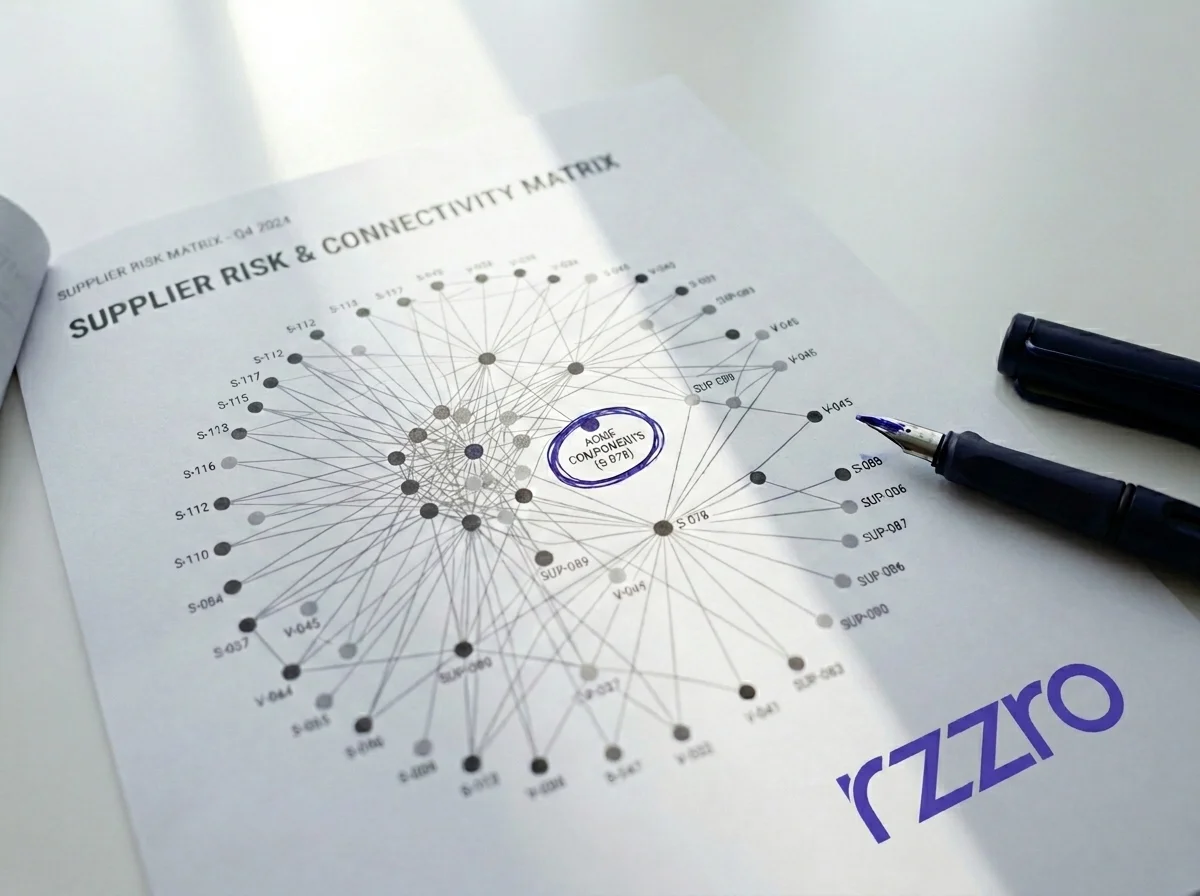
Start with a simple two-dimensional matrix: supplier concentration (percentage of spend per supplier) against criticality (impact of disruption on production or operations). High-concentration, high-criticality items are the immediate priority. Use a tier-2 mapping tool or service to identify hidden dependencies where two suppliers share a single upstream source.
Step 2: Measure the Real Cost of Single Sourcing
The unit cost advantage of single sourcing is visible in the P&L. The cost of a disruption is not — until it materializes. Run scenario analysis: what is the cost of a six-week production stoppage at a sole-source supplier? Include lost revenue, fixed cost absorption, customer penalties, and reputational damage. Compare this to the incremental cost of qualifying and maintaining a second source at 70-30 or 80-20 split.
As one industry brief frames it: "a slightly higher secondary supplier cost may be far less expensive than weeks of lost production caused by sole-source disruption."
Step 3: Qualify Alternative Sources Before You Need Them
The worst time to find a second supplier is during a crisis. For every high-concentration, high-criticality item, identify and pre-qualify at least one alternative source. This does not mean splitting volume immediately — it means completing the technical qualification, commercial framework, and risk assessment so that the alternative can scale if the primary source fails.
Procurement teams shifting to dual-source models must requalify suppliers under stricter criteria: tighter response time windows, regional material traceability, and process stability at scale.
Step 4: Build Diversification into Supplier Scorecards
Procurement evaluations traditionally weight cost, quality, delivery, and service. Add a fifth dimension: supply chain resilience. Score suppliers on geographic concentration, single-point-of-failure risk, financial health, and contingency planning. Make diversification a weighted criterion in sourcing decisions, not an afterthought.
Step 5: Monitor Continuously, Not Annually
Concentration risk is not static. A supplier's financial health, geographic exposure, and sub-tier dependencies change constantly. Use real-time monitoring tools that track supplier financials, news events, geopolitical risk indicators, and weather events affecting supplier locations. The SCM platform market — projected at $30.91 billion by 2026 — exists precisely to enable this continuous visibility.
The Cost of Inaction
Disruptions are becoming more frequent, more severe, and less predictable. Climate events, cyberattacks, geopolitical flashpoints, and regulatory enforcement are all converging on supply chains that were optimized for a world that no longer exists.
The organizations that treat concentration risk as a strategic priority — that map their tier-2 exposures, pre-qualify alternative sources, and build resilience into procurement scorecards — will respond like Nokia: fast, adaptive, recoverable. Those that continue optimizing for unit cost alone will face the Ericsson outcome: persistent disruption, market share loss, and potentially existential damage.
"Supplier concentration risk is one of the most common causes of supply chain failure."
— Agrinventory, Industry Analysis 2025
The procurement function has a choice. Continue optimizing for a stable environment that no longer exists, or build the visibility, diversification, and resilience that the current environment demands. The data is clear. The Toyota and Ericsson cases are not hypotheticals — they are the documented cost of concentration. The only question is which precedent your organization will follow.
Frequently Asked Questions
What is supplier concentration risk?
Supplier concentration risk is the exposure created when a buyer depends on one or very few sources for critical materials, components, or services. A disruption affecting that supplier — whether from fire, bankruptcy, cyberattack, geopolitical event, or natural disaster — can halt production, delay deliveries, and cause significant financial loss.
What is the difference between single sourcing and sole sourcing?
Single sourcing is a deliberate strategy where a buyer chooses to use one supplier even when others are available, typically to maximize volume discounts or simplify management. Sole sourcing occurs when only one supplier exists for a product or service — no alternatives are available. Both carry concentration risk, but sole sourcing requires more active mitigation because substitution is structurally constrained.
How much concentration is too much?
There is no universal threshold, but leading procurement organizations flag any critical item where more than 70 percent of spend is concentrated with one supplier. The threshold should be lower for items sourced from geopolitically exposed regions, suppliers with weak financials, or categories with long requalification timelines. The key metric is not concentration by itself — it is concentration multiplied by disruption impact.
Does dual sourcing always cost more?
Not necessarily. While splitting volumes can reduce scale discounts from the primary supplier, it introduces competitive tension that can drive better pricing, quality improvements, and service levels from both suppliers. The total cost of ownership must include the cost of disruption risk. When that risk is factored in, dual sourcing is often cheaper — especially for high-criticality items.
Sources
- European Journal of Operational Research — Dual Sourcing Under Disruption Risk
- Achilles — Supply Chain Risk Hotspots 2025
- Federal Reserve Bank of Richmond — Supply Chain Resilience and Economic Shocks
- IRJMETS — Strategic Reframing of Dual Sourcing (2024)
- Akirolabs — Dual Sourcing Strategies and Advantages
- McKinsey — Supply Chain Risk Pulse 2025
- Risk Ledger — Top 10 Supply Chain Risks 2026
- Fit Small Business — 23 Supply Chain Statistics 2025
- BCI — Supply Chain Resilience Report 2024
- Colvin Friedman — 2025 Reshoring Statistics
- Supply Chains — Top 5 Supply Chain Risks 2025
- DHL — Top 5 Supply Chain Risks 2024
- Agrinventory — Dual Sourcing to Increase Supply Chain Resilience
- Forceget — Supply Chain Disruption 2025
- EDS International — How Dual Sourcing Protects Your Supply Chain
- Xeneta — Top 10 Supply Chain Risks 2024
Research conducted via web research using you_research. 14 authority sources cited.