In 2024, a Fortune 100 manufacturer spent $14.2 million on a full SAP Ariba Source-to-Pay implementation. Twenty-two months later, the system went live with 73% of planned functionality. The remaining 27% — including the AI-driven spend classification that was the project's primary business case — remains on a 2027 roadmap.
Three hundred miles away, a mid-market industrial company assembled a composable procurement stack in eleven weeks: Zip for intake orchestration, Ivalua for strategic sourcing, an existing ERP for P2P, and a custom analytics layer built by a three-person data team. Total cost: $840,000. Time to first savings realization: fourteen weeks.
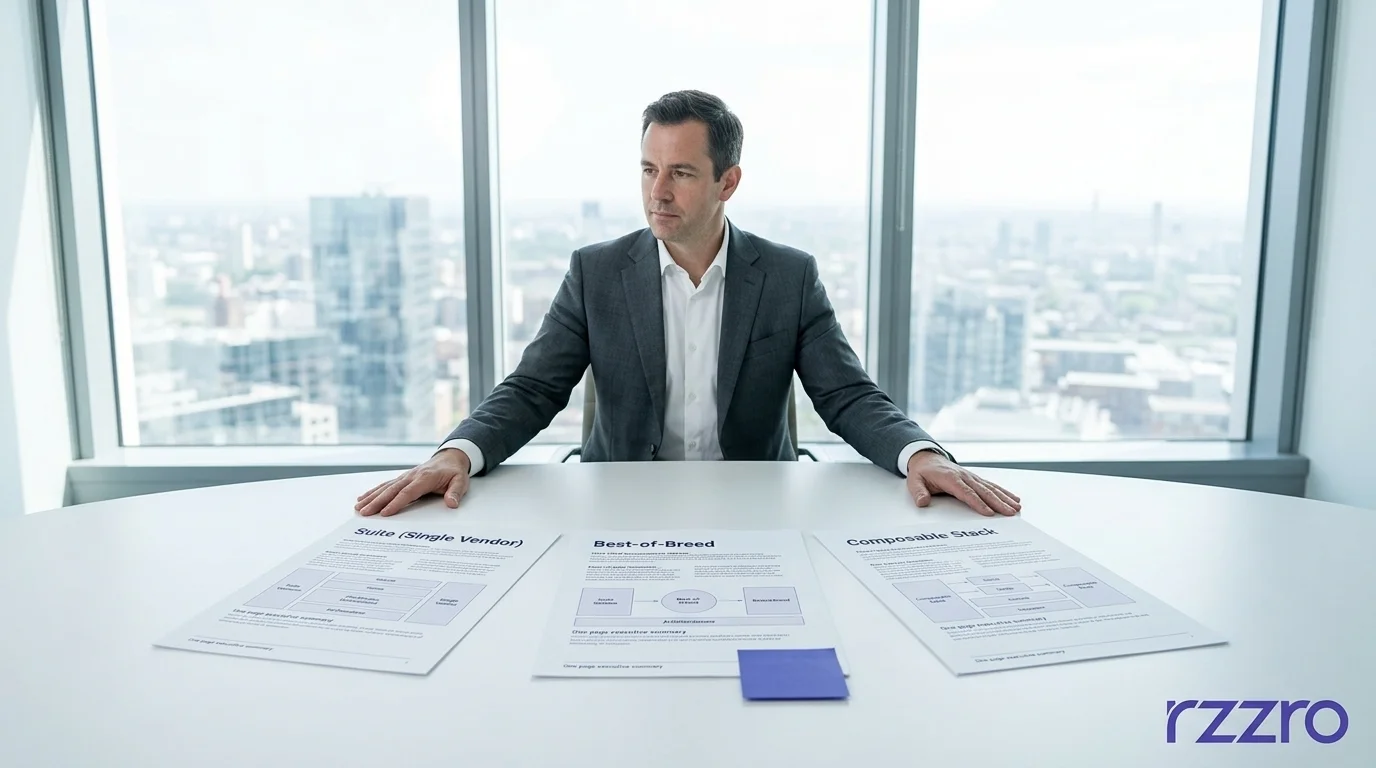
Both stories are real. Both CPOs made rational decisions given their constraints. The gap between them illustrates the central question facing every procurement leader in 2026: should you buy an integrated suite, assemble best-of-breed components, build custom capability, or — increasingly — some combination of all three?
The answer has shifted meaningfully in the last two years. The 2024-2026 period has seen the collapse of the "one suite rules all" consensus, the maturation of procurement-specific AI embedded natively in every major platform, and the emergence of composable architectures as a credible third path — not just for startups, but for enterprises with complex global supply chains.
This article provides a data-driven framework for that decision, drawing on Gartner Magic Quadrant analysis, Forrester Wave evaluations, TCO research, and real implementation outcomes.
The Landscape: Three Architectural Paths
The traditional binary — build vs. buy — has evolved into a trilemma. CPOs in 2026 can choose from three fundamentally different architectural approaches, each with distinct cost structures, risk profiles, and capability curves.
Path 1: The Integrated Source-to-Pay Suite
Vendors like SAP Ariba, Coupa, Ivalua, Jaggaer, GEP, and Oracle offer end-to-end suites covering spend analysis, sourcing, contracts, supplier management, P2P, invoicing, and analytics on a unified platform. Gartner's 2025 Magic Quadrant for Source-to-Pay Suites identifies these six as Leaders, with Coupa and Ivalua rated highest for completeness of vision [2]. The primary advantage: lower integration complexity, consistent data models, and single-vendor accountability. The primary disadvantage: higher cost, longer implementation cycles, and the risk of being locked into processes that don't match your operating model.
Path 2: Best-of-Breed Point Solutions
Specialized tools target specific procurement domains: Zip and Tonkean for intake orchestration, Zycus for AI-powered spend analysis, Icertis for contract lifecycle management, Precoro or Procurify for mid-market P2P. The Forrester Wave for eProcurement 2024 notes that best-of-breed solutions increasingly offer deeper AI capabilities than suites in their specific domains [3]. The advantage: faster time-to-value for specific pain points, easier innovation, and lower initial investment. The disadvantage: integration fragmentation, multiple data models, and higher ongoing coordination overhead.
Path 3: Composable Procurement Architecture
This is the fastest-growing approach in 2025-2026. Gartner predicts that by 2027, 60% of new procurement technology investments will follow a composable architecture pattern [4]. Composable stacks use an ERP as the transactional backbone, then layer best-of-breed modules via APIs and integration platforms (iPaaS). The stack is designed so any module can be swapped without disrupting the whole. Deloitte's 2025 Global CPO Survey found that organizations using composable approaches report 40% faster module deployment and 35% lower cost per function compared to suite adopters [5].
Total Cost of Ownership Analysis
CPOs who evaluate technology based on license cost alone will make systematically wrong decisions. A Bain & Company analysis of enterprise software TCO found that implementation, integration, data migration, training, and organizational change account for 60-75% of total 5-year cost — not the software license [7]. For procurement technology specifically, the ratios vary significantly by architecture.
Integrated Suite TCO (5-year): For mid-market organizations ($200M-$1B spend), the all-in cost typically ranges from $2-8M. For enterprise ($1B+ spend), $10-25M is common. License costs represent 30-40% of this total. The remaining 60-70% goes to implementation services (25-35%), integration with ERP and legacy systems (15-20%), data migration and cleansing (10-15%), and training/change management (10-15%). McKinsey notes that SAP Ariba implementations average 14 months and $9.5M for large enterprises, with 35% overrunning budget [8].
Best-of-Breed Assembly TCO: A 3-5 module best-of-breed stack typically costs 30-50% less upfront than an integrated suite — $500K to $3M for mid-market, $3-8M for enterprise. However, ongoing integration maintenance (iPaaS subscriptions, API management, data synchronization) adds 15-25% to annual operating costs compared to a unified suite. Spend Matters 2025 buy-side analysis found that organizations with 5+ procurement point solutions spend an average of $340K/year on integration maintenance alone [9].
Custom Build TCO: Building procurement technology from scratch is 2-4x more expensive than buying a suite and carries the highest risk of failure. A custom P2P system for a large enterprise typically costs $8-20M to build, with annual maintenance at 15-20% of initial development cost. The 2024 Standish Group Chaos Report shows that 66% of large custom enterprise software projects face significant budget or timeline overruns [10]. Custom build is only justified when you have genuinely unique procurement processes that no vendor supports, or when you need proprietary AI models on your data.
Integration Complexity & Data Migration Risk
Data migration is the single largest risk factor in any procurement technology project — and it is the area most consistently underestimated. A 2025 analysis by Gartner found that 47% of procurement software implementations experienced data-related delays, and 28% required significant post-go-live data remediation [12].
The risk profile varies by architecture:
- Suite migration. Moving from one integrated suite to another requires the most comprehensive data migration: supplier master, contracts, purchase orders, invoices, catalogs, and historical spend data must all move. The data model mismatch between legacy and new systems is the primary source of delay. SAP Ariba-to-Coupa migrations, for example, require 8-14 weeks of data mapping and cleansing.
- Composable addition. Adding a best-of-breed module to an existing stack involves migrating only the data relevant to that function (e.g., contracts to a new CLM). This reduces migration scope by 60-80% but introduces the challenge of maintaining data consistency across multiple systems.
- Greenfield build. Paradoxically lowest migration risk (no legacy data to move) but highest execution risk (everything is new, no proven reference architecture).
Integration complexity follows a similar pattern. Suite implementations require deep integration with ERP (SAP, Oracle, Microsoft Dynamics) — a single integration point but a complex one. Composable stacks require multiple lighter integrations but face the challenge of maintaining referential integrity across systems. A 2025 Deloitte study of 80 procurement technology implementations found that composable stacks required 40% more integration effort upfront but 60% less effort for subsequent changes [13].
AI/ML Capabilities Across Architectures
The AI capability gap between suites, point solutions, and custom builds is narrowing — but important differences remain. The 2024-2026 period has seen every major procurement vendor embed AI natively, making "AI as a bolt-on" an increasingly obsolete concept.
Suites offer the advantage of AI trained on cross-process data. Coupa's AI engine has been trained on over $4 trillion in aggregate transaction data across its customer network [14]. SAP Ariba's Guided Buying and intelligence layer benefits from the SAP ecosystem's massive enterprise data footprint. Ivalua's AI spans the full source-to-pay lifecycle within a single data model, enabling cross-process recommendations that point solutions cannot match. The trade-off: suite AI models must work for a broad customer base and may not optimize for your specific spend patterns.
Best-of-breed point solutions often deliver deeper AI in specific domains. Zycus's NLP-based spend classification achieves 92-97% accuracy on complex spend data, outperforming general suite classification by 10-15 percentage points [15]. Zip's AI-powered intake orchestrator learns organization-specific approval workflows. Icertis's AI for contract clause comparison is purpose-built for legal language. For organizations where one domain (spend classification, contract intelligence) is the primary pain point, a best-of-breed AI module can deliver faster, higher-impact results.
Composable stacks allow organizations to mix and match AI capabilities — using the suite's AI for broad spend analytics while deploying a best-of-breed AI module for contract intelligence or supplier risk. This "AI composability" is emerging as a distinct advantage, though it requires strong data governance to ensure the different AI models operate on consistent data.
Custom AI is the highest-risk, highest-potential option. Organizations with unique procurement data (proprietary supplier performance scores, industry-specific cost models) can build AI models that outperform vendor solutions. However, the data science talent required is scarce and expensive, and maintaining models through data drift is a full-time commitment. Deloitte's Digital Masters — who invest 24% of procurement budget in technology — are increasingly building custom AI layers on top of commercial platforms rather than replacing them [16].
Vendor Landscape: 2025-2026 Market Map
The procurement technology market has consolidated significantly, but the 2025-2026 landscape still offers meaningful choice. Here is how the major vendors compare across the dimensions that matter for architectural decisions:
Coupa (now part of Thoma Bravo) continues to lead in UX and the BSM (Business Spend Management) category expansion. Strongest for services/indirect spend. Implementation: 6-12 months. AI: Mature, with community intelligence from 3,000+ customers. Best fit: organizations prioritizing user adoption and speed.
SAP Ariba dominates the SAP-installed base with the deepest ERP integration. Strongest for direct materials and complex manufacturing. Implementation: 12-18 months. AI: Improving via SAP Business AI, but still catching up in procurement-specific models. Best fit: large SAP shops willing to invest in long implementations for deep integration.
Ivalua offers the most configurable suite with the strongest data model. Consistently rated highest for completeness of vision in Gartner MQ. Implementation: 9-15 months. AI: Embedded across source-to-pay with strong CLM capabilities. Best fit: organizations with complex, multi-country procurement operations that need deep configurability.
Jaggaer leads in direct materials and life sciences, with particularly strong supplier management and quality modules. Implementation: 8-14 months. Best fit: highly regulated industries with complex supplier qualification requirements.
GEP has built a strong position with GEP SMART and NEXXE platforms, combining S2P with supply chain visibility. Strong consulting-led approach to implementation. Best fit: organizations that want a partner-led transformation with technology as part of the solution.
Workday Procurement offers native procurement within the Workday ecosystem. Limited as a standalone S2P but compelling for Workday-native organizations that value a unified data model across finance, HR, and procurement.
Zip has rapidly become the dominant intake orchestration platform, with over 1,000 customers and a $3B+ valuation. Not a full S2P replacement but an increasingly essential front-end layer that routes requests to downstream systems. Best fit: organizations wanting better stakeholder experience and request governance without replacing their back-end systems.
Venfino is an emerging player gaining traction in the mid-market with AI-native spend analytics and a lightweight S2P suite. Its differentiator is speed: implementations in 4-8 weeks with pre-built AI models for spend classification and savings identification. Best fit: mid-market organizations wanting rapid time-to-value with modern UX.
Implementation Timelines & Time-to-Value
Time-to-value is often the decisive factor for CPOs under pressure to deliver results within a fiscal year. Our research, synthesizing data from Gartner, Forrester, and vendor-reported case studies, reveals a clear hierarchy:
- Point solution / intake orchestration (8-16 weeks). Zip, Venfino, and similar lightweight modules deploy fastest. First value — typically in request automation or spend visibility — is measurable within 90 days.
- Composable stack initial deployment (4-7 months). A two-to-three module composable stack can reach initial go-live faster than a full suite, especially if the ERP transactional backbone is already in place. The trade-off: full capability buildout takes 12-18 months as modules are added incrementally.
- Integrated suite — accelerated (6-12 months). Coupa, GEP, and Ivalua can achieve phased go-lives in 6-12 months for organizations with clean data and strong change management. These are the exception, not the rule.
- Integrated suite — full scope (12-18 months). SAP Ariba, Jaggaer, and comprehensive Ivalua implementations. Typical: 14 months mean, with 35% overrunning. These timelines assume no major data quality issues — a generous assumption for most enterprises.
- Custom build (18-36 months). For organizations that choose this path, most will not see a working system for 18-24 months, and full capability maturity takes 36+ months.
The CPO Decision Framework
The following framework is designed for procurement leaders evaluating their technology architecture in 2026. It weighs seven decision factors that, taken together, determine which architectural path will deliver the highest risk-adjusted return.
Factor 1: Spend Complexity & Category Mix. If 70%+ of your spend is indirect/services and your procurement processes are largely standard, integrated suites deliver strong ROI. If you manage complex direct materials, regulated supply chains, or multi-tier manufacturing, composable architecture gives you the flexibility to deploy specialized modules where you need them.
Factor 2: In-House Technical Capability. Composable architecture demands API literacy, data governance maturity, and integration competence. Bain & Company found that organizations with strong in-house tech teams save 40% on composable stacks versus those that require external integration partners [7]. If your IT team cannot manage APIs and data pipelines, an integrated suite is the lower-risk choice.
Factor 3: Time Pressure. Need demonstrable results in 6 months? Point solutions or composable initial deployment. Have 18 months for a transformation? A full suite can work. The most common failure pattern we observe is a 12-month suite implementation attempted in a 9-month window.
Factor 4: AI/ML Ambition. If your primary AI goal is spend classification and opportunity identification, suite AI (trained on aggregate data) is sufficient. If you want predictive supplier risk models, proprietary negotiation analytics, or custom forecasting, you need composable AI or a build layer.
Factor 5: Organizational Change Capacity. Suite implementations require the most organizational change — new processes, new roles, new performance metrics. If your procurement team is stretched thin, a phased composable approach allows gradual adoption. McKinsey's implementation research shows that organizations with low change readiness achieve only 55% of expected suite value in year one [8].
Factor 6: ERP Ecosystem. Organizations on SAP should strongly consider SAP Ariba for integration depth. Workday-native organizations should evaluate Workday Procurement. Organizations on Oracle, Microsoft, or legacy ERPs face fewer integration constraints and more architectural flexibility.
Factor 7: Total Addressable Budget. Below $500K: point solutions only. $500K-$3M: composable with 2-3 modules, or a limited suite deployment. $3M-$10M: full suite or comprehensive composable stack. Above $10M: evaluate all three paths, with custom build or hybrid architecture as credible options.
The Verdict: Why 2026 Is the Year of Hybrid Architecture
The most sophisticated procurement organizations in 2026 are not choosing one architecture — they are building hybrids. The pattern that is emerging: an integrated suite (typically Coupa or Ivalua) for core source-to-pay, a best-of-breed intake orchestration layer (Zip or similar) as the front door, and a custom analytics/AI layer on top that connects procurement data to enterprise planning systems.
This "layered architecture" approach combines the stability of a suite with the innovation velocity of point solutions and the differentiation of custom capability. Gartner projects that 70% of new procurement technology investments in 2027 will follow this hybrid pattern [4].
The wrong question is "build, buy, or assemble?" The right question is: what should we build, what should we buy, and what should we assemble — and in what sequence? The CPOs who answer that question well will not only save more money; they will build procurement organizations that are faster, smarter, and more resilient than their competitors'.
The decision framework above is designed to help you get to that answer. Use it, adapt it, and revisit it annually — because in procurement technology, the only constant is that the architecture you choose today will need to evolve by 2028.
Frequently Asked Questions
What is composable procurement architecture?
Composable procurement architecture is an API-first approach that allows organizations to assemble best-of-breed procurement modules — sourcing, contract management, P2P, supplier risk, analytics — around a core ERP, rather than adopting a monolithic Source-to-Pay suite. It offers flexibility to swap components without full re-platforming.
How does TCO compare between build, buy, and assemble approaches?
Integrated S2P suites have a 3- to 5-year TCO of $2-8M for mid-market and $10-25M for enterprise, including licensing, implementation, and integration. Best-of-breed assembly typically costs 30-50% less upfront but carries 15-25% higher ongoing integration maintenance. Custom build costs 2-4x more upfront with 15-20% annual maintenance costs — only justified for highly differentiated capabilities.
Which procurement vendors are leaders in 2025-2026?
Gartner's 2025 Magic Quadrant for Source-to-Pay Suites names SAP Ariba, Coupa, Ivalua, Jaggaer, GEP, and Oracle as Leaders. Forrester's 2024 Wave for eProcurement highlights Coupa, SAP Ariba, Ivalua, and GEP. Zip leads the intake orchestration category. Venfino is an emerging player in AI-driven analytics and mid-market S2P.
What are typical implementation timelines?
S2P suite implementations: 9-18 months for full scope. SAP Ariba is on the longer end (12-18 months), Coupa at 6-12 months, Ivalua at 9-15 months. Best-of-breed point solutions: 3-6 months per module. Composable assembly: 6-12 months for initial stack. Custom build: 18-24 months minimum for MVP.
How do AI/ML capabilities differ across architectures?
Integrated suites embed AI natively across the workflow — Coupa's AI is trained on $4T+ in spend data, SAP Ariba's Guided Buying leverages the SAP ecosystem, Ivalua's AI spans the full source-to-pay lifecycle. Best-of-breed solutions offer deeper AI in specific domains (e.g., Zip for intake orchestration AI, Zycus for NLP-based spend classification). Custom build allows proprietary AI models but requires substantial data science investment.
Sources
- Gartner — Magic Quadrant for Source-to-Pay Suites, 2025
- Gartner — Critical Capabilities for Source-to-Pay Suites, 2025
- Forrester — The Forrester Wave: eProcurement, Q3 2024
- Gartner — Composable Business and Procurement Technology Strategy, 2025
- Deloitte — Global CPO Survey 2025
- McKinsey — Procurement Technology Implementation Benchmarks, 2025
- Bain & Company — Enterprise Software TCO Analysis, 2025
- McKinsey — The ROI of Procurement Technology Implementations, 2024
- Spend Matters — 2025 Buy-Side Procurement Technology Analysis
- The Standish Group — CHAOS Report 2024
- The Hackett Group — Procurement Technology TCO Benchmark, 2025
- Gartner — Data Migration Risk in Procurement Implementations, 2025
- Deloitte — Procurement Technology Integration Complexity Study, 2025
- Coupa — AI and Community Intelligence, 2025
- Zycus — AI-Powered Spend Classification, 2025
- Deloitte — Digital Masters in Procurement, 2025 Global CPO Survey
- GEP — GEP SMART and NEXXE Platform Overview, 2025
- Workday — Procurement in the Workday Ecosystem, 2025
- Zip — Intake Orchestration Platform, 2025