The myth: More suppliers means more competition, which means lower prices. Spread purchases across as many qualified vendors as possible. Keep them competing. Never let any supplier feel too comfortable.
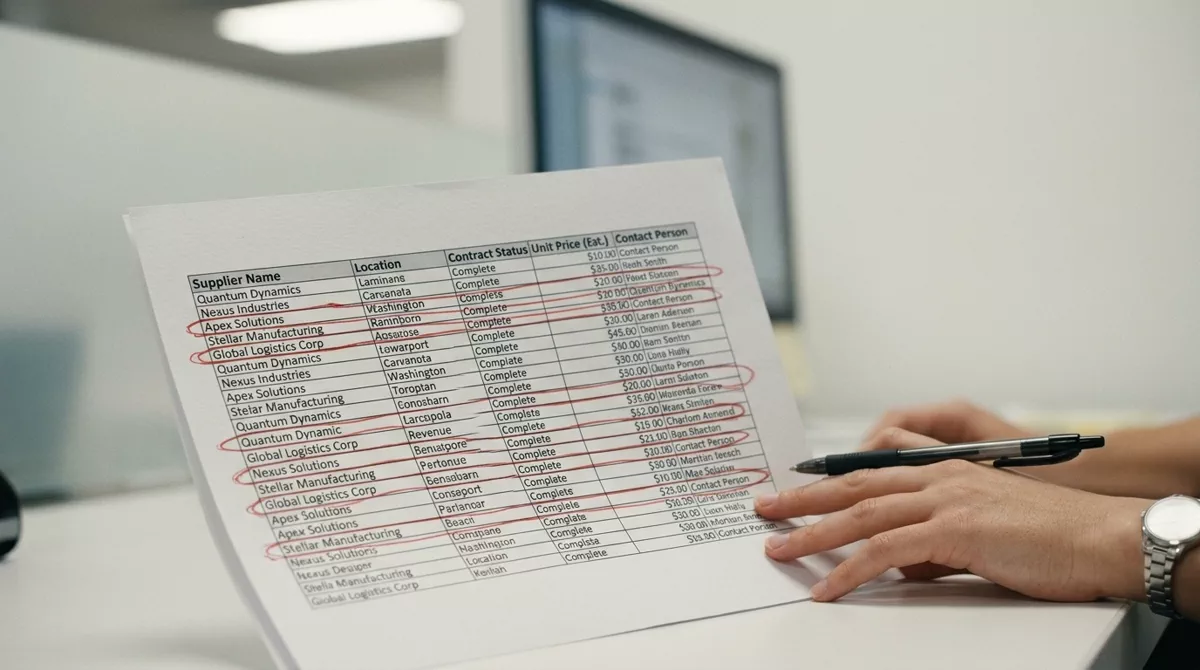
A procurement director once told me her organization had 14 approved suppliers for the same grade of stainless steel fasteners. Fourteen. Different prices, different lead times, different quality regimes. The combined spend was $2.3 million across those 14 suppliers — an average of $164,000 each. None of them considered this buyer a priority account. None had incentive to invest in quality improvement or joint cost reduction. The buyer was a small customer to all of them and a valuable customer to none.
Where the myth comes from
The idea has a respectable origin. Michael Porter's Five Forces framework, taught in every MBA program since 1980, explicitly advised firms to spread purchases among alternate suppliers to improve bargaining position. The logic is intuitive: competition drives down prices. It is true in simple commodity markets with perfect information and zero transaction costs. It is not true when the good or service is complex, when non-price factors like quality and responsiveness matter, or when coordination between buyer and supplier requires investment on both sides.
In 1993, Bakos and Brynjolfsson at MIT published a paper that should have ended the debate. Their model showed that a buyer does not maximize profits by maximizing the number of suppliers — profits peak where the marginal benefit of one more supplier equals the marginal coordination cost. Adding suppliers beyond that point destroys value. The paper was published in the Journal of Management Information Systems, widely cited in supply chain literature, and functionally ignored by decades of procurement practice.
Why more suppliers actually costs more
The hidden cost is coordination. Each additional supplier creates a new interface requiring RFQs, technical clarification cycles, delivery tracking, quality monitoring, invoice reconciliation, and relationship management. Research by Deprotech, citing Balaeva et al. (2020) in Public Money & Management, found transaction costs of 1% to 1.4% of contract value in standard procurement — rising to 6.6% to 8.1% in small-batch procurement where interface density is highest. Those costs often exceed any unit-price savings from competitive tendering.
Fragmentation has a second cost: diluted leverage. Acquis Consulting found that 35% to 75% of spend occurs outside negotiated agreements in fragmented procurement organizations. Each unmanaged supplier relationship costs approximately $925 in redundant onboarding and $150 to $225 per year in administrative overhead. When 40% to 60% of suppliers are duplicates providing the same goods at different prices — as Acquis found — the "competition" is not competition. It is disorganization.
The fragmented base
14 suppliers for one fastener grade. $164K average spend each. No supplier sees this account as strategic. Zero incentive to invest in quality, cost reduction, or innovation. Transaction costs consume unit-price savings.
The consolidated base
2-3 qualified suppliers. Consolidated spend creates account priority. Relationship investment drives quality improvement, joint cost reduction, and innovation. Dual sourcing maintains competitive tension without fragmentation.
The third cost: destroyed supplier incentives
The MIT model identified a cost most procurement teams never measure. When suppliers must invest in non-contractible improvements — innovation, quality upgrades, information sharing, responsiveness to unplanned demand — they only make that investment if they trust the buyer will share the gains. If the buyer can always switch to the lowest bidder, the supplier has no reason to invest. The gains from that investment get expropriated by the next low bid.
Fewer suppliers with stronger relationships create exactly the incentive structure that produces non-contractible value. The supplier invests because the relationship is deep enough to capture returns. The buyer benefits from innovation, flexibility, and quality that a transactional multi-sourced model cannot produce.
What the data shows: consolidation works
McKinsey research by Kothari, Noor, and Scholz (2011) found supplier consolidation generates 10% to 20% cost reductions in some purchasing categories through improved demand transparency and coordination. Automotive industry data points the same direction: between 1983 and 1988, automakers reduced supplier counts by 25% (Helper, cited in the MIT paper). Organizations that actively manage supplier-base hygiene recover 30% to 40% of savings previously lost to fragmentation.
What replaces the myth: category-by-category supplier strategy
The correct approach is not "always consolidate" any more than "always multi-source." It is category-segmented strategic sourcing that matches supplier count to category characteristics. Keystone Procurement frames this as moving past the "false choice between single-source-and-cheap or multiple-sources-and-expensive."
For strategic and innovation-critical categories, one close partner produces stronger non-contractible investment — quality improvement, joint R&D, information sharing — than a fragmented base ever could. For bottleneck and supply-risk categories, dual sourcing at two to three suppliers provides resilience without the overhead of a larger base. For leverage commodities, two to three suppliers with periodic market testing maintains competitive tension while capturing volume consolidation benefits. For routine, non-critical categories, one preferred supplier plus catalog access for spot needs eliminates administrative waste.
What this means in practice
- Run a supplier duplication audit: pull your spend by category and count suppliers providing the same goods or services. If 40% or more are duplicates, you have a fragmentation problem that is leaking margin.
- Segment your supply base by category type — strategic, bottleneck, leverage, routine — and set supplier-count targets per category, not a blanket policy.
- When evaluating a new supplier, include the total cost of the additional relationship — RFQ cost, quality onboarding, contracting, administration — not just the quoted unit price. The quoted price is a fraction of the total cost.
- For categories where innovation and quality matter more than unit-price compression, invest in fewer, deeper relationships. The MIT model says the incentive value exceeds the competitive-tension value for non-contractible improvements.
Frequently asked questions
If fewer suppliers is better, why does procurement keep adding them?
Supplier bases grow organically. Departments add vendors for immediate needs without central visibility. Each addition looks rational in isolation — a slightly lower price, a faster lead time — but nobody aggregates the total coordination cost. Without active supplier-base hygiene, fragmentation is the default state, not a deliberate strategy.
Does consolidation create single-source risk?
It can, which is why dual sourcing is the practical sweet spot. Two qualified suppliers provide resilience without fragmentation overhead. The Keystone Procurement analysis calls single-source dependency a real risk but notes that the answer is segmented strategy — dual-source where risk matters, consolidate where it does not — not a blanket multi-source policy that fragments every category.
When does multi-sourcing actually make sense?
Multi-sourcing works when products are standardized commodities with interchangeable specifications, when the supply market is deep and competitive, when transaction costs are low (e-procurement, catalog buying), and when innovation and relationship investment are not relevant. It also makes sense for benchmarking — running 2-3 competing suppliers to validate pricing. But the number should be chosen deliberately per category, not allowed to drift upward by default.
Data sources
- Bakos & Brynjolfsson — Why information technology hasn't increased the optimal number of suppliers (1993), MIT CCS. ccs.mit.edu. Accessed July 20, 2026.
- Acquis Consulting — How fragmented procurement drains mid-market profits. acquisconsulting.com. Accessed July 20, 2026.
- Deprotech — Supplier fragmentation in custom parts sourcing. deprotech.at. Accessed July 20, 2026.
- Keystone Procurement — The hidden cost of supply chain concentration. keystoneprocurement.eu. Accessed July 20, 2026.
- KodiakHub — Supplier strategy: how many suppliers do you really need? kodiakhub.com. Accessed July 20, 2026.