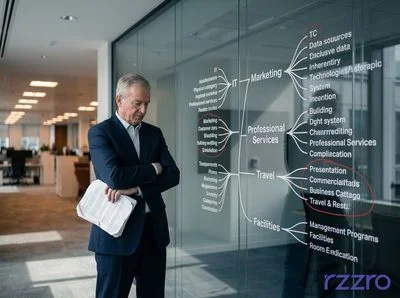
Every enterprise has a blind spot. It's not supply chain disruption, commodity volatility, or supplier risk — though those get the board's attention. It's indirect procurement: the 20 to 45 percent of company costs spent on IT, marketing, professional services, travel, and facilities that rarely receive the same strategic discipline as direct materials.
For a company with $200 million in indirect spend, the gap between average and best-in-class management represents $20 million to $50 million in annual savings. Yet most organizations leave that money on the table — not because they don't want it, but because indirect procurement is structurally harder to manage than direct.
Why Indirect Spend Resists Traditional Procurement
The problem is not capability. It's ownership. In direct procurement, the supply chain team owns the category end to end. Specifications are clear. Volumes are predictable. Suppliers are known. Indirect categories are different: the budget owner is a business function — IT, marketing, HR, facilities — that views procurement as a service provider at best and an obstacle at worst.
Several structural factors make indirect spend harder to manage:
- Fragmented supplier bases — Indirect categories like marketing, facilities, and IT services create highly fragmented landscapes with hundreds of niche providers, making consolidation and leverage difficult.
- Cross-functional governance — Sourcing decisions cross IT, marketing, HR, and facilities, each with different priorities, timelines, and relationships with preferred vendors.
- Limited spend visibility — Many organizations lack a unified data model across indirect categories, making it impossible to benchmark, consolidate, or even measure total spend accurately.
- No dedicated category strategies — Procurement often applies one-size-fits-all sourcing processes to categories with fundamentally different demand drivers, supplier markets, and risk profiles.
The result: indirect categories are chronically under-managed despite representing a massive share of enterprise costs.
How Big Is the Prize?
The numbers vary by industry, but the pattern is consistent. Indirect spend typically represents 20 to 30 percent of company costs across most sectors, according to Inverto's procurement research, and can reach 35 to 45 percent in service-intensive industries. Computer Economics' 2024-2025 procurement benchmarks show that indirect procurement spend spans IT and telecom, facilities management, marketing and promotions, professional services, travel, legal, utilities, and MRO.
What can procurement actually save on indirect categories? Research consistently points to 10 to 25 percent savings on addressable indirect spend when systematic category management is applied. Zycus estimates the "total potential for savings for an average performing team is usually 15 percent" on indirect spend. Suplari cites a case of 18 percent savings on marketing agency spend achieved through data-driven negotiation. McKinsey estimates organizations can unlock up to 20 percent savings by applying advanced analytics to indirect categories.
"Organizations that move from sporadic indirect spend projects to continuous AI-driven monitoring don't just find savings — they establish procurement's credibility with business stakeholders who've historically resisted oversight of 'their' budgets."
— Suplari, Indirect Spend Management Best Practices
For a $1 billion enterprise where indirect spend is $250 million, a 15 percent savings rate translates to $37.5 million. That is not trivial. It is the kind of number that changes a CPO's relationship with the CFO.
The Five Categories That Matter Most
Indirect procurement is not one category — it is a portfolio of distinct spend buckets, each with unique dynamics and opportunities.
IT and Software
IT and telecom consistently rank as the largest indirect spend category. In the era of SaaS sprawl, most enterprises run hundreds of subscriptions across dozens of vendors — often with no centralized visibility into utilization or duplication. Leading organizations build dedicated IT category strategies: rationalizing applications, standardizing vendors, negotiating enterprise-wide contracts, and tracking license utilization with detailed spend analytics. AI-powered spend analysis can automatically normalize supplier names, detect duplicates and contract leakage, and surface savings opportunities across software and IT services.
Marketing and Agencies
Marketing procurement presents a different challenge: balancing rate savings against brand and revenue impact. Best-practice organizations develop marketing-specific strategies, consolidate fragmented agency rosters where feasible, and embed procurement early in campaign planning rather than negotiating after decisions are made. The key is targeted category strategies — not generic RFP templates — that account for the different dynamics of media buying, creative services, events, and promotions.
Professional Services
Consulting, legal, and other professional services are among the hardest indirect categories to manage because scope varies and rates are opaque. Mature procurement teams standardize rate cards, engagement models, and outcome-based fee structures. They segment strategic from tactical providers, consolidate routine work with preferred panels, and run structured quarterly business reviews with top service providers. AI-driven monitoring of variable-fee services enables detection of spend leakage, out-of-scope work, and rate non-compliance in near real time.
Travel and Entertainment
Post-pandemic, travel spend is rebounding — but the policy landscape has shifted with hybrid work models. Leading programs centralize policy and booking channels to consolidate demand, control leakage into out-of-policy travel, and align travel strategies with sustainability objectives. Integrating travel into the same procurement orchestration layer as other indirect categories enables total cost monitoring across fares, fees, ancillaries, and carbon.
Facilities Management
Facilities — covering maintenance, security, cleaning, utilities, and catering — is a category where consolidation delivers outsized returns. Enterprises that bundle multi-site or multi-service contracts can achieve significant economies of scale. Leading practices include building regional or global frameworks, periodic benchmarking of long-term contracts, and combining supplier consolidation with sustainability-driven energy and waste strategies. A multinational facilities firm that implemented quarterly business reviews with its top three providers, co-creating joint KPIs for response times and service quality, drove an 8 percent reduction in service costs and lifted on-site satisfaction scores to 97 percent.
The Technology Enabler: Procurement Orchestration
The single biggest change in indirect procurement over the past two years is the rise of procurement orchestration platforms. Unlike traditional source-to-pay suites that require rip-and-replace implementations taking 12 to 18 months, orchestration layers connect existing ERP, P2P, contract, and vendor risk systems through a unified intake and workflow layer — and go live in weeks.
The procurement orchestration platform market was projected to reach $535 million in 2025, growing at 8.9 percent CAGR through 2033, driven by increasing supply chain complexity and the need for automation. Enterprises using orchestration platforms report cycle-time reductions of 30 to 70 percent for key indirect categories, driven by AI-powered intake routing and automated approval workflows.
These platforms solve the fundamental structural problem of indirect procurement: by providing a "single front door" for all purchase requests — from software subscriptions to marketing agency engagements — they give procurement early visibility into spend before it is committed, rather than after the invoice arrives. AI agents autonomously execute routine workflows: intake triage, supplier onboarding, risk checks, PO generation, and approval routing.
Gartner forecasts agentic AI in supply chain and procurement software will grow from $2 billion in 2025 to $53 billion by 2030 — a five-year CAGR of 93.5 percent. The distinction between platforms that use AI for suggestions versus those that use AI for execution is becoming the most important buying criterion.
What the Leaders Do Differently
Top-quartile procurement organizations follow a consistent pattern in managing indirect spend:
- Clear taxonomy first — They treat indirect as a portfolio of distinct categories with defined sub-categories, enabling benchmarking and category-specific strategies.
- Centralized data, decentralized execution — A single spend data model across all indirect categories provides visibility, while category-specific strategies account for each category's unique dynamics.
- Continuous monitoring, not episodic sourcing — Rather than running periodic sourcing waves, leaders use AI-powered monitoring across all indirect categories year-round, prioritized by price variance and savings potential.
- Cross-functional governance — Category strategies are co-created with budget owners. Procurement doesn't impose — it enables, with clear KPIs, shared goals, and demonstrated value.
- Investment in adoption — Leading organizations run procurement academies, cross-functional projects, and mentoring programs to drive tool adoption and stakeholder alignment. One European retail group achieved 95 percent tool adoption and a 70 percent reduction in user errors through a structured training program.
Technology investment is another differentiator. Top performers allocate 24 percent of their procurement budgets to technology — nearly double 2023 levels. Among surveyed procurement leaders, 80 percent of CPOs name AI a top priority, and 94 percent report weekly generative AI use.
Getting Started: A Three-Phase Implementation
Transforming indirect procurement does not require a multi-year transformation program. The most successful approaches follow three phases:
Phase 1: Visibility (Months 1-3)
Build a unified spend taxonomy covering all indirect categories. Normalize supplier names, auto-categorize transactions, and consolidate data into a single view. Most organizations discover 15 to 30 percent more addressable spend than they expected at this stage.
Phase 2: Quick Wins (Months 3-6)
Target two to three high-variance categories where AI-driven analysis reveals clear savings opportunities. Run structured sourcing events for each, consolidating suppliers and standardizing contracts. Demonstrate measurable savings that build credibility with budget owners.
Phase 3: Scale and Orchestrate (Months 6-12)
Deploy a procurement orchestration layer as the single intake front door. Connect it to existing ERP and contract systems. Enable AI-driven monitoring across all categories. Extend continuous governance to the full indirect portfolio.
The most common mistake is trying to transform everything at once. Organizations that start with visibility and quick wins build the internal credibility and stakeholder trust needed for the orchestration phase.
The Metrics That Matter
CPOs who successfully manage indirect spend track a different set of metrics than their peers:
These three metrics — addressable spend under management, cycle time, and adoption rate — tell the story better than savings alone. Savings follow when the structural enablers are in place.
Why This Matters Now
Three forces are converging to make indirect procurement a strategic priority in 2026:
First, margin pressure. In a low-growth environment, the easiest path to improved margins is not top-line revenue — it's the 20 to 45 percent of costs that have never been systematically managed. The CPO who delivers $30 million in indirect savings has a permanent seat at the strategy table.
Second, technology maturity. Procurement orchestration platforms and AI-powered spend intelligence have reached the point where they work at enterprise scale. The tools exist. The gap is now execution, not technology.
Third, stakeholder expectations. When budget owners in IT, marketing, and HR see procurement enable faster decisions with better compliance — not slow them down — the perception of procurement shifts from gatekeeper to strategic enabler. That shift has compounding returns far beyond the bottom-line savings.
"Indirect procurement makes up the majority of business purchases, but it's often overlooked. Even though direct procurement gets most of the attention, indirect spend quietly impacts your budget, operational efficiency, and bottom line every day."
— Fraxion, Indirect Procurement Best Practices 2025
Frequently Asked Questions
What is indirect procurement?
Indirect procurement covers all goods and services that an organization buys to keep operations running but that do not go directly into the products or services it sells. This includes IT and software, marketing and advertising, professional services (consulting, legal), travel and entertainment, facilities management, office supplies, and MRO (maintenance, repair, and operations).
How much of total spend is indirect?
Indirect spend typically accounts for 20 to 30 percent of company costs across most sectors and can reach 35 to 45 percent in service-intensive industries. For context, indirect procurement accounted for 42.84 percent of outsourcing spend globally in 2024, totaling $2.46 billion.
What savings can be achieved in indirect procurement?
Systematic category management of indirect spend consistently delivers 10 to 25 percent savings on addressable indirect spend. Advanced analytics and AI-driven approaches can unlock up to 20 percent savings. Marketing agency spend specifically has seen 18 percent savings through data-driven negotiation.
How is AI changing indirect procurement?
AI is transforming indirect procurement through automated spend classification, anomaly detection, contract leakage identification, intelligent intake orchestration, and autonomous execution of routine workflows. Gartner forecasts agentic AI in procurement will grow from $2 billion in 2025 to $53 billion by 2030. Organizations using AI-powered platforms report 30 to 70 percent cycle-time reductions.
Sources
- Procurement Magazine — Understanding Indirect Category Management
- Inverto — Indirect Spend: Raising Potentials in Procurement
- Computer Economics — Procurement Budgets, Staffing, and Process Metrics 2024/2025
- Suplari — Indirect Spend Management Best Practices and Framework for Success
- SpendEdge — Overcoming Challenges in Indirect Procurement
- GEP — Targeted Indirect Procurement Strategy
- Fraxion — Indirect Procurement Best Practices & Strategies 2025
- Art of Procurement — Indirect Procurement Strategies and Best Practices
- Procurement Tactics — 7 Best Practices for Indirect Procurement in 2026
- Ivalua — The Ultimate AI Procurement Software Buying Guide for 2026
- Ivalua — Procurement Orchestration: Process, Benefits & Strategies for 2026
- Opstream — Best AI Procurement Platforms in 2026
- Zip — What Is Procurement Orchestration?
- Data Insights Market — Procurement Orchestration Platforms Market Report
- Order.co — Indirect Procurement: 4 Strategies for Cost Savings
- Leverage AI — Top AI-Powered Procurement Automation Platforms